
 News
NewsEditor’s note: This story is part of ongoing coverage of the lead up to Mangione’s trial. Read coverage of federal oral arguments to dismiss Counts Three and Four here and on the dismissal ruling here.
In a letter filed Friday, federal prosecutors told Judge Margaret Garnett they will not will not appeal the ruling barring them from seeking the death penalty against Luigi Mangione.
On January 30, Garnett dismissed Counts Three and Four of Mangione’s federal indictment, thereby precluding the government from seeking the death penalty. Garnett gave prosecutors until Friday, February 27 to decide whether they would appeal the decision to the Second Circuit.
The Department of Justice’s decision on whether to pursue an interlocutory appeal rests on the perceived strength of the government’s position on the merits. Historically, prosecutors have also forgone interlocutory appeal to avoid delay when it could proceed on a sufficient case without it, as it did in United States v. Ahmed Khalfan Ghailani.
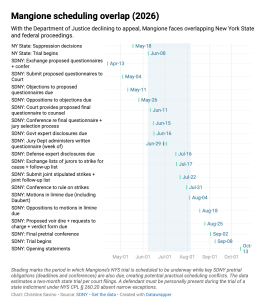
Because the federal government will not appeal, Mangione’s New York State trial will remain scheduled for June 8, a date that the defense has repeatedly stated it will not be ready for.
The state trial is expected to take approximately two months, which would leave about one month before federal in-person jury selection, which is scheduled for September 8. Federal opening statements are slated for October 13.
If the current scheduling sustains, Mangione will face overlapping litigation and potential timing conflicts—particularly because New York Criminal Procedure Law (CPL) § 260.20 requires a defendant’s personal presence at trial, subject to limited exceptions (including removal after warning for disruptive conduct).
For example, state jury selection would overlap with federal jury-questionnaire proceedings, and several federal deadlines and conferences are scheduled during the anticipated window of the state trial.
The current scheduling also leaves approximately one month between the expected May 18 state suppression decisions and the start of state trial.
In the interest of justice?
Like most criminal defendants, Mangione’s speedy trial clock has been repeatedly paused. Quite exceptionally, however, is that he has three of them running simultaneously—parallel state and federal prosecutions in New York and a separate case in Pennsylvania.
Mangione’s Pennsylvania case is effectively on hold due to Mangione refusing to attend court hearings virtually, which a Pennsylvania criminal court judge held was a waiver of Rule 600, the Commonwealth’s speedy trial provision.
The state–federal scheduling overlap could become an appellate argument if it materially prejudices the defense.
Federal and New York state courts recognize that the right to effective assistance of counsel includes the meaningful opportunity to prepare. In federal court, the Speedy Trial Act provides mechanisms to ensure defendants have adequate time to prepare for trial. For instance, delays resulting from continuances granted in the interest of justice, including those necessary for effective preparation, are excluded from the time limits for bringing a defendant to trial. Similarly, New York’s speedy trial statute, CPL § 30.30, excludes defense-requested adjournments and certain “exceptional circumstances” delays from the calculation of time chargeable to the People for readiness.
Likewise, case law demonstrates that appellate challenges may succeed if the denial of additional time meaningfully impairs the defense’s ability to prepare, thereby undermining the fairness of the trial and right to effective counsel.
In Powell v. Alabama, the Supreme Court presumed ineffectiveness where counsel was appointed so close to trial that it was impossible to prepare adequately. In United States v. Cronic, the court clarified that a presumption of prejudice arises when “any lawyer, even a fully competent one, could provide effective assistance is so small that a presumption of prejudice is appropriate.” The Second Circuit held in United States v. Smith that a denial of a continuance may violate the Sixth Amendment if it leaves counsel with so little time to prepare that a “breakdown in the adversarial process” resulted.
New York State cases have addressed similar concerns under the state constitution. In People v. Mooney, the Appellate Division established that defendants have a “right to a reasonable time to prepare for trial.” However, a court-mandated brief preparation time does not necessarily mean that the defendant was impaired. In People v. Adair, the court addressed a claim of ineffective assistance of counsel where defense counsel had only 17 days to prepare for trial. Despite this limited preparation time, the court found that counsel’s thorough cross-examination and overall performance demonstrated adequate preparation and meaningful representation.
A loophole to Constitutional Double Jeopardy
After Judge Gregoy Carro scheduled the state trial for June 8, Mangione’s attorneys argued that the federal trial should proceed first. The Manhattan District Attorney’s Office countered that its case should take priority.
As Mangione was led out from the proceeding, he stated to the press, “It’s the same trial twice. One plus one is two. Double Jeopardy by any common-sense definition.”
If the state trial proceeds before the federal one, a federal constitutional double jeopardy challenge is unlikely to succeed due to the Dual Sovereignty Doctrine. If the state trial proceeds second, Mangione may be able to raise Double Jeopardy under CPL § 40.20.
New York State’s Double Jeopardy statute is relatively capacious compared to the US Constitution’s Double Jeopardy Clause in this context. This is because the Constitution is limited by the Dual Sovereignty Doctrine, which permits successive prosecutions by separate sovereigns (i.e., state and federal governments) for the same conduct. In contrast, CPL § 40.20 prohibits successive prosecutions for the same act or criminal transaction within New York State unless one or more of the eight enumerated statutory exceptions apply, such as having substantially different elements or addressing different harms or “evils.”
However, there is a circumscribed loophole to the Dual Sovereignty Doctrine that may have been arguable earlier but is now unlikely to apply. Federal courts have occasionally expressed concerns about the potential for abuse of the Constitution’s Dual Sovereignty Doctrine, particularly in cases involving closely coordinated state and federal prosecutions.
In Bartkus v. Illinois, the Supreme Court established that a state prosecution could be barred if it was merely a “sham and a cover” for a federal prosecution, effectively making the state a tool of the federal government. This is sometimes referred to as the Bartkus exception.
It is an extremely narrow and currently hypothetical loophole. In United States v. Vanhoesen, the Second Circuit reiterated that cooperation between state and federal authorities does not, by itself, establish an exception to the Dual Sovereignty Doctrine, and it is in fact “laud[ed]” and “desired.” The Bartkus exception bar is thus extremely high, and the court held that unsynchronized filings between the state and federal authorities indicated that neither was acting as a “tool” of the other or that the second prosecution was a “sham and a cover” for the first.
This exception likely does not apply to the Mangione case, as was particularly demonstrated when Carro stated during the February 6 hearing that it appeared that the federal prosecution “reneged” on its agreement to allow the state trial to proceed first.
Manhattan Assistant District Attorney Joel Siedemann furthered that the victim’s family had requested from Assistant US Attorney Dominic Gentile that the state prosecution proceed first. Likewise, Karen Friedman Agnifilo stated that the defense informed Garnett about Siedemann’s earlier request for a July 1 trial start date, “and she still kept her September 8 trial date.”
Garnett told the court that the state “case is none of my concern” and that she would proceed as though the federal case was the only one.
Even as a rhetorical move, the Bartkus hypothetical would unlikely apply here. The fact that the state and federal prosecutors appear to be pulling in different directions on scheduling underscores friction rather than a unified effort, rendering any attempt to portray either sovereign as a “tool” or “sham and a cover” highly attenuated.
Mangione is due back in state court on May 18 for state evidence suppression decisions.
The defense’s Memorandum of Law arguing for suppression is available here and prosecution’s opposing Memorandum of Law available here.
