
 Dispatches
Editor’s note: This is Day 8 of JURIST’s coverage of Mangione’s suppression hearings. Read Day 1, Day 2, Day 3, and Day 4.
Luigi Mangione is accused of fatally shooting Brian Thompson, CEO of medical insurance company UnitedHealthcare, on December 4, 2024, outside a Manhattan hotel. He faces a nine-count indictment including second-degree murder, where he faces 25 years to life in prison, and multiple weapons offenses. Mangione was arrested on December 9, 2024, in Altoona, Pennsylvania—a city in Pennsylvania state, approximately 280 miles from New York City—five days after the shooting. While the arrest occurred in Pennsylvania, he is being prosecuted in New York state, where the alleged crime took place. The current suppression hearings—pre-trial proceedings where a judge decides what evidence can be used at trial—will determine what evidence from his Pennsylvania arrest can be used in the New York trial. His defense lawyers are seeking to suppress key evidence, including items found during what they argue was a warrantless search of Mangione’s backpack at an Altoona McDonald’s restaurant, as well as statements Mangione allegedly made to law enforcement.
Critical suppression hearings in the New York state prosecution of Luigi Mangione entered their eighth day with testimony that cut across two potential fault lines in the case: whether Altoona police followed their own inventory-search rules when handling Mangione’s property, and whether statements obtained during a Pennsylvania interrogation could survive scrutiny in a two-party consent state—a state where all parties to a conversation must consent before it may be lawfully recorded—after New York investigators took the lead.
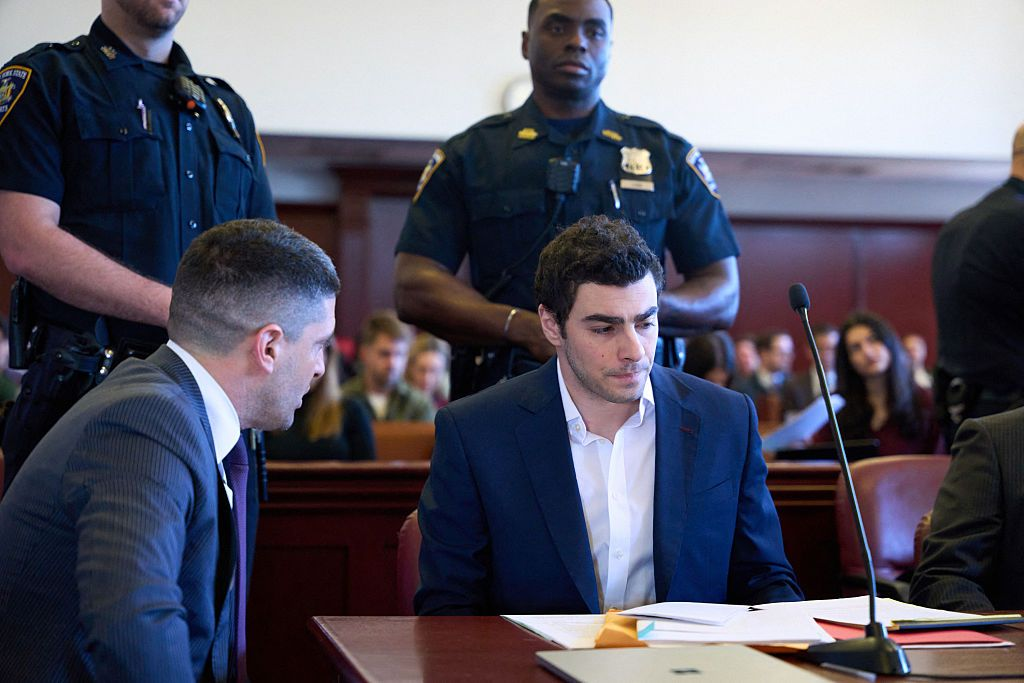
The day opened with Mangione entering the courtroom in a dark charcoal suit and white button-down. Soon after, Patrolman George Featherstone, Altoona Police Department evidence custodian—the officer responsible for storing and tracking physical evidence—took the witness stand. His testimony focused on the handling, packaging, and transfer of items seized from Mangione on December 9, 2024. Patrolman Featherstone has served with Altoona Police Department for approximately four and a half years and had been assigned as an evidence technician or custodian for roughly eighteen months at the time of Mangione’s arrest. His role, he explained, centers on maintaining the chain of custody—the documented process tracking who handled evidence and when—through secure, one-way lockers accessible only from his office, with keys held by a small group of supervisors. Patrolman Featherstone testified that he first became involved after Mangione was brought to the police station. He heard radio traffic indicating a person believed to resemble the New York City shooter was in custody, and he proceeded to the intake area—where arrested individuals are processed—once Mangione arrived.
Patrolman Featherstone explained that normally, the arresting officer decides whether items are evidence or personal property. However, he treated everything from Mangione as potential evidence because he didn’t know what New York investigators might need. Under Altoona Police Department policy, officers search arrestees during intake—the booking process—and list all items on a receipt and inventory (R&I) form. Items are then photographed, sealed in envelopes, and logged with signatures. Patrolman Featherstone testified that these inventory searches protect officer safety and ensure property can be returned when appropriate.
In Mangione’s case, Patrolman Featherstone said he kept all items as evidence because they would be transferred to New York authorities under a warrant obtained later that day. Items were photographed, sealed, and labeled, and a search-warrant inventory receipt—authorized by an Altoona supervisor—listed more than two dozen items found on Mangione and in his backpack. The inventory included a red notebook and handwritten notes, a 9mm ghost gun—an untraceable firearm without a serial number—with ammunition, a homemade suppressor, US and foreign currency, identification documents, a laptop, storage devices, and various personal items.
On cross-examination, defense counsel Karen Friedman Agnifilo asked Patrolman Featherstone whether all steps were completed according to departmental rules. She highlighted that some inventory searches did not occur in Mangione’s presence, noting that Patrolman Featherstone had testified that officers typically aim to conduct inventory searches in front of detainees for security purposes. She also pointed out that not every item appeared consistently across handwritten notes, R&I forms, and electronic systems, and that certain evidence envelopes lacked timestamps.
Patrolman Featherstone acknowledged that searches sometimes occur outside a detainee’s presence when safety concerns arise, particularly when firearms are involved. He also explained that not all items seized as evidence are logged into the property tracking system, especially when they won’t be returned to the detainee. In Mangione’s case, his personal property would normally have been sent to the State Correctional Institution in Huntingdon, Pennsylvania (SCI Huntingdon), where he was being held. However, everything was preserved for the New York Police Department (NYPD) instead because the homicide investigation took priority. Patrolman Featherstone testified that he wrote the time and his signature at the top of each evidence envelope as he examined and sealed them.
After the morning testimony, prosecutors called Lieutenant David Leonardi of the NYPD’s Manhattan South Homicide Squad. Lieutenant Leonardi described the New York investigation into the December 2024 shooting of UnitedHealthcare CEO Brian Thompson, recounting that Thompson was shot in the back and leg. Lieutenant Leonardi testified that he learned on December 9 that Altoona police had a possible suspect in custody who resembled the New York shooter. After speaking with Altoona officials, he requested that all property be held until his arrival, which occurred a few hours later after Lieutenant Leonardi and other NYPD officers drove to Altoona, Pennsylvania by car. He emphasized that his request was driven by the severity of the New York homicide investigation and that Altoona Police Department later obtained a warrant authorizing the transfer of property to the NYPD. According to Lieutenant Leonardi, everything was sealed and transported to New York, where it was re-photographed and processed by the NYPD laboratory.
Lieutenant Leonardi testified, “By the Hilton, I was advised that there was a male that was shot in the back…I was advised that the name was Brian Thompson, and he was the current CEO of UnitedHealthcare. There was fired brass… [meaning] shell casings and rounds…and a pool of blood by the wall.” He continued, “There were markings on the brass – the words were ‘deny,’ ‘depose,’ and I can’t remember the third one off the top of my head…At the time, we didn’t know what they meant. It looked to be the types of ways that some insurance companies get rid of cases so they don’t have to pay out.”
According to NYPD Chief of Detectives Joseph Kenny, the shell casings read “Delay, Deny, and Depose.” These words reference common criticisms of how insurance companies handle claims: delaying payment decisions, denying legitimate claims, and using expensive legal processes to pressure policyholders into giving up or accepting lower settlements.
The shooting sparked public debate about healthcare access in the United States. Research published in the American Journal of Public Health has estimated that approximately 45,000 deaths occur annually in the US due to lack of health insurance or access to care. UnitedHealthcare, one of the largest health insurers in the country, has faced criticism over claim denial rates, though the company has defended its practices as being consistent with medical necessity standards.
Lieutenant Leonardi further stated that video canvassing traced the suspect’s movements through Manhattan, including into Central Park, where a backpack containing “candy bars, candy, and Monopoly money” was later recovered. He furthered that videotape footage recorded how the suspect had “walked by [Thompson] in a lobby” before the shooting.
Under cross-examination, defense counsel Marc Agnifilo questioned how much control Lieutenant Leonardi had over the Altoona police, suggesting that New York’s murder investigation may have overshadowed Altoona’s investigation into Mangione’s alleged use of false identification. “There was no homicide in Altoona, Pennsylvania that they were involved with, right?” Attorney Agnifilo asked. Lieutenant Leonardi affirmed. Lieutenant Leonardi further acknowledged that once it appeared Mangione was a possible suspect, he asked Altoona officers to hold all seized property and refrain from questioning Mangione to allow New York investigators to interview him. Lieutenant Leonardi also testified that he arranged for an interrogation room in the Altoona police station for Mangione. According to Lieutenant Leonardi, Mangione requested a lawyer, at which point officers left the room while audio and video recording continued. That interview became the fulcrum of the day’s most consequential development.
Attorney Agnifilo questioned Lieutenant Leonardi about whether Mangione knew he was being recorded during his interrogation, and if Lieutenant Leonardi knew Pennsylvania’s two-party consent rules. In two-party consent states, laws require all people involved in a conversation to consent to recording. This contrasts with New York’s one-party consent regime, which requires consent from only one person involved in the conversation.
Lieutenant Leonardi testified that he consulted counsel at the time but could not speak about Pennsylvania’s laws. The issue was statutory rather than constitutional, arising under Pennsylvania’s wiretap and electronic surveillance law rather than potential Miranda warning or Fifth Amendment constitutional violations. This distinction is critical in cross-state investigations: a recording lawful in New York may be unlawful if conducted in Pennsylvania without all-participants’ consent. Officers allegedly did not inform Mangione that he would be recorded. Attorney Agnifilo raised the concern that Mangione may have said something without knowing that he was being recorded. However, the legal discrepancy may have been because Lieutenant Leonardi and his counsel were familiar with New York and not Pennsylvania consent laws. Consequently, prosecutors told the court they were withdrawing Mangione’s Pennsylvania interrogation statements.
The final witness of the day was Anissa Weisel, a senior investigative analyst with the New York County District Attorney’s Office. Weisel testified about her role in creating a timeline of events using body camera footage, dispatch audio, and other sources. She explained that she reviewed and redacted footage for relevance, identified speakers through name tags and cross-referencing, and organized events chronologically with date and timestamps. Defense counsel Jacob Kaplan challenged the timeline’s completeness, pointing out approximately six hours missing from the timeline, including the omission of certain officers’ arrivals, and statements suggesting a need for a warrant. Weisel acknowledged that multiple drafts were created and that prosecutors directed her to include only events they deemed relevant. Upon repeated objections by defense attorneys Agnifilo and Kaplan, Judge Gregory Carro stated that he admitted the timeline solely as an aid, and not evidence, to the court. Judge Carro noted that its approximately 6-hour omission limited its usefulness, stating, “too much was left out. I’m still going to have to review a lot of the camera footage.” He also stated to the defense that it was free to create its own version.
At the end of the day’s proceedings, tensions flared when Attorney Friedman Agnifilo accused prosecutors of repeatedly using inflammatory language such as “execute” to influence public perception. She stated:
As of today, Mr. Seidemann has stated ‘execute’ [or other grammatical variations, such as ‘execution’] 29 times. Your honor, you have said that ‘it has no impact on you whatsoever’…the only reason that he has used this inflammatory language…is for the audience…it’s for the press and to prejudice Mr. Mangione, and this is what the prosecution has been doing since the beginning.”
Judge Carro interjected, “I think that is what witnesses have done as well,” and Assistant District Attorney Joel Seidemann added that he disagreed that it was for that purpose. Ultimately, Judge Carro stated, “it doesn’t matter,” before scheduling the next suppression hearing for December 18, which he said would “hopefully [be] when we’ll wrap-up,” indicating that suppression proceedings should be completed within the week.
Judge Carro is expected to issue his suppression decisions on May 18, 2026.
