
 News
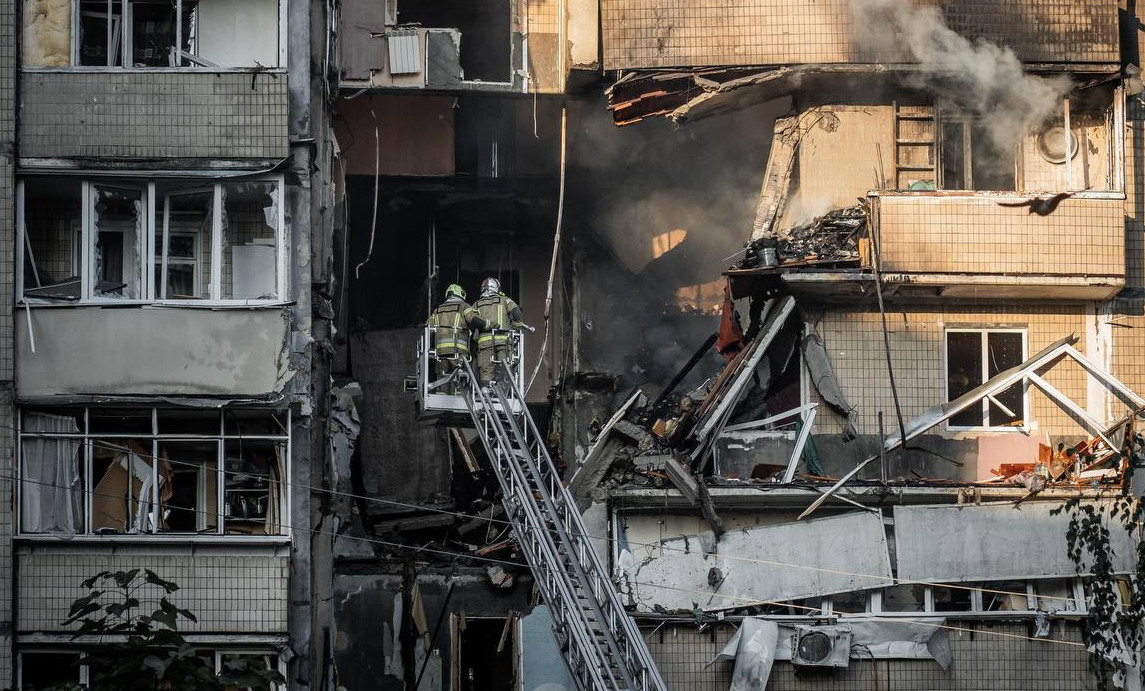
NewsThe UN on Sunday condemned Russia’s large-scale missile strikes on Ukraine that killed four people, including a baby, and injured 44. According to several news outlets, the strikes constituted the largest attack since Russia’s invasion in February 2022. It also marked the first time a government building in Kyiv has been struck, the Cabinet of Ministers headquarters.
In its press release, UN Humanitarian Coordinator for Ukraine Matthias Schmale stressed: “Civilians and civilian infrastructure are protected under international humanitarian law—they are not a target.” The United Nations Children’s Fund (UNICEF) drew particular attention to the death of a mother and her baby, describing it as “devastating.” Reports indicate that among the objects struck were homes, a kindergarten, and other civilian infrastructure.
International humanitarian law (IHL), most prominently embodied in the 1949 Geneva Conventions and their 1977 Additional Protocols, expressly prohibits such attacks. The Conventions, with universal applicability and broad recognition as customary international law, set out fundamental limits on the conduct of war, while extending special protections to vulnerable groups, including women and children, due to the particular risks they face in armed conflict. Geneva Convention IV relative to the Protection of Civilian Persons in Time of War, in particular, provides detailed protections for civilians in international and non-international armed conflicts, including those under the control of a party to the conflict or an occupying power.
The principle of distinction, which requires parties to an armed conflict to distinguish between combatants and civilians, is an important cornerstone in IHL. Civilians and their property, also referred to as “civilian objects,” may not be targeted unless they take a direct part in hostilities. Customary international law further reinforces this protection by prohibiting attacks on civilian objects, except when they are transformed into military objectives.
Additionally, the principles of proportionality and precaution apply. Proportionality, codified in Additional Protocol I to the Geneva Conventions and recognized as a principle of customary international law, prohibits attacks that may cause incidental civilian death, injury, and damage to civilian objects that “would be excessive to the concrete and direct military advantage anticipated.” The principle of precaution, also reflected in customary international law, obliges parties to the conflict to take all feasible measures to protect civilians and civilian objects from the effects of attacks.
