
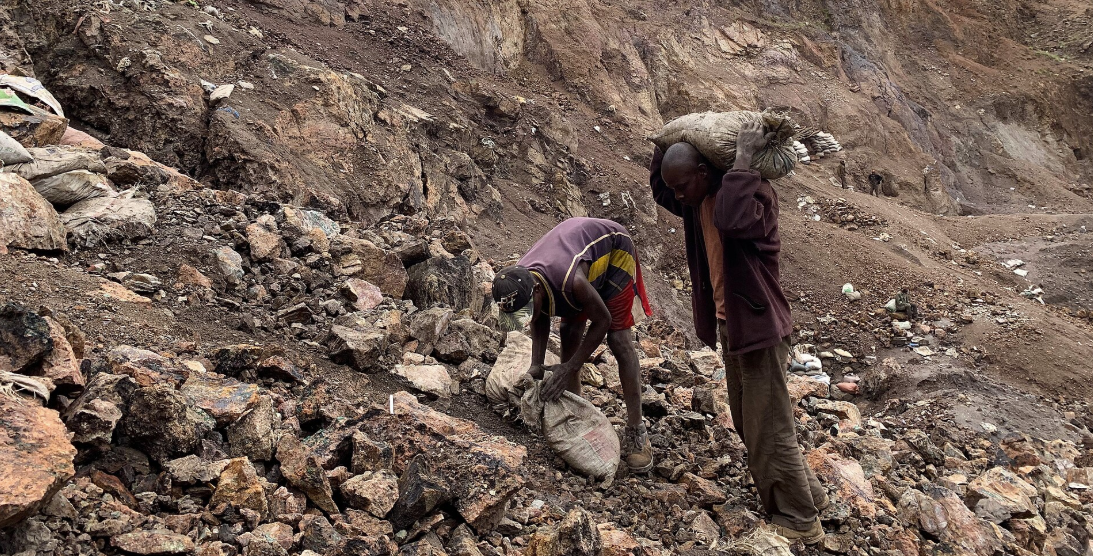
Amnesty International on Monday condemned the March 23 movement (M23) because of the human rights abuses they committed in the mines they control in the Democratic Republic of Congo (DRC).
Commenting on the dire domestic human rights crisis afflicting the region, Agnès Callamard, Amnesty International’s Secretary General stated:
The African Union and its Member States must take far bolder steps than they have done thus far to put an end to the likely pillage driven by an endless international appetite for African critical minerals. Failure to stand united against such pillage and the horrific abuses that comes in its wake will only encourage others to follow suit.
Within the mining sites it controls, M23 has trafficked gold and coltan resources and forced workers to work in coltan mines for a week at a time near Rubaya in North Kivu province, and Lomera, a gold mining site in South Kivu province. These mineral resources are later sold in Rwanda or purchased by corporations in the US and the EU.
Amnesty has also detailed a list of gross human rights violations committed by M23 rebels against miners, such as the extrajudicial executions of 18 miners, widespread torture by using shipping containers as torture cells, alongside the creation of underground pits, called ndake, where miners were beaten up to three times a day. The perpetration of such acts in the context of a non-international armed conflict (NIAC) are expressly prohibited under Common Article 3 of the Geneva Conventions.
In March 2025, Amnesty International condemned M23 fighters for forcibly entering healthcare facilities such as the CBCA Ndosho hospitals in Goma and kidnapping over 130 people before taking them to undisclosed locations where some still remain missing today, violating Customary International Humanitarian Law Rule 98 which prohibits enforced disappearances.
Human Rights Watch has also criticized large-scale roundups by M23 rebels where civilians, including children as young as 12 years old have been kidnapped from their homes, schools, churches, and universities before being moved to military training camps with no way of communicating with the outside world, a direct contravention of Rule 105 of Customary International Humanitarian Law (IHL) which safeguards the right to respect for family life.
M23 evolved from the former National Congress for the Defence of the People (Congrès National de Défense du Peuple), a group formed in 2006 to advance the interests of the Tutsi population in the eastern DRC, which eventually formed a peace agreement with the DRC government in 2009.
M23 formed in 2012 in response to the DRC implementing the peace agreement and was defeated in 2013. M23 reemerged in 2022 after it began to fight the DRC national army due to slow implementation of security measures in the eastern DRC and delayed development of infrastructure and transportation.
The eastern DRC has been subject to ongoing war crimes by Rwanda, which resulted in an International Court of Justice (ICJ) case being filed in June.

