The US Court of Appeals for the Fourth Circuit affirmed a preliminary injunction Tuesday barring the US Department of Homeland Security (DHS) from conducting immigration enforcement actions at or near Quaker, Sikh and Baptist houses of worship that sued the Trump administration over the policy permitting them.
The Fourth Circuit’s opinion recounts sworn declarations describing how congregations have changed how they worship since DHS lifted the enforcement limits. Roni Kingsley, clerk of the Richmond Friends Meeting, one of six Quaker organizations that sued, said in a declaration that a member “expressed concern that he could be mistaken for being undocumented and feared the idea of enforcement actions in or around the meeting.” At Oakland Baptist Church, affiliated with the Cooperative Baptist Fellowship (CBF), Rev. Dr. Jeff Hayes said immigrant congregants “are now afraid to come to our sacred space…since DHS’s policy means they might be targeted.” Another CBF congregation reported a 66 percent drop in attendance at its English-as-a-second-language classes.
In Philadelphia Yearly Meeting of the Religious Society of Friends v. US Department of Homeland Security, No. 25-1512, a unanimous three-judge panel held that the documented attendance declines were a “predictable effect” of the 2025 policy sufficient to establish standing, and that the plaintiffs were likely to succeed on their claim that the policy violates the Religious Freedom Restoration Act (RFRA). Senior Judge Barbara Milano Keenan wrote the opinion, joined in full by Judges Pamela Harris and G. Steven Agee, who also concurred separately. The panel found DHS waived any compelling-interest defense by failing to raise it or present evidence below.
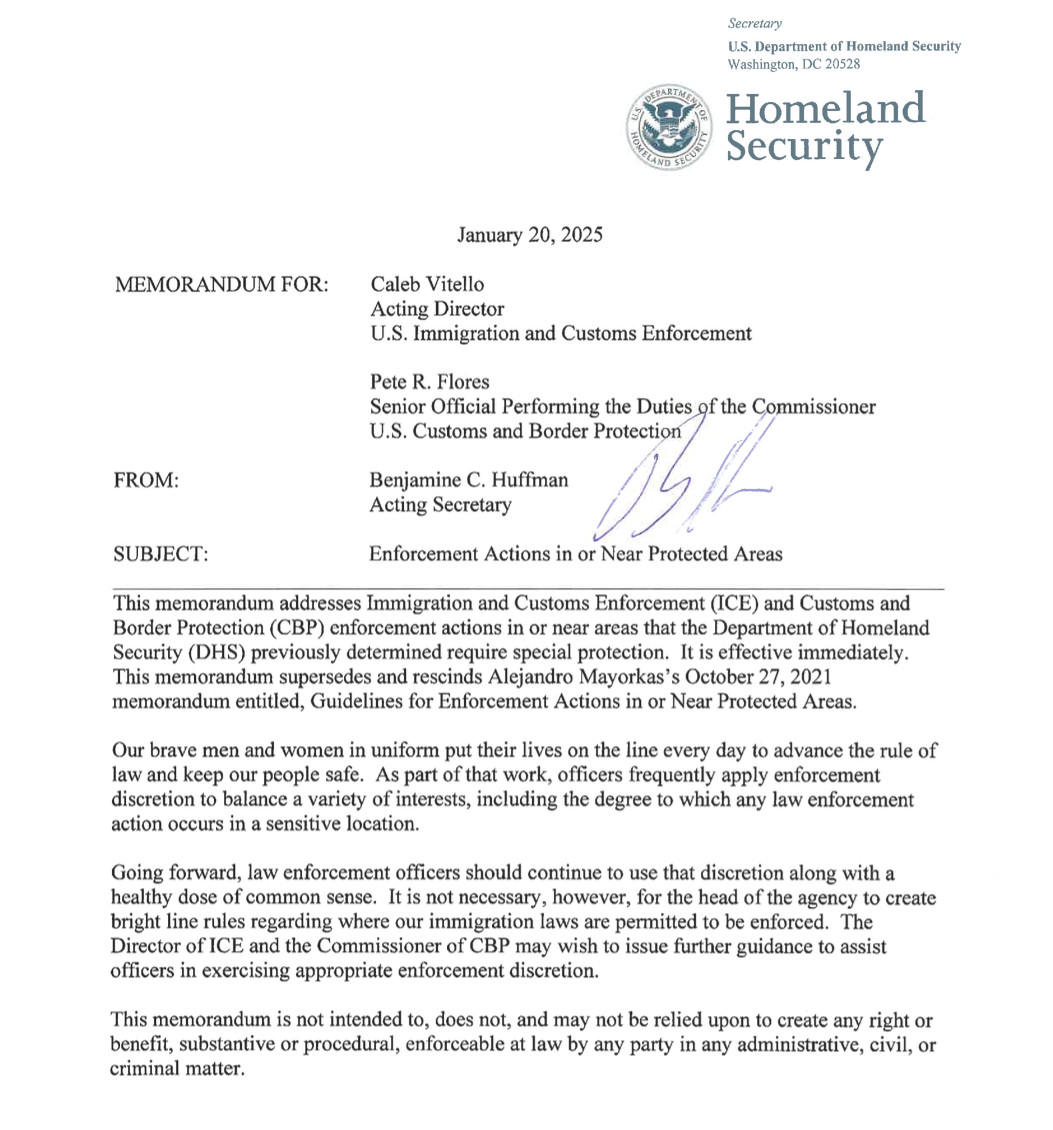
DHS rescinded a 2021 policy limiting enforcement near “protected areas,” including churches, schools, and hospitals, in a January 20, 2025 memo signed by then-Acting Secretary Benjamin Huffman, President Trump’s first day back in office. The memo dispensed with “bright line rules” on enforcement locations, instructing agents to rely on their own discretion instead.
Six Quaker organizations, Sikh Temple Sacramento, and CBF sued DHS in the US District Court for the District of Maryland. Judge Theodore Chuang granted a preliminary injunction in February 2025 covering the plaintiffs’ congregations but declined to extend it nationwide. Judge Agee’s concurrence stressed the injunction’s narrow scope, noting DHS may still make arrests at the plaintiffs’ properties with a warrant, in hot pursuit, or during genuine emergencies.
The plaintiffs said in a joint statement that the ruling “reaffirms a fundamental promise of religious liberty” and that they would keep litigating “to ensure that religious freedom remains meaningful for every congregation.” DHS’s original statement announcing the policy said “criminals will no longer be able to hide in America’s schools and churches to avoid arrest” and that the administration trusted agents “to use common sense,” language a DHS spokesperson repeated to Government Executive when asked about Tuesday’s ruling.
The injunction remains in effect as the case returns to the district court for further proceedings on the merits. The Quaker groups had previously sued over the policy when they first filed their lawsuit in January 2025.

_Police_Week_Memorial_Ceremony_at_DHS_Headquarters_in_Washington,_D.C._on_9_May_2024_-_11.jpg)