
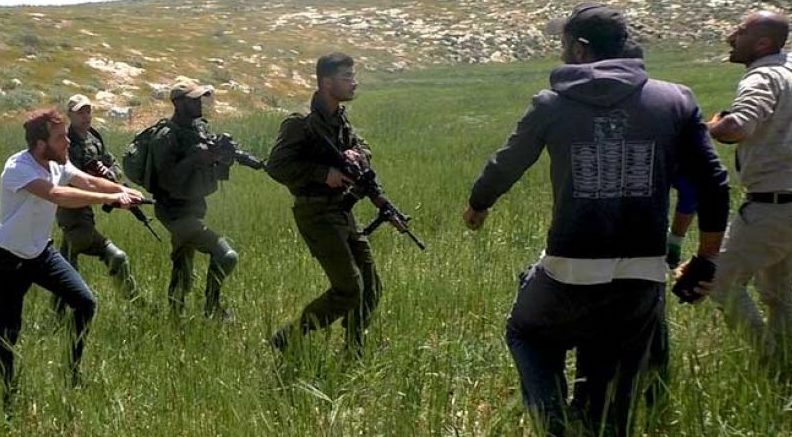
Human Rights Watch (HRW) warned on Thursday that escalating settler violence and aggressive settler expansion in the occupied West Bank is driving the displacement of Palestinians, with the organization attributing the rise of settler extremism to Israeli authorities.
HRW conducted investigations over April and May 2026 within 7 Palestinian West Bank communities. The organization expressed alarm over the spike of killings between March and April 2026, “including of children”. HRW said there was also a spike in “assaults, sexual violence, physical and mental abuse, arbitrary detention, arson, property destruction, and theft.” HRW reported the complicity of the military, stating that armed settlers “at times, [acted] alongside Israeli army units”, and that soldiers were present during instances of settler violence, but failed to intervene.
The armed settlers, according to sources interviewed by HRW, are destroying livestock and crops, “restricting access to water and grazing land”, and attacking Palestinian “residents and property”. In June, the UN highlighted alarming attacks against Palestinian children by Israeli settlers, and threats of sexual violence against Palestinian women and girls.
Sarah Sanbar, HRW Acting Israel and Palestine researcher, attributed the enabling of settler violence and extremism to the Israeli authorities. Sanbar said that the authorities provide weapons, “legal cover”, and funding. She stated:
The Israeli government and the settlers share the same goal of maximum land and minimum Palestinians, with the authorities not only failing to stop settler violence, but actively enabling it.
In June, Amnesty International released an executive summary on the ethnic cleansing of Palestinians by the settlers supported by the Israeli military. It reported that in Zenuta, settlers set fire to classrooms and tents, beat residents with rifles, emptied residents’ water tanks, and “pumped sewage onto their farmland”. Amnesty International asserted that despite frequent international portrayals of settler violence as exceptional, the organization views it as systematically embedded within state policy.
Amnesty International also reported that “the Ministry of Settlement and National Missions‘ budget has increased 122 percent under the current government”, and the government has approved 50 million shekels (roughly $16 million USD) in funding towards “illegal settlement outposts”.
According to a UN report on settler expansion in March, “an unprecedented 84 new outposts were established during the reporting period”. The UN warned that settler violence is exacerbating suffering and a deteriorating human rights situation in Gaza, and forcing the mass displacement of civilians.
HRW urged the international community to impose targeted sanctions on those complicit in supporting settler violence, suspend arms transfers to Israel, “ban trade with illegal settlements”, and “consider suspending preferential trade agreements with Israel.”
Forced displacement is prohibited under international law. Rule 129 of customary international law stipulates that “parties to a non-international armed conflict may not order the displacement of the civilian population, in whole or in part…”
The UN resolution on the Protection of Women and Children in Emergency and Armed Conflict 1974 declared that the forcible eviction of civilians is considered a criminal offence.

