
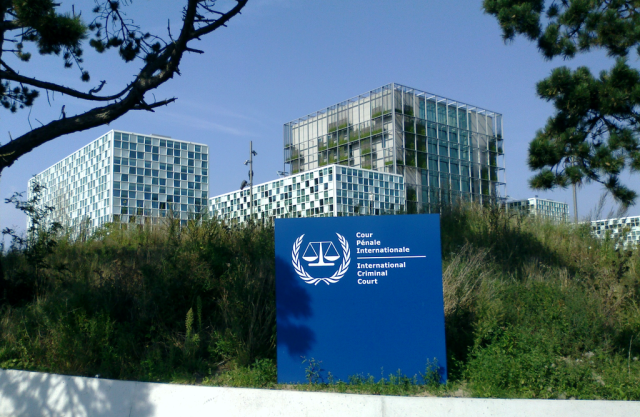
Two US-based advocacy groups sued President Donald Trump’s administration on Wednesday, alleging that sanctions imposed by Trump on members of the International Criminal Court (ICC) and the UN impede the organizations’ ability to engage in Palestinian-related human rights advocacy and therefore violate their First Amendment rights.
The sanctions in question stem from a 2025 Executive Order (EO) mandating that prosecutors and judges at the ICC face economic penalties for their involvement in the investigation of war crimes by US forces in Afghanistan and the issuance of an arrest warrant for US ally Israeli Prime Minister Benjamin Netanyahu. Over the past year, the US, a country that does not recognize the authority of the ICC, has expanded the sanctions to include some human rights organizations and UN Special Rapporteur Francesca Albanese for their support of the investigations.
Filed in federal court in Manhattan, the suit against upper administration officials by advocacy nonprofits Democracy for the Arab World Now (DAWN) and Taxpayer Alliance Against Genocide (TAAG) seeks a court order barring the administration from using the EO to prevent US citizens from working with sanctioned individuals and supporting investigations into potential human rights abuse by the US.
Throughout their advocacy work, both organizations have worked closely with the ICC, the UN, and Albanese, relying on collaborative research and preparing communications for the court and the public, documenting US officials’ role in aiding the commission of war crimes.
DAWN and TAAG assert in their complaint that the EO indicates individuals may face criminal prosecutions and civil penalties for engaging with sanctioned parties and receiving or providing “any service” from them. Because the word “service” is ambiguous and can be construed broadly, the organizations allege that they have had to self-censor in order to avoid scrutiny from the administration.
In addition to violating the First Amendment, DAWN and TAAG allege that Trump exceeded the boundaries of his presidential authority when he invoked the International Emergency Economic Powers Act (IEEPA), which prohibits the president from using economic sanctions to restrict communications and the transmission of information.
In a press release, Omar Shakir, executive director of DAWN, indicated that the sanctions unconstitutionally restrict American citizens from seeking justice and accountability, stating:
The Trump administration is using the blunt instrument of economic sanctions not only to punish human rights defenders but to police the political expression of millions of Americans. The government is violating the constitutional rights of American citizens in order to shield officials of a foreign government who have committed a genocide.
Their suit comes just days after US Secretary of State Marco Rubio announced that the US would launch a diplomatic campaign to dismantle the ICC. Rubio indicated that the US would work with allied governments and use all tools at the government’s disposal to tear apart the court “brick by brick.”
In response, DAWN Advocacy Director Raed Jarrar stated, “When the world’s most powerful country aims to dismantle the world’s only permanent international court, it sends the message that the powerful are above the law. It is not the ICC that Rubio is dismantling brick by brick- but the rules-based international order that grew out of the ashes of World War II.”
This is not the first suit filed against the Trump administration over the sanctions. In June the sanctioned ICC judges themselves sued the president, alleging that Trump overstepped the boundaries of his statutory authority. In February the family of Albanese sued as well, asserting the sanctions have had a “serious impact” on their livelihoods. In May a US federal judge temporarily blocked the sanctions against Albanese for likely violating her free speech rights. In response, however, the US subsequently placed her back on the list of sanctioned individuals.

_in_The_Hague.png)