
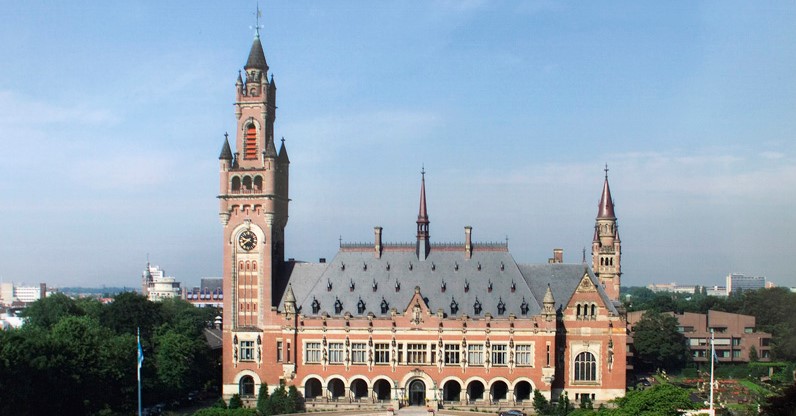
The International Court of Justice opined Thursday that an international labor treaty protects the right to strike. The advisory opinion provides clarity to the treaty provisions, particularly the scope of the right to association at international law.
The controversy centers on the interpretation of articles 2, 3, and 10 of the Freedom of Association and Protection of the Right to Organise Convention, 1948 (Convention No.87) of the International Labour Organization (ILO). While the convention does not explicitly mention the right to strike, the majority held that the right to organize activities and formulate programs provided in the convention includes the right to strike. The court accepted that strikes, understood as temporary work stoppage or slowdowns by worker groups as a means to stand up for demands, fall within the scope of “activities” in the convention.
This opinion rejected the interpretation proposed by employer groups. For instance, Business Africa and the International Organisation of Employers suggested a narrower definition of “activities” to include only internal matters such as negotiation, adoption of constitutions and rules, and election of representatives. They argued that interpreting the provisions to include the right to strike violates treaty interpretation rules in the Vienna Convention on the Laws of Treaties.
During the proceedings, Bangladesh, Costa Rica, Japan and Switzerland objected to the current interpretation. However, the majority found that they were also state parties to the International Covenant on Economic, Social and Cultural Rights (ICESCR), of which article 8(d) explicitly protects the right to strike. The majority observed that they had not excluded the right to strike by reservations when they became a state party.
The International Trade Union Confederation welcomed the ruling, stating that the right to strike is “a fundamental means through which workers defend their interests, secure decent work and contribute to democratic societies.”
While the advisory opinion is not legally binding, it is considered an authoritative judicial pronouncement. IndustriALL Global Union, a worldwide workers union coalition, said that the implications of the advisory opinion are far-reaching because the convention is not only ratified by 158 countries, but is also embedded in UN labor standards, OECD guidelines and international trade agreements.
Notably, the convention is not the sole source of the right to strike in international law. Other than article 8(d) of the ICESCR, various regional treaties such as the European Social Charter and the Additional Protocol to the American Convention on Human Rights guarantee the right to strike explicitly. The European Court of Human Rights have also consistently interpreted article 11 of the European Convention on Human Rights to include the right to strike.

