
Joshua Villanueva is JURIST’s Washington, DC Correspondent and an LL.M. candidate in National Security and U.S. Foreign Relations Law at The George Washington University Law School.
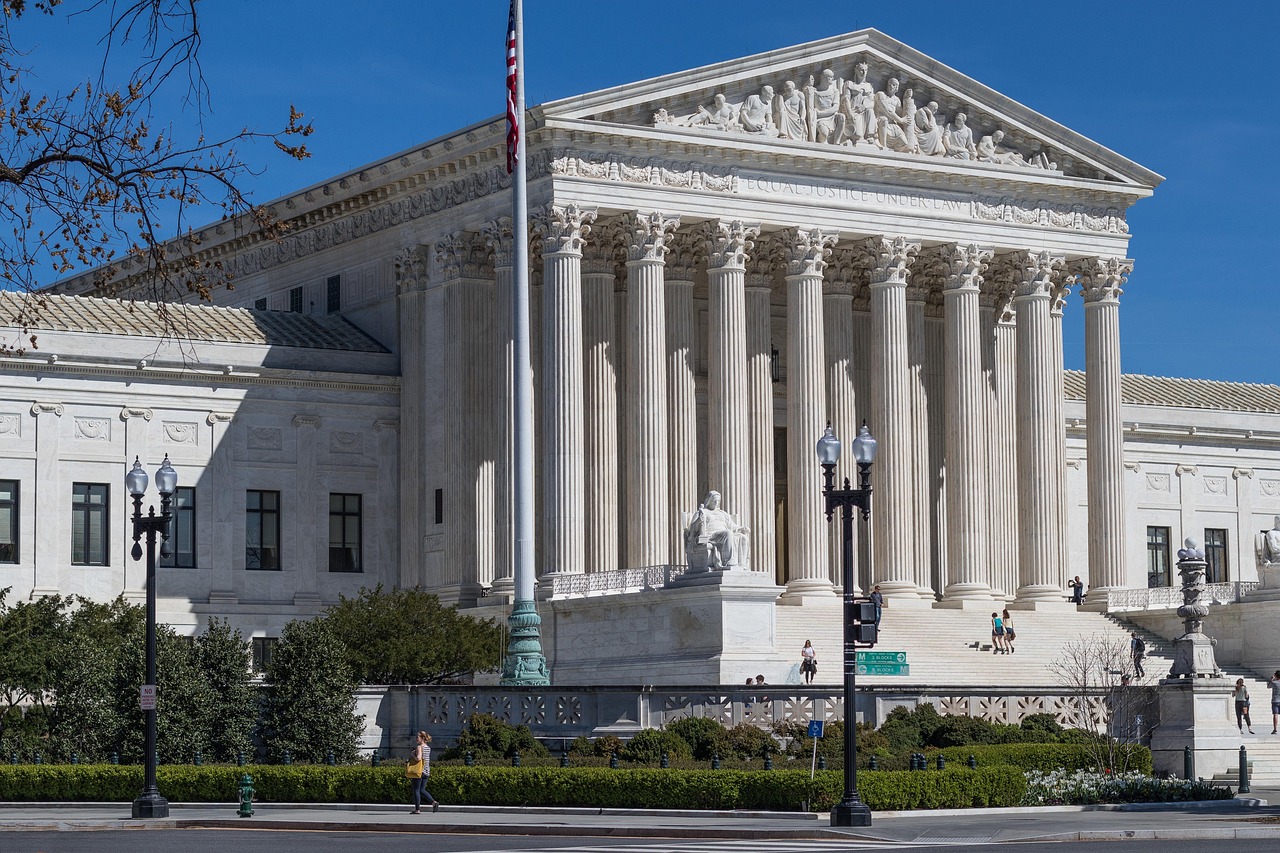
The US Supreme Court on Wednesday heard oral argument in Trump v. Barbara, testing whether President Donald Trump’s executive order restricting birthright citizenship can survive the Constitution’s Citizenship Clause and the Court’s long-settled precedent in United States v. Wong Kim Ark. The case asks whether nearly all children born on US soil are citizens at birth, or whether, as the administration argues, children born to undocumented immigrants and some temporary visitors are excluded because they are not “subject to the jurisdiction thereof” within the meaning of the Fourteenth Amendment.
Whispers moved through the courtroom, and necks craned toward the public gallery as Trump took a front row seat. With him were Attorney General Pam Bondi, Commerce Secretary Howard Lutnick, and White House Counsel David Warrington. Trump was the first sitting president to attend a Supreme Court oral argument, according to the Supreme Court Historical Society. The Court did not acknowledge his presence from the bench, but his attendance highlighted the political and constitutional stakes of a case that goes to the heart of citizenship, executive power, and the meaning of the Fourteenth Amendment.
Trump remained in the courtroom through Solicitor General D. John Sauer’s presentation, listening silently from the gallery as Sauer defended the administration’s attempt to tie citizenship to parental domicile and allegiance. He left shortly after ACLU attorney Cecillia Wang began her presentation. Notably, Trump remained attentive throughout Sauer’s argument. He closed his eyes once, but did not sleep. After leaving the Court, he posted on Truth Social that the United States was “STUPID” to allow birthright citizenship.
California Attorney General Rob Bonta was also in the gallery. His office, along with 21 other state and local governments, filed an amicus brief supporting the respondents
The government’s narrow reading of the Citizenship Clause
Sauer began his argument by urging the justices to adopt a much narrower interpretation of the Citizenship Clause than has been used for over a century. Sauer argued that the Clause was intended after the Civil War “to grant citizenship to the newly freed slaves and their children,” not to “the children of temporary visitors or illegal aliens.” He maintained that “subject to the jurisdiction thereof” requires a “direct and immediate allegiance,” not just ordinary obedience to US law. According to Sauer, this allegiance is established through lawful domicile, which he identified as the key link between the Fourteenth Amendment, the Civil Rights Act of 1866, and his proposed rule for modern citizenship cases.
The justices quickly expressed skepticism about this position. Chief Justice John Roberts questioned how the government could expand from narrow, historically recognized exceptions—such as children of ambassadors or those born during hostile occupation—to the much broader group the administration seeks to exclude. Roberts described the government’s examples as “very quirky” and questioned how these “tiny and sort of idiosyncratic examples” could justify excluding large numbers of children born to undocumented migrants and temporary visa holders. The justices across the ideological spectrum were broadly skeptical of the administration’s theory, examining both its historical foundation and practical implications.
A central issue was whether the administration could maintain Wong Kim Ark’s authority while limiting its impact. Sauer argued that the government was not seeking to overrule Wong Kim Ark, but to interpret it narrowly as applying only to parents with “permanent domicile and residence” in the United States. This distinction was essential to the administration’s theory, as Wong Kim Ark is the leading Supreme Court case affirming that a child born in the United States to foreign parents is a US citizen under the Fourteenth Amendment. However, several justices questioned whether the government could restrict the precedent without fundamentally altering its reasoning. Justice Sonia Sotomayor repeatedly pressed Sauer on the language and exceptions in Wong Kim Ark, while Justice Elena Kagan described the administration’s theory as “revisionist” regarding both the constitutional text and the nation’s established understanding of birthright citizenship.
Justice Clarence Thomas’s questions were far fewer than his colleagues’, but they framed several of the argument’s foundational issues. Thomas directed Sauer back to first principles, asking how the Citizenship Clause was meant to respond to Dred Scott and whether national and state citizenship should be understood as carrying the same definition under the Fourteenth Amendment. He also pressed on whether the debates surrounding the Amendment were really about immigration at all, suggesting that the Clause’s immediate historical focus was the citizenship of formerly enslaved people and, to some extent, tribal Indians.
Sauer clashes with the Court as Wang stays composed
Sauer’s exchanges with the justices grew increasingly tense as they all questioned him about Wong Kim Ark. Sauer grew visibly agitated, gesturing vigorously and at one point raising his voice as he defended the administration’s position. Sotomayor pressed him directly on whether the government was, in effect, asking the Court to overrule or hollow out Wong Kim Ark. Sauer denied that the administration was seeking outright overruling and instead characterized later statements in the Court’s cases about birthright citizenship as unreasoned assumptions or “drive-by” conclusions. That formulation did little to ease the justices’ concern that the administration was asking for a constitutional result that would be difficult to reconcile with the Court’s precedents, including statements in later cases describing children born in the United States to undocumented or overstaying parents as citizens.
In contrast, Wang maintained a steady, composed presence throughout the argument, even as the justices pressed her on difficult historical and doctrinal questions. Her delivery was measured and controlled, and she consistently answered in clear, concise terms without becoming evasive or overextended. She narrowed each exchange to the core point she wanted to make, which gave her responses an air of discipline and credibility.
Gorsuch, Barrett, and Jackson test the limits of domicile
Justice Neil Gorsuch challenged the government’s domicile theory from several perspectives. He questioned whether domicile should be defined as it was in 1868, when the Fourteenth Amendment was adopted, or under current immigration law. Gorsuch also asked who determines domicile—the mother, the father, both parents, or a combination—and how courts or agencies would make this determination in practice. He emphasized that the Citizenship Clause refers to the child, not the parents, while the government’s argument relies on attributing parental legal status to the child. Gorsuch’s questions highlighted a key issue: the administration claims to rely on the original meaning of the Fourteenth Amendment, yet its approach would allow modern Congresses to redefine who can establish lawful domicile in the United States.
Justice Amy Coney Barrett examined the workability and coherence of the administration’s theory. She tested Sauer’s arguments with challenging scenarios, such as children of enslaved or trafficked persons, foundlings with unknown parents, and the broader conflict between jus soli and jus sanguinis citizenship systems. Justice Brett Kavanaugh was visibly laughing as Barrett pressed on the jus soli and jus sanguinis systems. Barrett emphasized that the administration’s rule would require the government to investigate parental status, intent, and domicile, all of which are often disputed or difficult to determine. She also questioned whether the government’s approach would require a bureaucratic review of a parent’s legal status before granting citizenship to a newborn. Barrett was among several justices who openly questioned the clarity and practicality of the administration’s position.
Justice Ketanji Brown Jackson examined the structural implications of the government’s argument. She suggested that the Fourteenth Amendment’s Citizenship Clause was intended to place citizenship beyond the reach of future Congresses and presidents. Jackson asked whether, if Congress can define who may lawfully establish domicile, it could effectively alter constitutional citizenship through ordinary immigration laws. She also shifted the focus to practical implementation, questioning how the administration’s rule would work in practice and whether parents would need to provide documents at birth or later challenge denials of citizenship. Jackson’s questions highlighted both the practical and doctrinal weaknesses of the government’s theory.
Alito probes allegiance while Roberts rejects policy drift
Justice Samuel Alito was more open than several of his colleagues to exploring the administration’s theory, but his questions also exposed its difficulties. At one point during Wang’s argument, Alito offered several hypotheticals involving a child born in the United States to an Iranian father. He noted that such a child would automatically be an Iranian national at birth and might owe military service to Iran, then asked whether that child could really be said to be “not subject to any foreign power” within the meaning of the Civil Rights Act of 1866. The hypothetical aimed to test the respondents’ arguments that the 1866 Act and the Fourteenth Amendment should be read in tandem and that allegiance to another sovereign disqualifies a child from American citizenship. Wang responded that, read in context, the 1866 Act’s phrase was aimed at the ambassador exception and could not sensibly be interpreted to exclude the children of all foreign nationals, because that would also strip citizenship from the US-born children of lawful immigrants.
During his exchange with Sauer, Alito also raised what he called a “humanitarian problem”: individuals who are subject to arrest and removal under US immigration law but have established permanent lives in the country. Sauer responded that the United States’ broad birthright citizenship policy is unusual among modern nations, especially in Europe, and argued that countries without such rules have not faced similar issues. This exchange reflected a broader theme in the government’s argument, as Sauer frequently cited international practices and concerns about illegal immigration and “birth tourism.” However, Roberts later emphasized that current policy concerns cannot alter constitutional meaning.
A notable moment occurred during Roberts’s questioning about “birth tourism.” Sauer admitted that “no one knows for sure” how common the practice is, but argued that the Court faces a “new world” where billions are “one plane ride away” from obtaining US citizenship for their children. Roberts responded with the catchphrase of the day: “It’s a new world. It’s the same Constitution.” This exchange reflected the Court’s broader discomfort with basing a major reinterpretation of the Fourteenth Amendment on current policy concerns rather than established constitutional principles.
Kavanaugh stays measured and gives little away
Justice Kavanaugh was notably quieter than several of his colleagues through much of both sides’ presentations. He spoke only when Roberts called on him, and his questioning was more measured than that of the other justices. Kavanaugh did not clearly reveal where he would come out, but he did give Sauer room to explain the administration’s theory at greater length than most of the other skeptical justices. His questions focused on the textual difference between the Fourteenth Amendment’s phrase “subject to the jurisdiction thereof” and the Civil Rights Act of 1866’s “not subject to any foreign power,” as well as on why Congress in 1940 and 1952 repeated the constitutional language in the nationality statutes if it wanted a narrower meaning. Kavanaugh also explored whether Congress might have any room under Section 5 of the Fourteenth Amendment to legislate in this field, while repeatedly noting that a ruling for the respondents could, in theory, rest on Wong Kim Ark and the statute alone. Kavanaugh was careful not to show his hand, even as he probed both sides. It’s unclear at this point how he might vote on this case.
Historical exceptions return to the forefront
The argument also addressed Native Americans, tribal lands, and births on Indian reservations. These issues arose because the government cited the historical exclusion of tribal Indians from automatic citizenship under the original understanding of the Fourteenth Amendment. Gorsuch and Barrett used this topic to question Wang whether the recognized exceptions are fixed or reflect broader, evolving principles. Sauer, in contrast, appeared uncertain when Gorsuch asked if Native Americans born today would be birthright citizens under the government’s domicile-based test, eventually answering yes if lawfully domiciled, but then expressing uncertainty. Sauer hesitated, and Gorsuch dryly responded: “I’ll take the yes.” Gorsuch’s exchange revealed a strong, silent tension between the government’s claim of a rigid original meaning and its reliance on a domicile framework that could change over time.
The discussion of wartime “enemy aliens” highlighted similar issues. Wang argued that recognized exceptions apply only when another sovereign’s authority actually supersedes US jurisdiction, such as in the case of foreign diplomats, foreign occupation, or the unique status of tribal nations. She rejected the government’s broader claim that foreign nationality or divided allegiance alone is sufficient. The justices discussed children born during Japanese internment in World War II, and Wang cited historical examples showing that babies born in internment camps were treated as US citizens if born on US soil. This example challenged the administration’s effort to equate foreign nationality or wartime status with exclusion from birthright citizenship, emphasizing that the constitutional rule has historically depended on US territorial jurisdiction.
Wang returns to a bright-line rule
Wang argued that the Citizenship Clause established a broad common law jus soli rule, making nearly everyone born in the United States a citizen, with only a few narrow historical exceptions. Wang told the Court that the government’s refusal to seek formal overruling of Wong Kim Ark undermined its case, as the precedent’s rule excludes the parental-domicile theory. She argued that the Fourteenth Amendment was intended to set a clear constitutional standard to prevent future officials from manipulating citizenship based on parentage, caste, or changing political views. Wang stressed that, under Wong Kim Ark, temporary presence, divided nationality, and lack of naturalization do not negate birthright citizenship if the child is born in the United States and not within a narrow exception such as the ambassador rule.
Wang also cautioned that the administration’s theory would create widespread legal and administrative instability. She argued that if citizenship depends on contested assessments of parental status or domicile, many federal and state laws that assume citizenship by birth would become uncertain. She further stated that thousands of children would immediately lose their citizenship under the executive order, and that the government’s logic could eventually cast doubt on the citizenship of many more Americans. Reports indicate that the order could affect about 250,000 births annually if implemented.
This case had grown into something far bigger than a fight over immigration policy. Trump’s unprecedented appearance in the courtroom underscored a deeper question: how far can a president go in reshaping the very definition of being an American? The justices’ probing revealed their discomfort with the administration’s attempt to cloak its position as a simple return to original intent. They pressed for a principled, workable way to limit Wong Kim Ark without gutting its core. The tension crystallized when Chief Justice Roberts, unmoved by arguments about changing times, replied simply: “It’s a new world. It’s the same Constitution.” The stakes could not be clearer. The Court’s forthcoming decision will determine the future stability of one of the Fourteenth Amendment’s most fundamental promises.
