
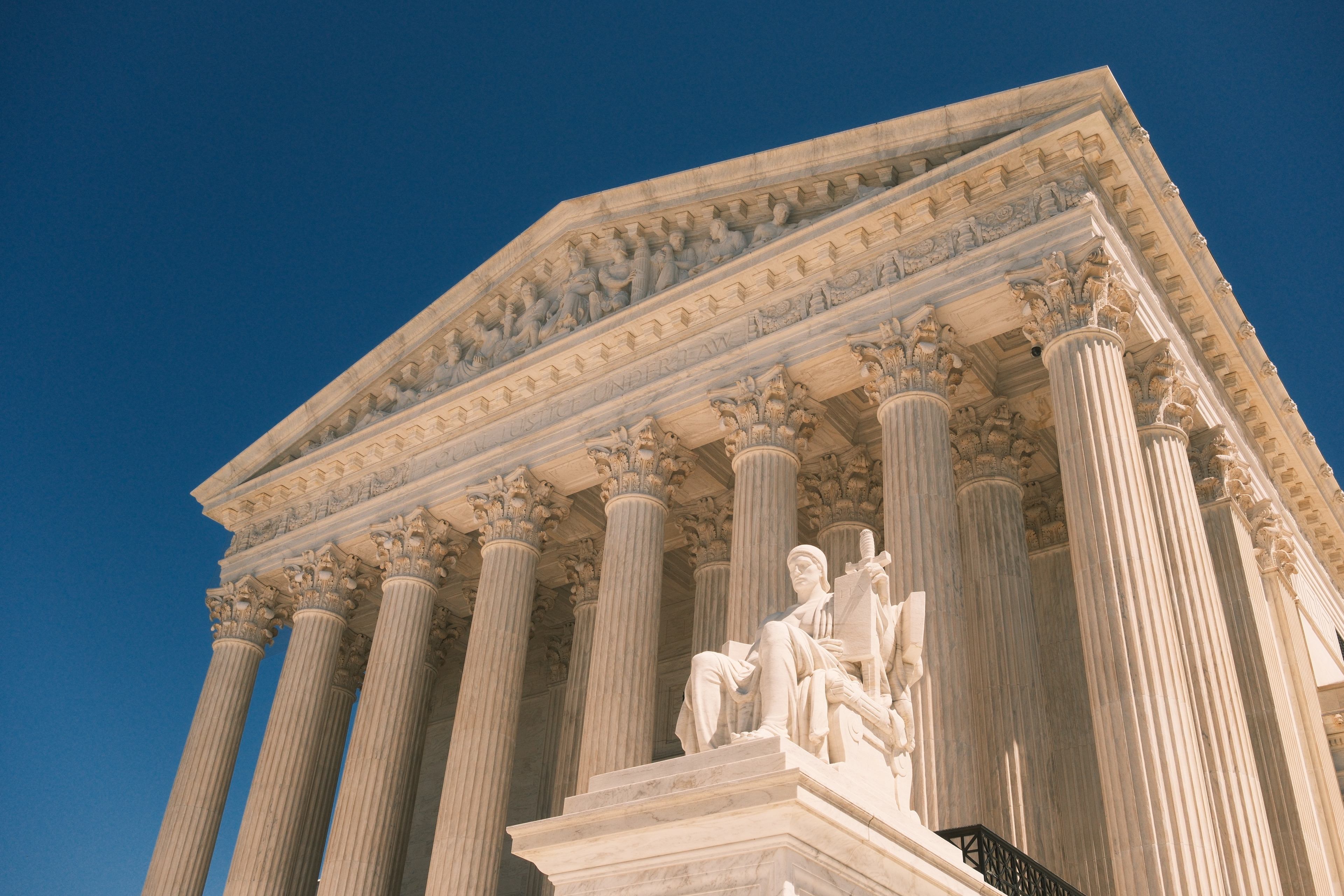
The Supreme Court on Wednesday struck down Louisiana’s congressional map as an unconstitutional racial gerrymander, while overhauling the legal framework courts have used for four decades to evaluate minority voting rights claims under the Voting Rights Act.
The 6-3 decision, written by Justice Samuel Alito, will make it significantly harder for plaintiffs to challenge redistricting plans as racially discriminatory and could reshape congressional and state legislative maps across the country.
The case arose from Louisiana’s 2022 post-census redistricting, which produced a map—known as HB1—containing only one majority-Black district despite African Americans making up roughly a third of the state’s population.
A group of Black voters, led by plaintiff Press Robinson, filed a federal lawsuit, arguing the map violated Section 2 of the Voting Rights Act, which prohibits voting practices that discriminate on the basis of race. As described in the complaint, “Louisiana’s new congressional map packs Black voters into the state’s only majority-Black district and cracks other Black voters among districts that extend into predominantly white communities in the southern, western, and northern reaches of the state.” In June 2022, the district court agreed the map likely violated the law and ordered Louisiana to draw a new one with a second majority-Black district.
After appeals delayed the case past the 2022 election, Louisiana’s legislature in 2024 enacted a replacement map, SB8, that added a second majority-Black district stretching roughly 250 miles from Shreveport in the state’s northwest to Baton Rouge in the southeast. Lawmakers chose that unusual configuration, Louisiana acknowledged, to protect the districts of three prominent Republican incumbents: House Speaker Mike Johnson, Majority Leader Steve Scalise and Appropriations Committee member Julia Letlow.
A different group of voters, led by plaintiff Phillip Callais, then sued in federal court in the Western District of Louisiana, arguing SB8’s elongated second district was an unconstitutional racial gerrymander. A three-judge federal panel agreed. Now defending the map it had been ordered to draw, Louisiana appealed to the Supreme Court, joined by the Robinson plaintiffs, who had intervened to defend the second majority-Black district they had originally sought.
The Supreme Court on Wednesday affirmed the lower court ruling against SB8, and in doing so, restructured the test established in the court’s 1986 decision in Thornburg v. Gingles, which has governed Section 2 vote-dilution cases ever since.
Under the revised framework, plaintiffs must now show that alternative maps meet all of a state’s legitimate districting goals — including partisan political objectives such as protecting incumbents — without using race as a drawing criterion. Plaintiffs must also demonstrate, through analysis controlling for party affiliation, that racially polarized voting cannot be explained by partisanship alone. “If a Section 2 plaintiff cannot disentangle race from the State’s race-neutral considerations, including politics,” Alito wrote, “then Section 2 cannot impose liability.”
The majority held that Section 2 imposes liability only when evidence supports “a strong inference that the State intentionally drew its districts to afford minority voters less opportunity because of their race.”
Applying that test, the court found Louisiana’s earlier map did not actually violate Section 2, meaning the state had no compelling reason to rely on race in drawing SB8.
Justice Elena Kagan, joined by Justices Sonia Sotomayor and Ketanji Brown Jackson, wrote a sharp dissent accusing the majority of effectively returning Section 2 to its pre-1982 state, when plaintiffs had to prove discriminatory intent—a standard Congress explicitly rejected when it amended the law that year.
“Under the Court’s new view of Section 2, a State can, without legal consequence, systematically dilute minority citizens’ voting power,” Kagan wrote. She said the ruling completes a years-long project by the court to dismantle the Voting Rights Act, following its 2013 decision in Shelby County v. Holder gutting the law’s preclearance provisions and its 2021 ruling in Brnovich v. Democratic National Committee narrowing Section 2’s reach over voting restrictions.
President Donald Trump praised the ruling Wednesday in a post on his Truth Social account, calling it “a BIG WIN for Equal Protection under the Law” and thanking Alito for “authoring this important and appropriate Opinion.” Trump said the decision “returns the Voting Rights Act to its Original Intent, which was to protect against intentional Racial Discrimination.” His take did not address the 1982 amendments to the law, in which Congress explicitly rewrote Section 2 to cover discriminatory effects, not just intent — a history Kagan’s dissent emphasized at length.
Many critics took a dimmer view.
“This decision is a profound betrayal of the legacy of the civil rights movement. By gutting Section 2 of the Voting Rights Act, the Court has weakened the primary legal tool that voters of color rely on to challenge discriminatory maps and election systems,” Sophia Lin Lakin, director of the ACLU’s Voting Rights Project, said in a statement.
Members of the Congressional Black Caucus wrote: “Today, just 60 years later, with the stroke of a pen, this rogue, unaccountable Court has effectively signed the death certificate of the Voting Rights Act, undoing decades of Black progress.”
