
 News
NewsHuman Rights Watch (HRW) on Thursday urged national leaders to cease combative rhetoric as conflict continues in the Middle East, warning that further escalation could result in devastating civilian casualties and regional instability.
Commenting on the extreme unrest in the region, Philippe Bolopion, executive director of HRW, stated:
As the Middle East conflict has spread and intensified, so too has the dangerous rhetoric by leaders on all sides, including open threats to commit war crimes… This explosive combination, building on world leaders’ longstanding failure to hold those responsible for serious violations of international law to account, is threatening the rules-based order that has long sought to protect civilians.
HRW criticized government official statements, such as those from US President Donald Trump, that suggest potential violations of the laws of war. In particular, the group condemned a statement from US Defense Secretary Pete Hegseth, in which he said the US “will keep pushing, keep advancing, no quarter, no mercy for our enemies.” HRW contended that such an order violates Rule 46 of Customary International Humanitarian Law, or the “no quarter rule.”
The “no quarter” rule is a strict prohibition against ordering, threatening, or conducting hostilities that leave no survivors, forming the backbone of the principle that the only legitimate object of war is to weaken the enemy’s military forces, not to inflict unnecessary suffering.
Iranian authorities have been previously accused of crimes against humanity, including in early January when they committed mass arrest and massacres of national protesters. The regime recently doubled down on threats to protestors, vowing to inflict an “even harsher blow than” previous crackdowns. Israeli officials have also been repeatedly accused of using plainly illegal force in its territory and beyond, contrary to Article 2(4) of the UN Charter.
The US attack on a primary school which resulted in the deaths of children, use of white phosphorus by Israeli forces over homes in Lebanon, Iranian attacks on commercial ships in the Strait of Hormuz and use of illegal cluster munitions against Israel, all constitute serious violations of the laws of war.
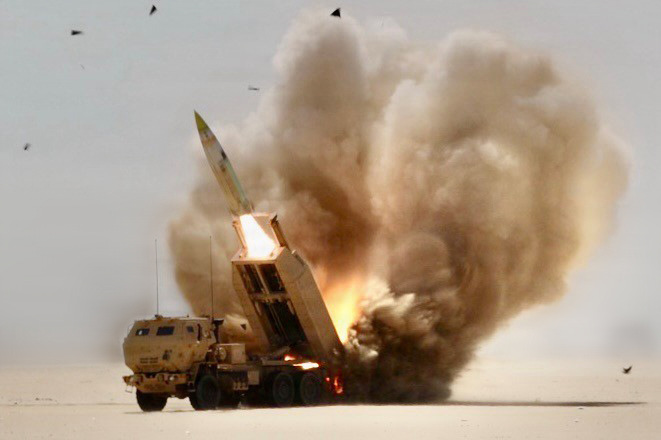
Chaos in the Middle East erupted when the US and Israel coordinated surprise attacks on Iran’s missile infrastructure, air bases and military sites on February 28. The assaults led to the assassination of Ayatollah Ali Khamenei, Supreme Leader of Iran, sending shockwaves throughout the region and prompting retaliatory threats from the Islamic Revolutionary Guard Corps, Hezbollah, and the Iranian army.
The UN Refugee Agency reported that 884,000 individuals were internally displaced in the first week of the attacks, intensifying the humanitarian crisis as families flee their homes with limited access to food and water.

![[null Courtesy]](https://commons.wikimedia.org/wiki/File:HIMARS_Support_Operation_Epic_Fury_(9564986).jpg)