
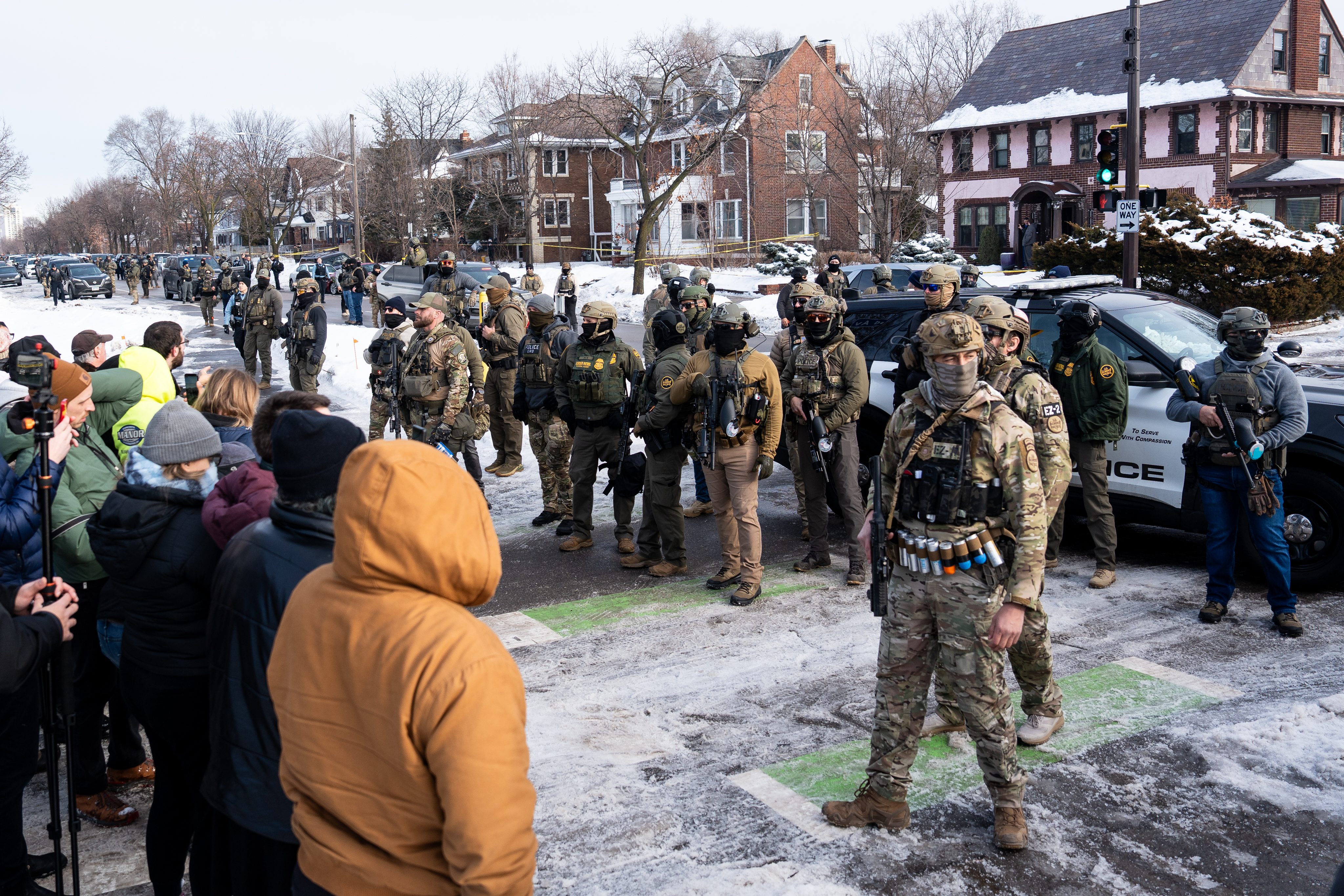
A US federal judge in Minnesota on Saturday refused to halt the Trump administration’s massive immigration enforcement operation in the Twin Cities, denying a request by the state of Minnesota and the cities of Minneapolis and St. Paul for preliminary injunctive relief.
District Judge Katherine Menendez held that plaintiffs had not shown a sufficient likelihood of success on the merits to justify the “extraordinary remedy” of a preliminary injunction on “Operation Metro Surge,” a large-scale deployment of immigration agents across the state.
Minnesota has challenged the operation as a violation of the Tenth Amendment’s anti-commandeering doctrine and the “equal sovereignty” of the states. Plaintiffs contend that the enforcement surge, backed by roughly 3,000 federal agents, has imposed massive costs on state and local governments, and seeks to punish “sanctuary policies” in Minneapolis and St. Paul. Prior to the operation, roughly 80 ICE officers operated in the Twin Cities.
Minnesota and the Twin Cities argued that the surge effectively commandeers state and local governments, forcing them to expend substantial resources to manage operational fallout instead of normal police work, schools, emergency management, transportation, and social services. They also argued that the administration is attempting to leverage them into repealing “sanctuary” ordinances and cooperating with immigration enforcement, in violation of the anti-commandeering principle articulated in New York v. United States, Printz v. United States and Murphy v. NCAA.
Plaintiffs pointed to public statements by administration officials, including Border Czar Tom Homan, that suggest the duration of the surge depends on the level of state and local “cooperation.” A letter from Attorney General Pam Bondi to Governor Tim Walz also revealed federal requests for access to state records and repeal of non-cooperation policies.
Judge Menendez did not dismiss the underlying constitutional concerns. Her order openly acknowledged evidence of “profound and even heartbreaking” consequences for Minnesotans, noting allegations of racial profiling and excessive force by federal agents. However, she concluded that plaintiffs had asked the court to apply the anti-commandeering doctrine in a case where the Supreme Court has provided little guidance.
Addressing plaintiffs’ “resource-diversion” argument, Menendez cited United States v. Texas. In that case, the Supreme Court held that downstream costs to state budgets from federal immigration-enforcement decisions are alone not sufficient to establish standing. The court reasoned that if such indirect fiscal impacts rarely justify opening the courthouse door, they are unlikely to constitute a Tenth Amendment violation.
Minnesota’s “equal sovereignty” claim, borrowing from Shelby County v. Holder, also failed to clear preliminary injunction thresholds, the judge found. Historically, such claims involve federal statutes that burden the sovereign functions of singled-out states. However, Menendez found that this case instead involved decisions about where to deploy federal law enforcement resources and noted that the executive branch must retain flexibility to allocate personnel based on changing national conditions.
On other factors, such as irreparable harm, the court largely accepted plaintiffs’ factual showings of multiple fatal shootings by federal agents, serious allegations of misconduct, and wide-ranging disruptions to education, health care, worship, and local economies. The order stated that it would be “difficult to overstate” the impact of the operation on Minnesota communities.
But the judge held that these harms must be weighed against the federal government’s interests in enforcing immigration law. She leaned on a recent opinion in Tincher v. Noem, which stayed a narrower injunction that limited federal agents’ interactions with protesters during the same operation.
Minneapolis Mayor Jacob Frey said he was “disappointed” with the decision and called ICE operations “an invasion.” Bondi, by contrast, praised the decision as “another HUGE” legal victory, and said that neither “sanctuary policies” nor “meritless litigation” would stop the administration from enforcing federal law in Minnesota.

![Chad Davis, [1]](https://commons.wikimedia.org/wiki/File:ICE_Agents_in_Minneapolis_After_Shooting.jpg)