
 Dispatches
Editor’s note: This story is part of ongoing coverage of the lead up to Mangione’s trial. Read Day 1, Day 2, Day 3, Day 4, Days 5-7, Day 8, and Day 9 of state suppression hearings on the case.
Luigi Mangione’s state trial is set to begin on June 8, Judge Gregory Carro of the Manhattan Criminal Court announced on Friday. This places Mangione’s state trial ahead of his federal one, which is scheduled to begin on October 13.
Lead defense attorney Karen Friedman Agnifilo told the court, “Mr. Mangione is being put in an untenable situation. This is a tug-of-war between two different prosecution offices.” She previously lamented the concurrent federal and New York state prosecutions as “a high-stakes game of tug-of-war between state and federal prosecutors, except the trophy is a young man’s life.”
Proceedings concluded with Friedman Agnifilo stating, “Your Honor, we are not going to be ready on June 8.”
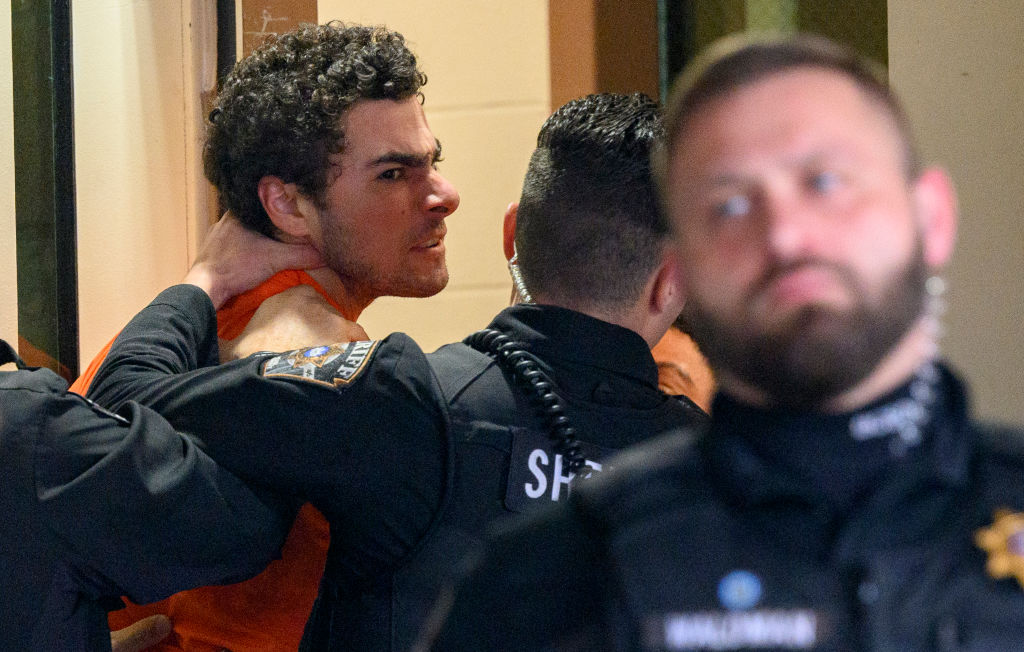
As a shackled Mangione was being escorted out, he turned to the press and said in a raised voice, “It’s the same trial twice. One plus one is two. Double Jeopardy by any common-sense definition.” His tenor was agitated but controlled, and he was thereafter quickly led out by court officers.
During the incident, defense attorney Marc Agnifilo encouraged Mangione to stay silent. The defense did not immediately reply to a request for comment on Mangione’s statement.
The sudden declaration marks the second time that Mangione has publicly spoken in New York State court, the first one being when he entered a not guilty plea in December 2024.
It also marks the second time he has spoken without recognition in court. In December 2024, Mangione “corrected” prosecutors by stating that the money found in his backpack may have been “planted.” He further stated that what prosecutors referred to as a “Faraday bag” was actually a “waterproof” bag, and questioned their accusations of “criminal sophistication.” The defense similarly argued during state suppression hearings that Mangione had a “waterproof,” not “Faraday” bag on him when he was apprehended.
Mangione faces a nine-count indictment in his New York State case for the murder of UnitedHealthcare CEO Brian Thompson, with the highest count being second-degree murder, which holds a maximum 25 years to life.
The remainder of the state charges are mostly weapons-related with one count being for possession of a forged instrument. Assuming consecutive sentencing, he faces a minimum of approximately 19 years on these counts.
If the prosecution appeals in Mangione’s federal case, the state trial will begin on September 8.
One week before Friday’s hearing, counts three (murder through use of a firearm) and four (firearms offense) were dropped in Mangione’s federal case, thus precluding the death penalty. The two counts were nullified after Judge Margaret Garnett ruled that the predicate crime of stalking did not legally amount to a crime of violence. The federal prosecution has until February 27 to decide whether it will appeal the decision to the Second Circuit, which would effectively delay the federal case.
In a brief press conference outside of the courthouse, lead defense attorney Karen Friedman Agnifilo stated, “Double Jeopardy is meant to protect people, and they are using it as a weapon here.”
In September 2025, Carro denied the defense’s motion to stay the New York State case under the Double Jeopardy Clause, citing the Dual Sovereignty Doctrine, which allows for prosecution of the same crime in different jurisdictions.
He further explained that New York State’s Criminal Procedure Law (CPL) § 40.20 could trigger Double Jeopardy protections on the state-level, but only if a jury has been sworn or a prior prosecution results in a conviction.
CPL § 40.20 provides Double Jeopardy protections that extend beyond those afforded by the federal and state constitutions, particularly by rejecting the Dual Sovereignty Doctrine. It thus prohibits separate prosecutions for offenses arising out of the same act or criminal transaction, even if the prosecutions occur in different jurisdictions, unless one or more of the eight enumerated statutory exceptions apply.
Thus, if a court determines that Double Jeopardy exists under CPL § 40.20 and absent any statutory exceptions, the qualifying indictment is required to be dismissed after a final verdict is made.
Applied to Mangione’s dual prosecutions, a prior federal conviction or acquittal could have allowed the defense to invoke double jeopardy under CPL § 40.20 to dismiss the New York State indictment.
Friedman Agnifilo stated, “it is absolutely unfair that Mr. Seidemann wants two bites of the apple. New York State has a double jeopardy law for a reason.” The legal phrase “two bites of the same apple” usually refers to the impermissibility of a party attempting to relitigate or retry the same issue, claim, or case after it has already been decided.
“They’re seeking to deprive the prosecuting agency on a local crime, a murder that happened in Midtown on our streets of a guest to our city,” Assistant District Attorney Joel Siedemann countered. “This has been the reason for their delays, hoping that if it goes after the federal case,” that New York law would prohibit the Manhattan District Attorney’s office from prosecuting Mangione, he argued.
The most recent case in which a murder indictment was dismissed under CPL § 40.20 due to Double Jeopardy is People v. Mercado. The defendant was charged with intentional murder and depraved indifference murder for the same killing in New York State. The prosecution argued that the “different elements” exception under CPL § 40.20 applied, which permits separate prosecutions if the offenses have substantially different elements.
However, the Mercado court determined that while the murder offenses possess different elements, the acts establishing the offenses were not distinguishable and based on the same acts. It thus dismissed the indictment for depraved indifference murder. The court noted that the same evidence was presented to both grand juries, including testimony that the defendant aimed a .380 caliber gun and shot the victim in the head.
The court also emphasized that the legislative intent behind CPL § 40.20 was to provide broader protection against successive prosecutions than the constitutional Double Jeopardy provisions. It reiterated that, under People v. Abbamonte and absent statutory exceptions, an accused should not “suffer repeated prosecution” for the same general conduct, regardless of the number of statutory offenses violated or jurisdictions involved.
An official defense has not yet been publicly filed in Mangione’s New York State case, and in September 2025, state prosecutors claimed the defense missed an August 25 deadline to disclose whether they planned to use a psychiatric defense.
However, Mangione’s lawyers filed a letter to Carro on Thursday stating that they “must prepare potential defenses that are unique to the state proceedings and unavailable in federal court.” Such murder defenses could include New York State’s extreme emotional disturbance defense, which allows for a “cooling-off” period to demote a murder charge to manslaughter due to extreme distress, and the affirmative defense to felony murder, where the defendant was not the only participant in the underlying felony (subject to conditions, including that the defendant cannot have aided or committed the murder).
The state trial is expected to last “several” months, with the prosecution having already noticed 15 different experts, including for weapons analysis, to testify at trial.
Mangione’s lawyers repeatedly pushed back on the timeline, with Marc Agnifilo shaking his head “no” at the bench several times. If the current schedule holds, the June 8 state trial would leave approximately one month before federal in-person jury selection on September 8.
While trial scheduling alone does not establish a constitutional violation, an appellate challenge could arise if the defense can show that the denial of additional time meaningfully impaired preparation.
In United States v. Smith, the Second Circuit emphasized that a denial of a continuance may violate the Sixth Amendment if it leaves counsel with so little time to prepare that the adversarial process breaks down. Similarly, the Supreme Court held in United States v. Cronic that a Sixth Amendment violation may occur if “the likelihood that any lawyer, even a fully competent one, could provide effective assistance is…small.” The Second Circuit is binding on Mangione’s federal case and Supreme Court is binding on federal law issues pertaining to his federal and state cases.
Twenty-four members of the public were permitted to attend the hearing.
A small number of regular courtroom observers—some of whom are known for camping outside the courthouse and representing Mangione’s support to the media—were seated in the press section after reportedly obtaining credentials through their personal, pro-defendant Substack articles. Press seating is guaranteed—and closer to the defendant. When asked about the policy, the Mayor’s Office of Media and Entertainment (MOME) Press Credentials Office, which issues New York press passes, confirmed that such Substack publications qualify for credentials.
When asked about the possibility that visible supporters without a reporting function—including individuals advocating for jury nullification—could mass supplant court press in the jury’s view, the office stated that decisions regarding additional press access lie within the discretion of individual courts.
The arrangement is unusual for a high-profile murder proceeding. Typically, the court and marshals screen credentials, the press is expected to be neutral between the prosecution and defense, and supporters sit in the public gallery.
Mangione is due back in state court on May 18 for evidence suppression decisions.
