
 Dispatches
Editor’s note: This story is part of ongoing coverage of the lead up to Mangione’s trial. Read Day 1, Day 2, Day 3, Day 4, Days 5-7, Day 8, and Day 9 of state suppression hearings on the case.
Last month, a 90-minute suppression hearing was held in Luigi Mangione’s federal case to determine if authorities lawfully seized and searched his backpack in a McDonald’s in Altoona, Pennsylvania.
Judge Margaret Garnett opened by announcing that in-person jury selection is scheduled to begin September 8, a non-death penalty trial October 13, and a death penalty trial January 11.
All dates are subject to change, and the state trial has long been expected to proceed first.
Mangione faces a four-count indictment in federal court for the December 4, 2024, fatal shooting of UnitedHealthcare CEO Brian Thompson in Midtown Manhattan. He was arrested in the Altoona McDonald’s—approximately 280 miles from New York City—five days later. Mangione pleaded not guilty to all charges in December 2024.
If Garnett of the Southern District of New York agrees that the backpack should be suppressed, key evidence, including a 9mm pistol, loaded magazine, suppressor, “manifesto” or red notebook, and hand-drawn notes, will be barred from trial.
Garnett indicated on September 9 that a suppression hearing would not be required. Three days later, however, she modified the scheduling order to grant the defense a “brief” evidentiary hearing, citing the “seriousness of the charges the Defendant is facing.”
During the hearing, the government relied on the testimony of Deputy Chief Nathan Snyder to establish that Altoona Police Department policy requires officers to inventory all property associated with an arrestee taken into custody in a public place, not merely items found on the arrestee’s person.
Courtroom Proceedings
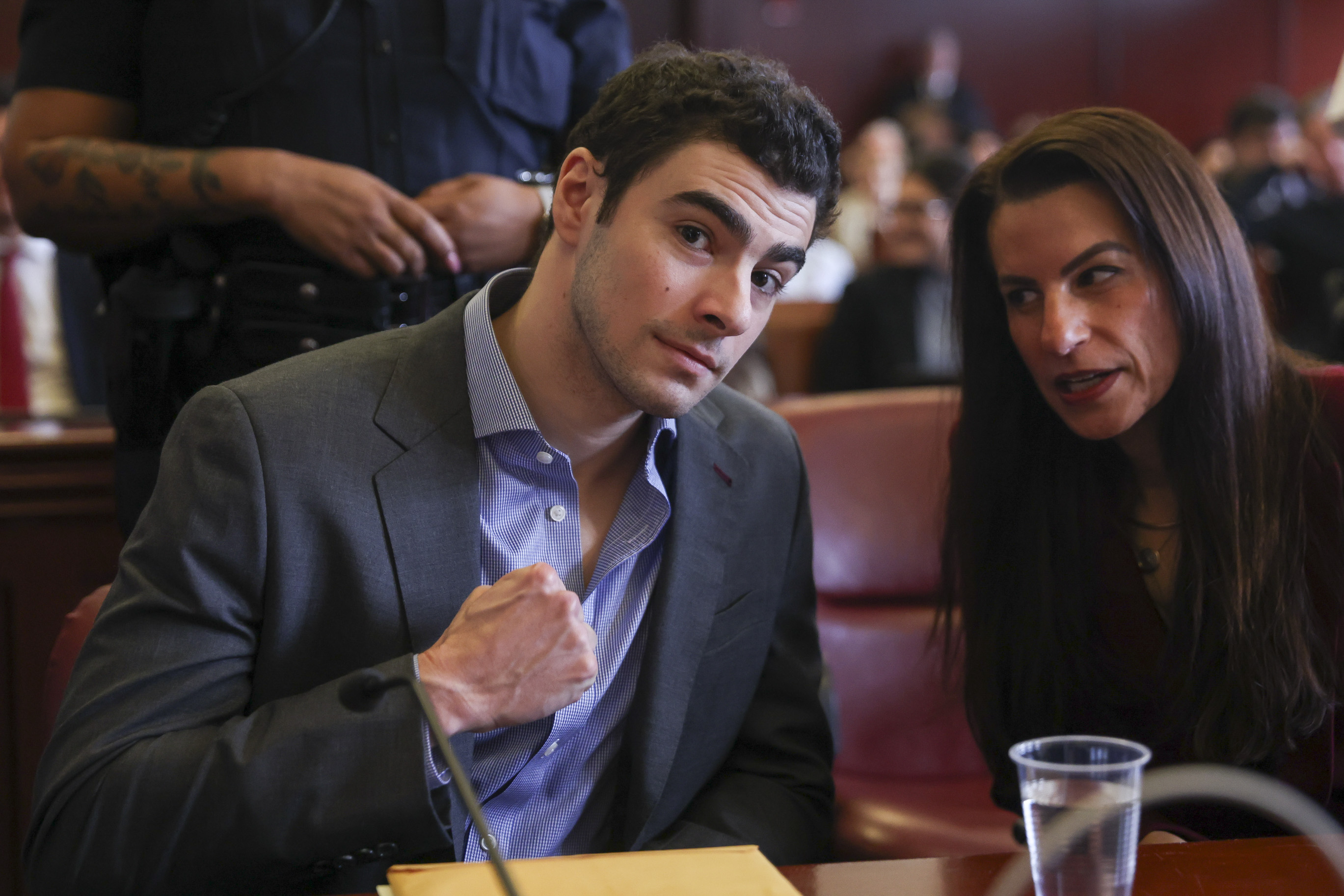
Mangione entered the courtroom wearing tan prison garb with his legs shackled but wrists free.
He appeared attentive and visibly tense as proceedings unfolded, in contrast to his seemingly unperturbed tenor during state suppression hearings.
Garnett directed the parties to discuss the potential use of jury questionnaires in preparation of a January 30 scheduling conference. Jury questionnaires are written questions provided to prospective jurors in advance of voir dire, designed to streamline jury selection. Although both pre-trial processes, voir dire is the typically in-person selection of jurors, and jury selection is the the broader, multi-step process of assembling jurors. New York courts most commonly use jury questionnaires in cases involving extensive pretrial publicity, unusually large jury pools, or anonymous juries—circumstances that are likely to apply in the Mangione case.
Further, Garnett stated that the sole issue for the suppression hearing was to receive evidence concerning Altoona’s procedures for securing, safeguarding, and, if applicable, inventorying the personal property of an arrestee taken into custody in a public place, for purposes of assessing the government’s inevitable discovery argument. The inevitable discovery doctrine allows for illegally obtained evidence that would be subject to suppression to be admitted if it would have been eventually found through legal means. She further noted that, in her view, the remaining factual predicates relevant to the suppression motion were not materially disputed, meaning warranting further judicial review.
On direct examination by Assistant US Attorney Dominic Gentile, Snyder testified that General Orders 3.1, 3.5, and 3.6—Altoona police department directives—work in tandem to require documentation, inventorying, and safeguarding of detainee property until a disposition is made. He further explained that these policies are reinforced through departmental “task sheets” used in officer training and applied consistently throughout an officer’s career.
When asked whether these procedures apply only to property found on a detainee’s body or extend to all property belonging to the detainee, Snyder testified that they apply to all property. He also confirmed that these procedures were in effect at the time of Mangione’s arrest and described them as standardized and mandatory rather than discretionary.
In response to questioning from the court, Snyder explained that inventory searches serve administrative purposes, including safeguarding detainees’ personal belongings, protecting officers from later claims of loss or theft, and ensuring that weapons or dangerous items are not inadvertently stored or returned.
In a hypothetical posed by Garnett involving an arrest in a public place where a bag is separated from the arrestee, Snyder testified that officers would take custody of the item, inventory it, and safeguard it rather than leave it behind.
On cross-examination, defense counsel Marc Agnifilo focused on the textual limits of General Order 3.1.9, titled “Required Detainee Searches,” which governs searches conducted before a detainee is placed in a cell. Agnifilo reviewed the provision, highlighting that it repeatedly references searches of the detainee’s body—such as clothing, belts, footwear, and body cavities — without expressly referencing bags, backpacks, or other containers.
Snyder acknowledged that the provision does not explicitly mention bags. The defense argued that the structure and language of the order indicate that it is concerned with bodily searches rather than searches of personal effects, and that extending its authority to containers risks conflating investigatory searches with administrative inventory procedures.
During state suppression hearings, lead defense counsel Karen Friedman Agnifilo likewise challenged the applicability of General Order 3.1.9 to the backpack search, asking Sergeant Eric Heuston on cross-examination whether the order made any mention of a detainee’s bag. Heuston affirmed that it did not.
The defense also introduced General Order 1.2, titled “Limits of Authority,” which governs search and seizure procedures more broadly and expressly grounds departmental authority in constitutional and statutory law. Snyder stated that Altoona Police Department general orders are intended to comply with the US Constitution, the Pennsylvania Constitution, and applicable rules of criminal procedure.
Marc Agnifilo asked Snyder hypothetically, if “you found something illegal, like a firearm magazine or something like that, you would stop and get a search warrant?”
Snyder answered “yes,” after which Gentile re-took the lectern on direct examination.
“But if you found something that was dangerous, like a magazine or firearm, would you stop searching then, even though there might be a gun attached to that or something even more harmful?” Gentile asked.
“No, not necessarily,” Snyder answered.
The seemingly contradictory answers potentially indicate the applicability of Pennsylvania’s search incident to arrest exception to the warrant requirement. If officers are conducting a lawful arrest, the exception allows them to search the arrestee’s person and the immediate area within their control to prevent them from harming officers or destroying evidence.
The defense argued that the backpack was not in Mangione’s immediate control, since it was moved six feet away from him by Officer McCoy.
Whether Mangione’s bag was lawfully seized is also being considered by Judge Gregory Carro in New York state court. A decision hearing is scheduled for May 18, 2026. During state suppression hearings, Altoona officers testified that there was debate over whether they needed a search warrant to search Mangione’s bag. Corporal Trent stated that they “probably” needed a search warrant, although other officers, including Officers Fox and Burns, countered that they did not because they were conducting a search incident to arrest.
No ruling from the bench
Garnett is expected to issue a written decision on evidence admissibility at a later date.
Mangione is due in federal court again on Friday, January 30 for a scheduling conference. Garnett is expected to rule on outstanding motions, potentially including the defense’s motion to dismiss the Counts Three (murder through use of a firearm) and Four (firearms offense). A decision on whether Mangione’s death penalty will be precluded is also expected in the near-term.
If Garnett rules in favor of the defense for any of these motions, the federal government may appeal to the Second Circuit and effectively postpone the federal trial, likely by approximately one year.
