
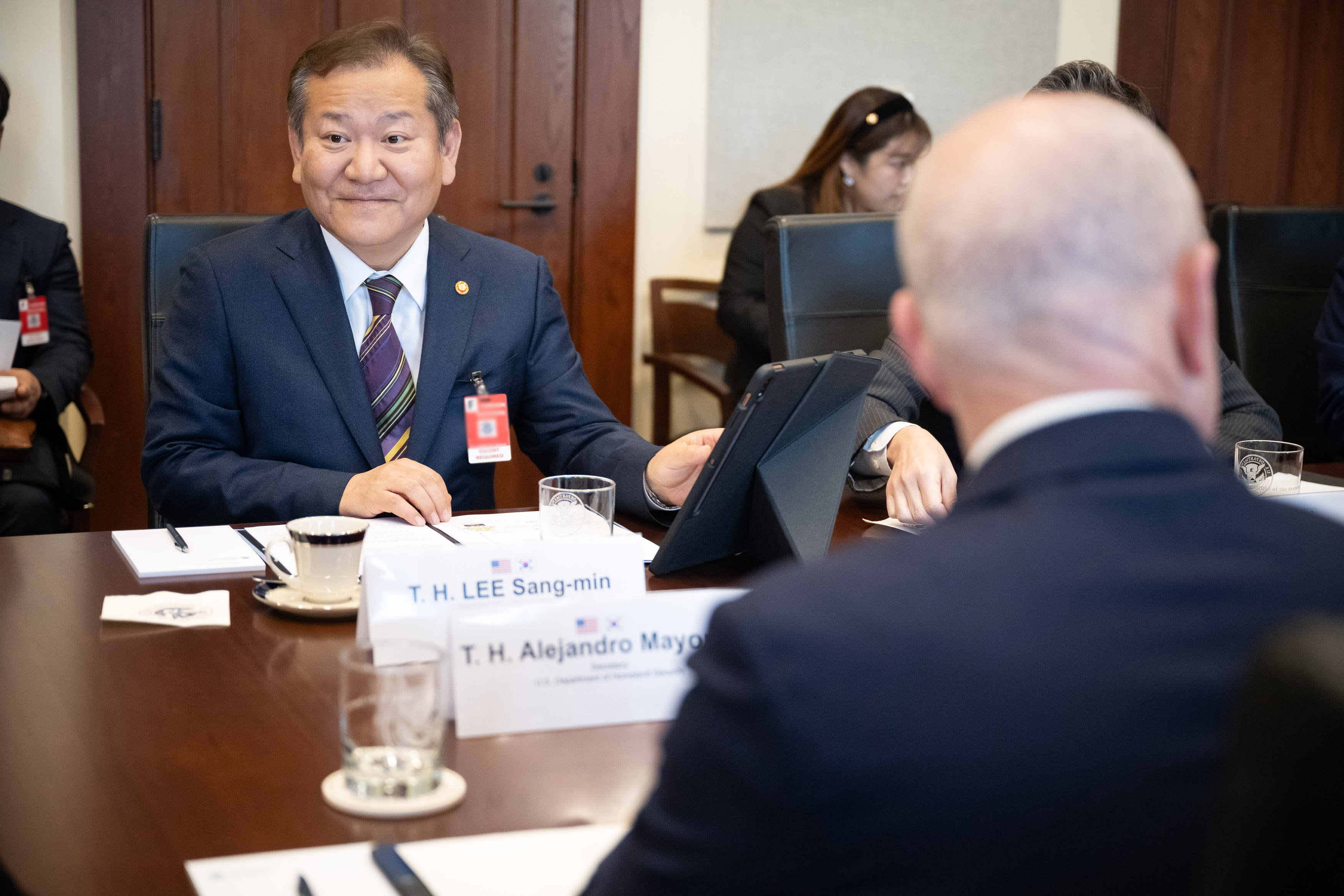
The Seoul Central District Court on Thursday sentenced former interior and safety minister Lee Sang-min to seven years in prison for his participation in the insurrection connected to former President Yoon Suk Yeol’s brief imposition of martial law on December 3, 2024.
The Seoul Central District Court convicted Lee of playing a key role in the attempted rebellion by relaying presidential orders to police and fire authorities to cut electricity and water supplies to media outlets critical of the administration. The three-judge panel held that Lee’s actions contributed to an effort to suppress dissent and extend military rule, stating that such conduct undermined democratic principles and warranted significant punishment. Prosecutors had requested a 15-year sentence.
The instructions targeted at least five news organizations, including outlets deemed oppositional, but were not implemented because martial law was lifted within hours. Lawmakers overcame military and police blockades to enter the National Assembly and voted unanimously to nullify the decree.
Lee, who has been detained since August 2025, denied criminal intent during the trial, asserting he followed lawful executive directives without knowledge of any unconstitutional plan. His defense team indicated an appeal is forthcoming.
Opposition groups hailed the verdict as essential accountability for threats to democracy, while supporters of the former administration criticized the prosecutions as partisan retribution.
The ruling marks the second conviction of a senior Yoon cabinet member in connection with the events. Former Prime Minister Han Duck-soo received a 23-year sentence in January for his involvement.
The martial law episode unfolded when Yoon invoked emergency powers under Article 77 of the Constitution, claiming opposition forces had engaged in anti-state activities. Troops were deployed to the National Assembly, civilian governance was suspended temporarily, and attempts were made to restrict media access. The measure ended early on December 4 after the assembly’s override.
Yoon was impeached by the National Assembly in December 2024, removed by the Constitutional Court in March 2025, and arrested in January 2025. He faces separate trials, including one for rebellion, where prosecutors seek the death penalty.
In a related case on January 16, Yoon was sentenced to five years for abuse of power, document forgery, and obstruction of justice. A verdict on the primary insurrection charges is expected on February 19, 2026.
The proceedings underscore judicial scrutiny of executive overreach and the criminal accountability of officials who execute unlawful orders. The cases test South Korea’s constitutional mechanisms for preventing abuse of martial law authority, and proceedings are widely viewed as a test of South Korea’s democratic institutions and the judiciary’s ability to address high-level attempts to subvert the constitutional order.
Lee’s conviction brings the total number of senior officials sentenced in the martial law cases to at least two, with dozens more former ministers, military commanders, and aides still facing trial. The outcomes may influence future interpretations of emergency powers and cabinet liability in constitutional crises.

_Secretary_Alejandro_Mayorkas_met_with_Lee_Sang-min,_Republic_of_Korea_Minister_of_the_Interior_and_Safety_in_Washington,_D.C._on_16_November_2023_-_5.jpg)