
 Dispatches
Editor’s note: This story is part of ongoing coverage of the lead up to Mangione’s trial. Read Day 1, Day 2, Day 3, Day 4, Days 5-7, Day 8, and Day 9 of suppression hearings on the case.
Luigi Mangione’s federal criminal trial could begin as soon as October 2026.
On January 9, Judge Margaret Garnett of the Southern District of New York outlined a tentative schedule for the case. The final dates largely rest on unresolved questions surrounding the applicability of capital punishment and predication of a federal interstate stalking statute for death-eligible charges.
Mangione faces a four-count federal indictment in US v. Mangione, where he is charged with interstate stalking and murder through use of a firearm with a silencer and muffler. He also faces capital punishment under a murder through use of a firearm charge and pleaded not guilty to all federal charges in December 2024.
The defense motioned to dismiss counts containing the murder through use of a firearm (count three) and firearms offense (count four) charges of the indictment. These counts rely on a federal interstate stalking statute as the predicate “crime of violence,” a classification that makes the case eligible for the federal death penalty.
If Judge Garnett grants the defense’s motion to dismiss the death-eligible counts, the case would no longer be a capital case, potentially simplifying proceedings but opening the door to an immediate appeal by the government to the US Court of Appeals for the Second Circuit.
If Judge Garnett denies the motion to dismiss the death-eligible counts, she would then address the defense’s motion to dismiss the death penalty based on unconstitutionality.
If the death penalty remains, voir dire is tentatively scheduled for late 2026, with trial starting in January 2027. Capital trials take longer to prepare for and screening for death-qualified jurors can further complicate proceedings.
If the death penalty is precluded, voir dire is tentatively scheduled for September 2026, with trial commencing in October 2026.
“I’m well aware of the time that jury selection took in the Saipov case, but I don’t think, given the procedures I intend to use, that we need three months,” Judge Garnett said.
US v. Saipov was the last capital case in the Southern District of New York. Sayfullo Saipov was indicted and convicted in 2023 on 28 counts for driving a 6,000 pound truck into civilians on a Manhattan street in the name of ISIS, killing eight. The jury deadlocked on Saipov’s death penalty during the sentencing phase, leading to the automatic alternative of life without parole.
Judge Garnett’s announcement also clarified that voir dire in US v. Mangione may not take as long as some expected, due to potential jury nullification and stealth jurors. It also likely indicates that the court will use judge-led voir dire, which is common in federal criminal cases and can be more time-efficient because it allows both sides to submit questions ahead of time.
During proceedings, prosecutors and defense counsel argued suppression issues and a defense motion to dismiss the two counts—murder through the use of a firearm (count three) and the firearms offense (count four)—that render the case capital-eligible.
Judge Garnett made clear that her forthcoming written rulings—particularly on whether the charged stalking offense qualifies as a “crime of violence”—would determine whether the case proceeds as a capital prosecution, significantly shaping trial timing and structure.
Courtroom atmosphere and public response
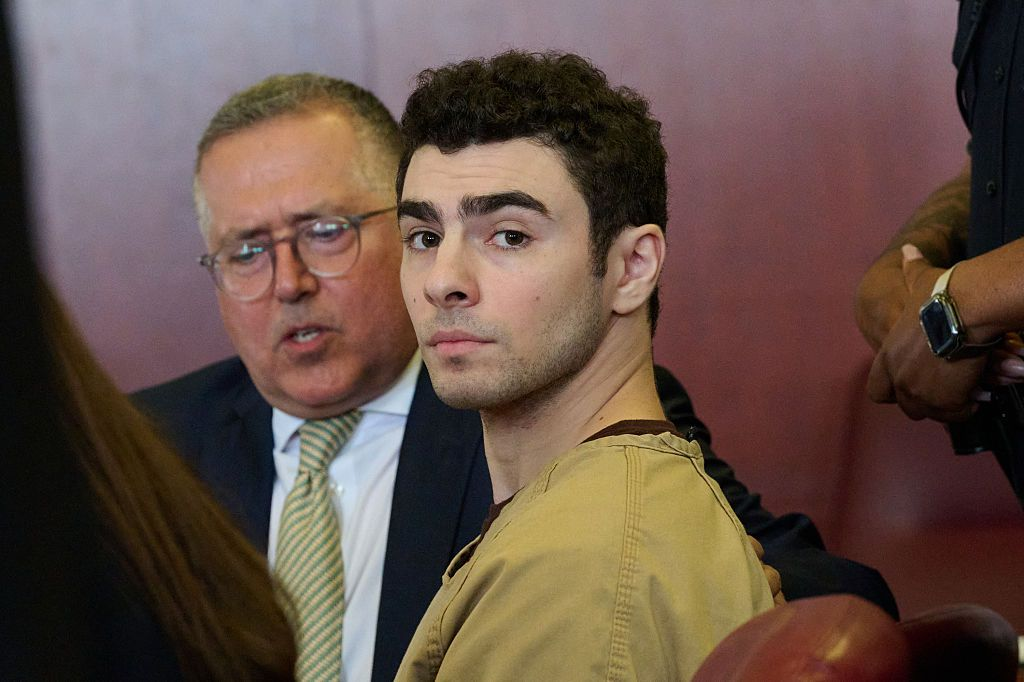
Mangione appeared in court wearing tan prison garb layered over a maroon undershirt and cream long-sleeve shirt. His ankles were shackled, though his wrists were uncuffed, and he took notes intermittently as counsel argued.
He sat between his attorneys Marc and Karen Friedman Agnifilo, with appellate specialist Paresh Patel added to the defense team for the January 9 hearing.
Public interest in the proceeding was pronounced. The first member of the public lined up outside the courthouse as early as 7 AM the previous day. Outside, death-penalty opponents gathered holding signs reading “No Death for Luigi Mangione.”
A billboard truck circulated nearby with rotating messages criticizing the government’s pursuit of capital punishment in the case. One message alleged conflicts of interest involving Attorney General Pam Bondi and UnitedHealth Group, while others described the death penalty as “inhumane” and “unconstitutional.”
Suppression disputes: notebook and backpack
The conference opened with discussion of Mangione’s suppression motions, focusing on whether law enforcement officers unlawfully searched and read the contents of a notebook recovered from Mangione’s backpack at the time of his arrest in Altoona, Pennsylvania.
Defense counsel Jacob Kaplan argued that while officers may have been permitted to safeguard Mangione’s personal property, they exceeded the bounds of any lawful inventory search by reading the notebook without a warrant. Kaplan analogized the notebook to digital devices, contending that inventory procedures allow officers to record the existence of an item but not to examine its contents.
“It would not give them the right to go ahead and read the journal,” Kaplan said.
Prosecutors countered that no suppression hearing was necessary because the government does not intend to rely on any notebook contents viewed during the initial encounter. Instead, assistant US attorneys argued that the notebook was later searched pursuant to a judicially authorized warrant that expressly covered handwritten materials and did not rely on any prior reading of its contents.
“The Government searched the contents of the defendant’s notebook pursuant to a judicially authorized search warrant,” prosecutor Sean Buckley wrote in an earlier filing, adding that the warrant was supported by probable cause independent of any earlier review.
Judge Garnett appeared skeptical that an evidentiary hearing was required. Emphasizing that suppression analysis turns on whether evidence the government seeks to introduce at trial must be excluded, she stated, “The only relevance of this question is if the US has evidence it intends to offer at trial against Mr. Mangione, and if it should be suppressed. I don’t see a need for a hearing.”
A related dispute concerned whether police lawfully took and searched Mangione’s backpack after officers moved it several feet away from him during questioning. Kaplan argued that the backpack was no longer within Mangione’s control at the time of arrest, rendering subsequent inventory procedures improper.
Judge Garnett rejected the premise that officers must leave personal property behind when arresting a suspect in a public place. “If you’re arrested in a public place, police are supposed to safeguard your personal property,” she said, questioning what officers were expected to do with items a defendant identifies as his own.
“At present, I don’t think a hearing is necessary,” Judge Garnett concluded, though she stated she would continue to review the arguments. She added that if she changes her mind, the court will “schedule that within the next couple of weeks.”
On January 12, she changed course and granted the defense an evidentiary hearing for an Altoona Police Department officer to testify on procedures related to safeguarding, and potentially inventorying, personal property of a person arrested in a public space. In explaining the shift, Judge Garnett stated that she considered both sides of the argument and the “seriousness of the charges the Defendant is facing.”
Motion to dismiss and the death-eligible counts
The central legal dispute of the conference concerned the defense motion to dismiss counts three and four of the indictment.
Defense counsel Paresh Patel argued that the stalking statute does not qualify as a crime of violence as a matter of law because it can be violated without the use, attempted use, or threatened use of physical force against another person. Patel emphasized how the statute criminalizes acts that place a victim in reasonable fear through harassment, including conduct involving threats of self-harm, rather than violence against others.
“The only intent here is the intent to harass,” Patel argued. “How do we get to murder from intent to harass?”
Judge Garnett pressed Patel on the significance of the “death resulting” element, which the government must prove beyond a reasonable doubt to the jury.
Patel acknowledged that death resulting is an element but argued that the statute does not require intent or even knowledge with respect to the death, making accidental or unintended deaths legally sufficient.
The absurdity doctrine enters the discussion
As arguments unfolded, Judge Garnett repeatedly raised hypotheticals testing the outer bounds of the statute. She posed scenarios involving nonviolent harassment, threats lacking intent to harm, and even hypotheticals in which a victim’s death results from fear-induced self-harm or medical distress rather than from any violent act by the defendant.
In one example, Judge Garnett asked whether a defendant could face death-eligible charges if a victim with a medical condition died after becoming frightened by nonviolent conduct, such as blocking a driveway or sending repeated messages.
In another, she questioned whether a threat such as “I’ll burn down the house,” where harm is indirect or speculative, could transform stalking into a crime of violence.
“These are serious issues,” Judge Garnett said, noting that the stalking statute was drafted primarily to address domestic stalking and harassment scenarios—a legislative purpose that may be “at a lot of tension” with the statute’s use as a predicate for capital murder.
The defense argued that reading the statute literally to encompass such scenarios would produce absurd results, effectively converting a broad harassment statute into a gateway for the death penalty. Patel maintained that courts should resist interpretations that allow capital eligibility to hinge on unforeseeable or accidental outcomes divorced from violent intent. The argument appealed to the absurdity doctrine, which allows judges to disregard a statute’s plain language to avoid an “absurd” outcome.
Prosecutors countered that the statute is divisible and that the government would rely only on provisions involving threats of violence. Assistant US Attorney Jun Xiang argued that courts routinely interpret statutes to avoid criminalizing innocent conduct by reading in mens rea requirements where appropriate.
Judge Garnett acknowledged that courts often imply a culpable mental state when a statute is silent but questioned whether such judicial narrowing is sufficient where the statute’s structure allows for far-reaching applications. She emphasized how applying the death penalty based on such an expansive reading could raise profound constitutional and interpretive concerns.
No ruling from the bench
After extensive arguments, Judge Garnett declined to rule from the bench, emphasizing the gravity of the issues and their potential consequences for the case’s trajectory.
“As you can tell from the time I took, I think this is a serious issue,” she said. “I’m not going to decide it today.”
Afterwards, Mangione appeared agitated, crossing his arms and holding a vexed facial expression.
The prosecution then stated that it plans to introduce expert witnesses at trial.
Likewise, the defense stated that it needed more time for capital trial preparation since it is using mitigation and jury specialists currently working on US v. Gendron. Gendron is the sole death penalty case authorized by Attorney General Merrick Garland during the Biden administration, where the defendant fatally shot ten Black individuals in a racially motivated attack in a Buffalo, New York, supermarket. Gendron’s federal trial is currently scheduled for 2026.
Judge Garnett set another conference for January 30 at 11 AM to discuss next steps.
