
Victor Qiu is a JURIST Washington, D.C. correspondent and an attorney. The views expressed in this article are his own and in his personal capacity.
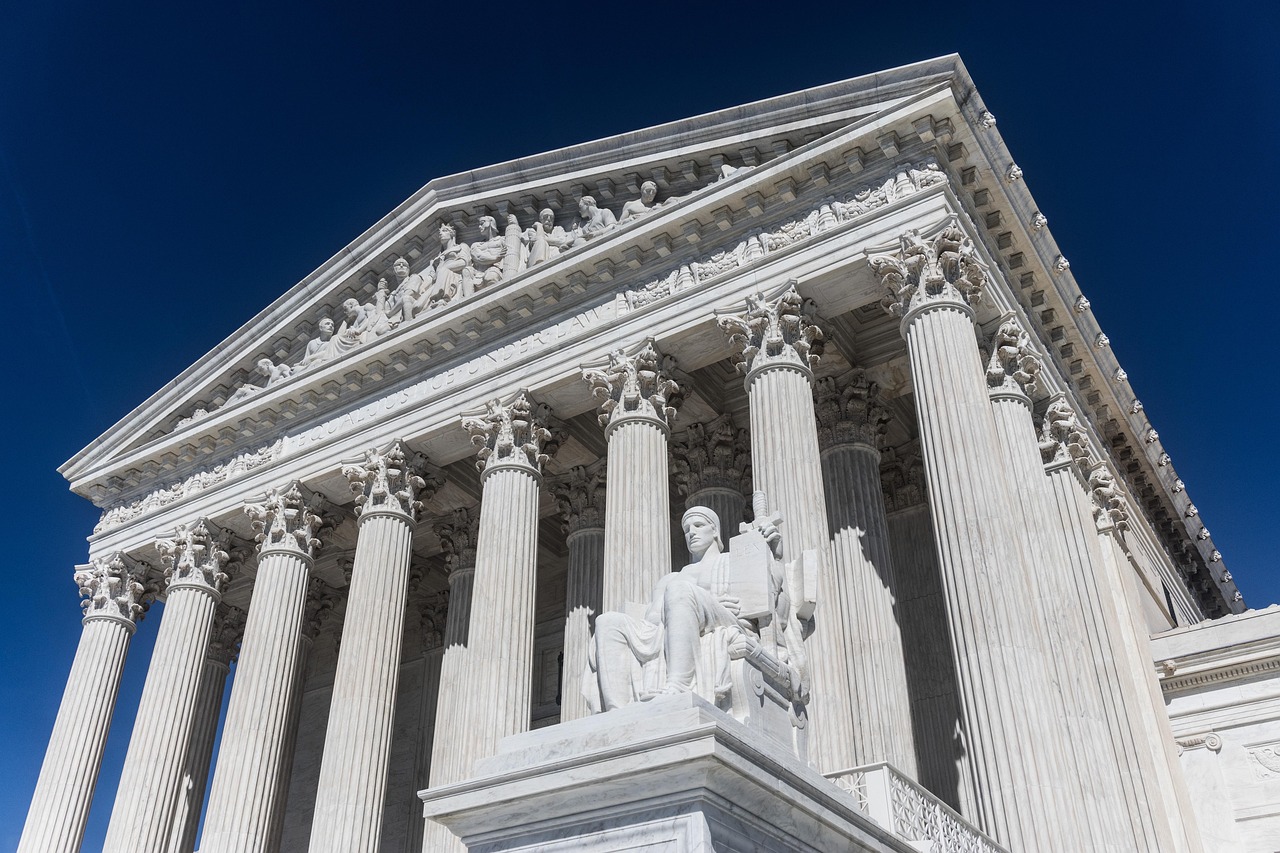
On the morning of Wednesday, January 21, I attended the oral argument for Donald J. Trump, et al. v. Lisa D. Cook at the US Supreme Court. When I arrived outside the Court, there was a single demonstrator standing in front of the building steps. However, this high-profile case attracted significant media and political attention. Media lined the sidewalk with television cameras facing a podium affixed with the House of Representatives seal. Inside the Court, the press section, bar section, and the public gallery were all full. From my seat, I saw Governor Cook walk down the center aisle and take her seat in the front, behind the counsel’s table.
Shortly before 10 a.m., the Justices entered the courtroom and took their seats. Before oral argument began, sponsoring attorneys read out loud the names of several groups of lawyers to be admitted to the Supreme Court Bar. The Chief Justice granted the motions to be admitted, and oral arguments began.
Trump v. Cook revolves around the Federal Reserve Act, which establishes the structure of the Federal Reserve’s Board of Governors. Fed governors are nominated by the President and confirmed by the Senate for staggered terms of 14 years. They can be removed by the President “for cause,” a term that the Federal Reserve Act of 1913 does not define. The respondent in this case, Lisa Cook, is an economist who was confirmed to be a Fed governor in 2022.
In August 2025, President Trump fired Cook in a letter, citing “gross negligence in financial transactions” stemming from alleged mortgage fraud. Cook filed suit in the U.S. District Court for the District of Columbia, and Judge Jia M. Cobb granted Cook’s motion for a preliminary injunction, which allowed Cook to remain in office while the litigation worked its way through the courts. The Justice Department appealed to the Court of Appeals for the D.C. Circuit, which denied their request for a stay of the injunction and left Judge Cobb’s ruling in place.
The Justice Department then filed an application with the Supreme Court to stay Judge Cobb’s ruling and allow the President to remove Cook. The Court declined to grant the stay, which allowed Cook to remain in office. Technically, the issue before the Court is whether it should stay the district court’s ruling or leave it in place. On a practical level, the substantive issue is whether courts can review the President’s determination that “cause” exists to remove a Fed governor.
Solicitor General D. John Sauer, representing President Trump, began by summarizing Cook’s alleged mortgage fraud, arguing that such behavior impugns her “conduct, fitness, ability, or competence to serve” as a Fed governor. Sauer highlighted that this case was the first instance in the nation’s history in which a preliminary injunction halted the President’s decision and reinstated a Fed governor to office.
The Justices began with questions about the factual background of the case – the alleged mortgage fraud. Chief Justice John Roberts focused on whether the President’s determination of cause – the alleged mortgage fraud – was unreviewable. Justice Sonia Sotomayor asked whether the “cause” includes pre-office conduct and whether a nexus is required between pre-office conduct and post-office conduct. Sauer responded that while there is judicial review in some cases, “there would be deference to the President” in determining cause. Sauer reminded the Justices that the preliminary injunction granted by the district court was “unprecedented” and that the Court held in In re Sawyer that a “preliminary injunction was not available to restore an officer.”
Justice Amy Coney Barrett inquired whether the court should take into account the nature of the accused crime, such as if the accusation was of “murder or something like that.” Reinforcing his “nexus” argument earlier, Sauer urged the Court to recognize the “close nexus” between the alleged conduct and Cook’s role, noting that Fed governors set interest rates for the country, and Cook was allegedly “getting favorable interest rates for herself.”
As this case arrived at the Supreme Court through an emergency application, the factual record is thin and not fully settled. Justice Samuel Alito noted some concern that this case was handled “in such a hurried manner” and that “no court has ever explored those facts.” Justice Neil Gorsuch and Justice Elena Kagan probed Sauer further as to what would constitute a hearing in which Cook could present evidence. Sauer reiterated that the President’s position is that Cook had due process through public notice of the firing in the “Truth Social post and the removal letter.” Concluding his argument with a nod to the nation’s tradition that the President has the authority to remove officers, Sauer reiterated that the preliminary injunction handed down by the district court was inappropriate.
Then, Paul Clement, attorney for Lisa Cook, stepped up to the podium. References to history seemed to be a recurring theme in his oral argument. Clement began by stating that the Federal Reserve is a “uniquely structured entity with a distinct historical tradition.” Justice Clarence Thomas asked Clement what a hearing would look like in his view. Clement responded that proper review could have been “notice” and an “opportunity for a hearing before an impartial tribunal.”
The Justices asked Clement questions on similar themes to those they asked Sauer in his argument. Justice Brett Kavanaugh asked what judicial review would look like in this case. Clement noted that he agreed with Sauer that it was not up to the Supreme Court to dictate the rules, but suggested that the Court could create a path for the Executive Branch to pursue a more protective and insulating process, such as a formal hearing.
Justice Ketanji Brown Jackson suggested to Clement that a hearing or circumstance may be needed to establish the facts, and Clement agreed. Towards the end of Clement’s argument, Justice Jackson scrutinized whether notice on Truth Social was “sufficient notice” to remove a Fed governor for cause. Clement made a final point that while this notice on social media is not the traditional notice forum, the issue is that, here, the President’s notice prejudged the matter.
As I left the Court through the side exit, two demonstrators stood in front, while members of the media gathered along the sidewalk, hoping to speak with Cook.
A decision is expected in the next few weeks or months, given the emergency nature of this case. Until then, Cook will continue to serve as a member of the Federal Reserve Board of Governors.
