
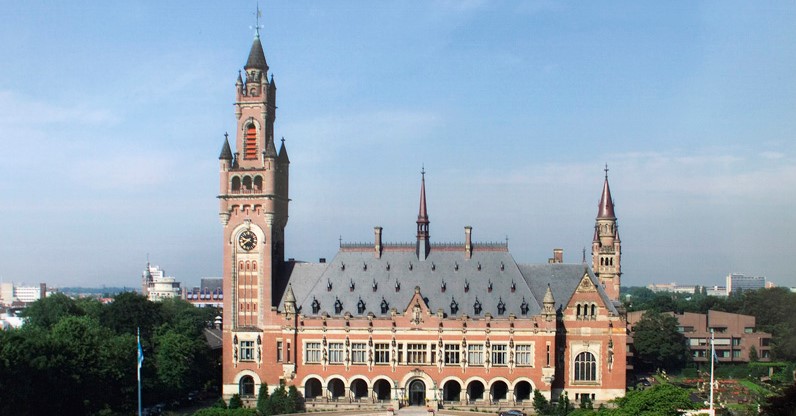
Myanmar on Friday began its defense before the International Court of Justice (ICJ) in the ground-breaking genocide case brought by the Gambia, rejecting all allegations of genocide against the Muslim Rohingya minority.
Myanmar’s agent Ko Ko Hlaing emphasized Myanmar’s recognition of the 1948 Convention on the Prevention and Punishment of the Crime of Genocide, but said the country did not breach any of its obligations under international law. He stated: “A finding of genocide would place an indelible stain on my country and its people. These proceedings are of fundamental importance for my country’s reputation and future.”
He noted that the military operations carried out in northern Rakhine state in 2016 and 2017 were counter-terrorism operations, and were not carried out with genocidal intent. Furthermore, he rejected the claim that Myanmar denies the existence or rights of the Muslim population in northern Rakhine state. But he added: “Myanmar considers that Bengalis in northern Rakhine State are culturally, ethnically and religiously part of the same group as the population living immediately across the border in Bangladesh.”
Stefan Talmon, an international law professor at the University of Bonn, also spoke on behalf of Myanmar. Professor Talmon’s argument rested on the high burden and standard of proof for establishing a breach of the Genocide Convention. He argued that the Gambia, which brought the case against Myanmar, must meet the highest standard of proof, “beyond a reasonable doubt.” Talmon additionally questioned the validity of the Gambia’s argument on the grounds that it does not follow precedent established in the Bosnia v Serbia and Croatia v Serbia cases. He asserted that the Gambia’s argument is inductive, as opposed to the deductive approach used in the prior cases.
The ICJ has traditionally set a high bar for establishing genocide. The only time it has found a violation of the Genocide Convention was regarding the Srebrenica Genocide during the Bosnian War. However, the court held that Serbia only breached its obligation to prevent genocide but had not directly committed genocide.
The Gambia’s case alleges that Myanmar’s armed forces have conducted widespread and systemic “clearance operations” against the predominantly Muslim Rohingya population with genocidal intent. Violence in northern Myanmar has led to over a million Rohingya displaced to a Bangladeshi refugee camp. The case began in November 2019, when the Gambia requested that the court begin proceedings against Myanmar under the Genocide Convention. In 2020, Myanmar was ordered to halt and prevent all genocidal acts against the Rohingya.
The Gambia’s case against Myanmar is the first instance where a state not affected by the facts at issue has brought proceedings under the Genocide Convention. The case serves as important precedent for South Africa’s application against Israel, in which South Africa charges that Israel’s actions against Palestinians amount to genocide.

