
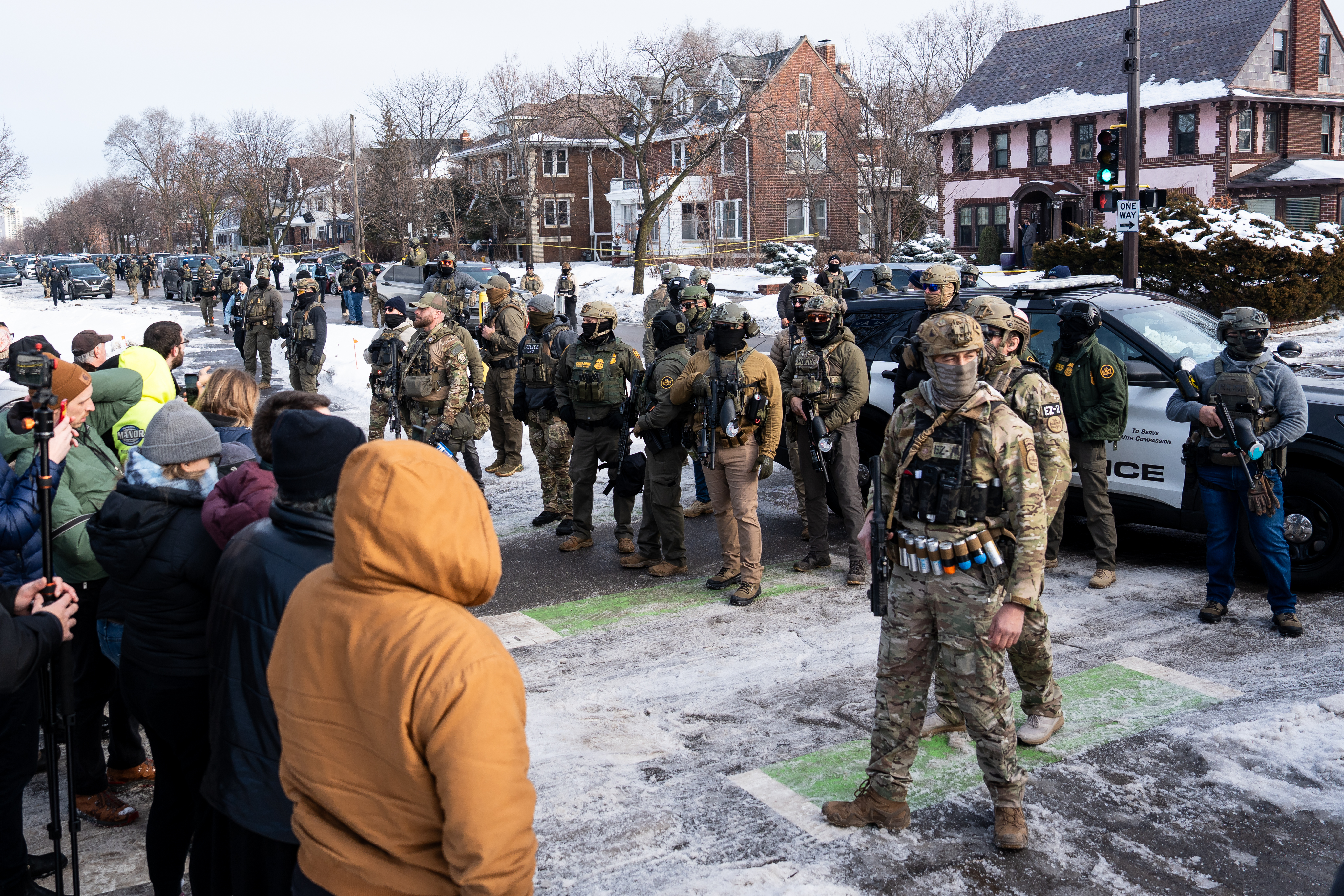
The US District Court for the District of Minnesota on Friday granted in part and denied in part a motion for a preliminary injunction brought by six individuals who say federal immigration agents unlawfully arrested, stopped, threatened and/or used chemical irritants against them while they observed, recorded, and protested immigration enforcement activity in the Twin Cities of Minneapolis and Saint Paul.
The court order prohibits agents from retaliating against individuals engaged in “peaceful and unobstructive protest activity” and from arresting or detaining such persons “in retaliation” absent probable cause or reasonable suspicion that the person committed a crime or interfered with covered officers. The court also barred the retaliatory use of pepper spray or similar tools against peaceful, unobstructive protesters and observers.
The ruling further restricts vehicle stops in the context of protests, holding that the “act of safely following” federal agents “at an appropriate distance” does not, by itself, provide reasonable suspicion to justify a stop. The order requires defendants to disseminate the injunction broadly to covered agents by distributing it to all covered federal agents within 72 hours and to newly deployed agents who arrive in Minnesota to participate in the operation.
The plaintiffs sued Department of Homeland Security (DHS) Secretary Kristi Noem and senior officials from Immigration and Customs Enforcement (ICE) and its Enforcement and Removal Operations (ERO) arm, alleging that the government’s “Operation Metro Surge” has produced “an unprecedented increase” in federal law enforcement presence in Minnesota. The plaintiffs also claimed that agents have responded to community observers with intimidation, force and detention.
Plaintiffs submitted videos depicting the escalation at a traffic stop and arrest. The court pointed to footage indicating that a plaintiff “does not appear to resist” as officers take him down and place him in a vehicle, while defendants alleged that he led a hostile crowd and threw objects at officers. The court found that, at this stage, the plaintiffs had demonstrated a fair chance of success that protected activity was a motivating factor in the adverse action.
Plaintiff Alan Crenshaw alleged that he was pepper-sprayed “right in the face” while standing on the side of the road in a crosswalk observing ICE activity, describing intense pain and lingering symptoms. Multiple witnesses described pepper spray directed at observers who were “recording, chanting, shouting, and blowing whistles” and not blocking vehicles.
Defendants claimed chemical irritants were used to clear blocked traffic after warnings, but the court found plaintiffs showed a likelihood of success that irritants were used in ways that could support retaliation claims in some circumstances. The court also found plaintiffs showed a likelihood of success that federal agents violated the Fourth Amendment by stopping their vehicles without “reasonable, articulable suspicion.”
A major legal issue was whether plaintiffs’ conduct, such as observing, recording, and sometimes following law enforcement vehicles, constituted protected First Amendment activity. Defendants relied on Molina v. City of St. Louis to argue there is no protected right to observe law enforcement, but the court rejected that framing at this stage. It explained that Molina was a qualified-immunity case about whether a right was “clearly established” at the time, and that inquiry is “separate” from whether a right is constitutionally protected.
The injunction remains in effect until Operation Metro Surge concludes or changed conditions render it unnecessary, and the court authorized either party to seek modification. The court also denied defendants’ request for a stay pending appeal, noting defendants did not address the governing stay factors and therefore did not meet their burden.
Operation Metro Surge was launched in early December 2025 and has involved a major scale-up of immigration enforcement, with DHS deploying thousands of immigration agents to the Minneapolis-Saint Paul area amid heightened public attention and protest activity. Tensions escalated sharply after an ICE agent fatally shot Renee Good on January 7, an incident that prompted widespread demonstrations and scrutiny of federal law enforcement tactics in Minnesota. Local officials have already limited federal use of city resources for civil immigration activity, including Minneapolis Mayor Jacob Frey’s restriction on using city property as a staging area for immigration enforcement operations.

