
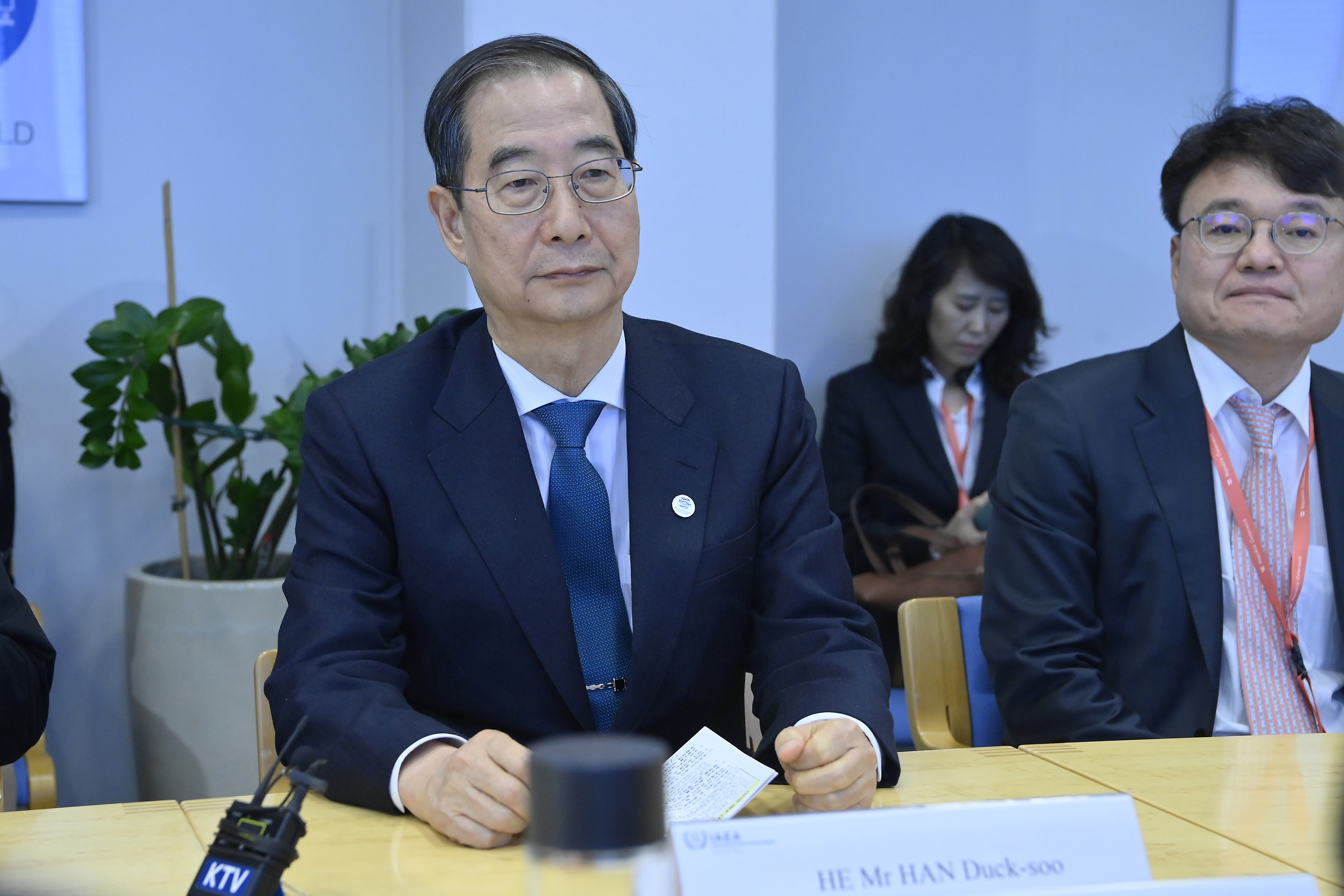
Former South Korean Prime Minister Han Duck-soo was sentenced to 23 years in prison on Wednesday after a Seoul court found him guilty of rebellion for his role in former President Yoon Suk Yeol’s declaration of martial law in December 2024. The sentence exceeded the 15 years sought by the special counsel and marked the first rebellion conviction of a senior official from the Yoon administration.
Streamed live in a televised ruling, the Seoul Central District Court held that Yoon’s imposition of martial law constituted an act of rebellion against the constitutional order. The court found that the deployment of troops and police to the National Assembly and election offices amounted to an unlawful use of force designed to suppress democratic institutions.
It grounded its ruling in Article 87 of the Criminal Act, which defines insurrection as collective violence intended to eliminate state authority or undermine the constitutional order in whole or in part. Presiding Judge Lee Jin-gwan held that the conduct surrounding the December 3 martial law declaration met that threshold. According to Lee, the issuance of an unconstitutional decree, combined with the deployment of military and police forces to seize control of the National Assembly, the National Election Commission, and other state institutions, amounted to insurrection under the statute.
The court concluded that Han played a central role by attempting to legitimize the decree at a Cabinet Council meeting, thereby providing procedural cover for an unconstitutional act. Presiding Judge Lee Jin-gwan warned, “Because of the defendant’s action, the Republic of Korea could have returned to a dark past when the basic rights of the people and the liberal democratic order were trampled upon, becoming trapped in the quagmire of dictatorships for an extended period.”
The court found that Han deliberately enabled the martial law decree by ensuring the Cabinet meeting met the legal quorum. Rather than intervening to delay or blocking the process, Han convened the meeting with only the minimum number of ministers required to make the declaration formally valid. Judges also pointed to Han’s conduct during the meeting. The court cited testimony that Han used hand signals to indicate the numbers four and one to another minister, confirming that a quorum had been reached. The panel interpreted the gesture as active coordination to move the plan forward, rejecting arguments that Han was attempting to restrain or oppose the declaration.
Han may appeal Wednesday’s conviction and has consistently argued that he opposed President Yoon’s plan to impose martial law. He told the court that he warned Yoon against the move and rejected claims that he actively participated in its execution.
Yeol declared martial law through Art. 77 of the South Korean constitution on December 3, 2024, triggering the rebellion case that now sits before the Seoul Central District Court. Prosecutors have charged Yoon as the architect of the scheme and are seeking the death penalty. The court is scheduled to rule on former President Yoon’s rebellion charges on February 19.
Following the declaration, the Yongsan Presidential Office confirmed receipt of the National Assembly’s impeachment resolution against Yoon on December 14, 2024. On the same day, Prime Minister Han Duck-soo assumed office as Acting President. Han’s tenure was short-lived. On December 27, 2024, the National Assembly submitted and unanimously passed an impeachment motion against him, suspending him from his duties as Acting President amid allegations tied to the martial law process.
The ruling, among other recent high-profile rulings surrounding the martial law crisis, is widely seen as a legal benchmark for pending cases tied to the December 2024 declaration. Courts are expected to rely on the reasoning in Han’s judgment, setting the stage for rebellion charges against Yoon and other former officials implicated in the same events.

_(52882965052).jpg)