
 Dispatches
Luigi Mangione is accused of fatally shooting Brian Thompson, CEO of medical insurance company UnitedHealthcare, on December 4, 2024, outside a Manhattan hotel in New York state. He faces a nine-count indictment including second-degree murder, where he faces a maximum of 25 years to life in prison, and multiple weapons offenses. Mangione was arrested on December 9, 2024, in Altoona, Pennsylvania—a city approximately 280 miles from New York City—five days after the shooting. While the arrest occurred in Pennsylvania, he is being prosecuted in New York state, where the alleged crime took place. The suppression hearings—pre-trial proceedings where a judge decides what evidence can be used at trial—determined what evidence from his Pennsylvania arrest can be used in the New York trial. Mangione pleaded not guilty to all charges in late December 2024.
Suppression hearings continued into Week Two, with prosecutors calling multiple Altoona Police Department (PD) officers to justify the December 9, 2024 detention, arrest, and search of Mangione at a McDonald’s restaurant in Altoona. The defense is seeking to suppress key evidence, including statements made to law enforcement and a backpack allegedly holding a 9-millimeter Glock handgun, magazine, suppressor, and a separate 9-millimeter hollow-point round.
Across three days of testimony, the prosecution and defense examined witnesses slightly faster after Judge Gregory Carro warned both sides, “this isn’t the trial” and to thus “move it.” Officers defended what they characterized as a lawful investigative detention that evolved into a custodial arrest for Pennsylvania forgery and false-identification offenses, followed by a warrantless search of Mangione’s backpack under search incident to arrest—a legal exception to the warrant requirement that allows police to search a person and their belongings when arrested. Mangione’s defense counsel pressed a competing narrative: that Altoona police acted from the outset on suspicion that Mangione was the New York shooter, relied heavily on media coverage rather than confirmed intelligence, and conducted a search without a warrant.
DAY 5
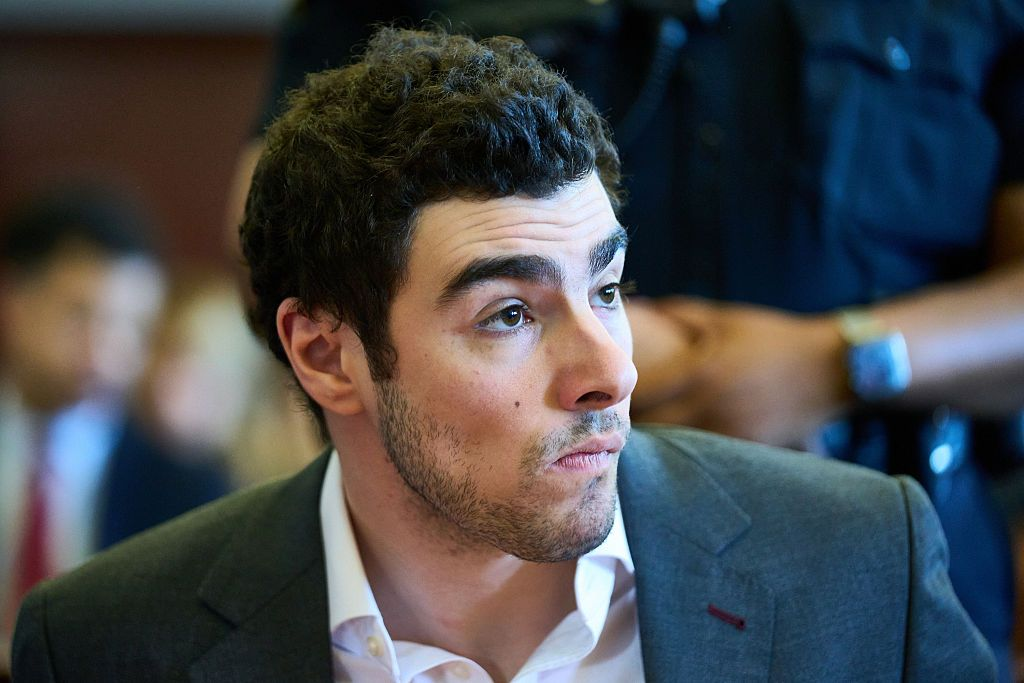
Mangione appeared for Day 5 in a dark navy suit with a blue gingham button-down shirt as prosecutors called Stephen Fox, an Altoona patrolman and K9 handler, as their primary witness. Fox testified that he is a former US Marine currently assigned to the Altoona Police Department, where he works with a narcotics-detection dog, a black lab named K9 Blue, on a Blair County drug task force. He stated he was trained in Pennsylvania criminal law and criminal procedure but acknowledged he had no training in New York law and no authority to enforce it. The prosecution has highlighted with all officer witnesses that New York and Pennsylvania have different laws regarding searches and seizures. Fox testified there was no joint investigation between the New York Police Department (NYPD) and Altoona PD regarding Thompson’s killing.
When asked about his familiarity with the UnitedHealthcare CEO shooting, Fox testified that he had seen coverage “on Fox News several times.” He described the killing as a “violent act of cowardery that attacked a defenseless human being,” adding that he was aware through media reports that shell casings allegedly bore engravings reading “deny, defend, depose,” and that the shooter appeared to use “a black handgun that appeared to have a suppressor.” Mangione’s defense attorneys objected repeatedly to Fox’s use of terms such as “execution” and “assassination,” with Judge Carro overruling, at one point stating, “we’re at a hearing, it has no effect,” meaning judicial proceeding rules are less stringent regarding potentially prejudicial statements since no jury is present and this was not a trial.
Fox testified that on December 9, he heard a Blair County, Altoona dispatch regarding patrons at a McDonald’s who believed they had spotted the “New York City CEO shooter.” He recalled hearing the name “Mark Rosario” relayed over dispatch and learning that the 911 center was “not getting a response” for that name because the initial identification document (ID) provided by the suspect was allegedly fake. Fox testified that this absence of confirmation prompted him to respond to the McDonald’s. Upon encountering Mangione, Fox testified that, “based on the way that he was sitting there…he wasn’t making eye contact…at this point I realized this most likely was the NYC shooter that we were dealing with.”
Fox said he informed Mangione that he was under “official police investigation” and warned him that providing false ID would result in arrest. Fox testified that Mangione admitted the ID was fake—an admission Fox characterized as establishing the crime of forgery under Pennsylvania law. Fox conducted a frisk and testified that Mangione told him he had “peanut butter” and “a knife” on his person beforehand. Fox stated that he then placed Mangione in investigative detention, describing it as “restricting” the suspect’s movements “by putting them in handcuffs.” Fox emphasized that Mangione was not in custody, which would trigger Miranda rights—the constitutional right to remain silent and have an attorney present during police questioning. In footage presented to the court, Fox can be heard telling Mangione that he was “not in custody.” Defense counsel highlighted that Mangione was surrounded by multiple officers, positioned against a wall, and physically unable to exit the area—facts they argued transformed the encounter into custody for constitutional purposes.
Fox testified that he read Mangione his Miranda rights. Under cross-examination, however, defense counsel emphasized that Fox read the warnings rapidly—”98 words in 15 seconds.” Defense counsel further elicited that Fox did not stop questioning after Mangione shook his head side-to-side, allegedly indicating that he wished to remain silent. Fox testified that he did not interpret Mangione’s head movement as an invocation of silence, but rather only saw a “flared cheek,” and continued the encounter. Mangione’s defense lawyer, Karen Friedman Agnifilo, pressed Fox on cross-examination, asking if he thought a side-to-side head shake didn’t mean no, and “you weren’t going to let him leave, were you?” Fox answered, “No, he wasn’t free to leave because of the false ID that he provided.” Non-verbal conduct can be sufficient for invoking the right to remain silent, meaning police must cease questioning.
Friedman Agnifilo pointed out that K9 Blue was a narcotics—not explosive—detection dog, and yet Fox still came to the McDonald’s. She probed, “Blue didn’t have the scent of the New York City shooter, but you decided to respond anyways,” to which Fox affirmed.
Fox testified that he was the officer who searched Mangione’s backpack with Officer Wasser, also present at the scene of Mangione’s arrest. He stated that officers were concerned the bag might contain something that could “harm human life,” particularly because the firearm used in the UnitedHealthcare CEO on shooting had not been recovered. Fox stated that Mangione’s bag was a “Faraday bag,” not a waterproof one as the defense claimed, since it had a lining that “blocks electronic signals from escaping.” Fox confirmed that multiple officers suggested obtaining a search warrant, including Corporal Trent, another officer present during the arrest, who stated “we should probably get a search warrant.” Fox testified that his superiors—particularly Sergeant Burns—directed officers that no warrant was required because the search was incident to a lawful arrest.
Fox testified that he transported Mangione to Blair County for arraignment. During the patrol car ride, Fox alleged that Mangione asked him and his Sergeant if the police were going to provide the name of the 911 caller to the press, stating it would be “bad for her” if this occurred. Fox also testified that Mangione “apologized for the inconvenience of the day.” Fox stated that Mangione seemed “genuine” on cross-examination by Attorney Friedman Agnifilo.
According to Fox, there was a large media presence outside of the Pennsylvania courthouse where Mangione was arraigned. In a surprise allegation, Fox stated that Mangione looked at the crowd and remarked, “all these people here for a mass murderer—wild.” Assistant District Attorney Joel Siedemann confirmed to JURIST that Fox’s testimony alleged that Mangione, not an officer, stated this. The prosecution asserted that they would not seek to introduce the statement during trial, and the statement would likely be barred from trial as hearsay—out-of-court statements offered to prove the truth of the matter asserted. Mangione’s defense has been reached for comment.
According to Rolling Stone, a US news and culture magazine, one day later and before his extradition hearing, Mangione shouted to reporters outside the Pennsylvania courthouse, “your coverage of this event is completely out of touch and an insult to the intelligence of the American people and their lived experience.” In court for the suppression hearings, I witnessed Mangione put his head in his hand when a witness said that Mangione had asked how the media perceived him.
Fox also described Mangione as tripping while shackled because Fox forgot that he was in ankle shackles. Fox testified that Mangione stated, “it’s okay, I’m going to have to get used to it.”
DAY 6
Mangione returned to court on Day 6 wearing a dark charcoal suit and blue pinstriped shirt, immediately exchanging large smiles with his counsel upon sitting at the defense table. Before new witnesses were called, Attorney Friedman Agnifilo objected to the prosecution’s handling of “graphic and sensitive” video exhibits, including a more than two-hour compilation of surveillance camera footage depicting the December 9 shooting, efforts to resuscitate United Healthcare CEO Brian Thompson, and civilian interactions with law enforcement. She argued that the footage had never been played in open court, was uploaded to a media file-sharing platform, circulated widely online—including on TMZ, a celebrity and crime news website, where it garnered over 1 million views—and served “no law enforcement purpose” in the suppression hearing. Mangione’s lawyers further argued the release was prejudicial to Mangione and “the People…plainly attempting to use this suppression hearing as a vehicle to litigate their case in the court of public opinion.” Judge Carro responded that the issue was not for him to address at that moment, and noted that if the video had been played in court, it would have been released to the press as a matter of course. He continued that, “we’re going to deal with it when we select a jury in this case [and] I don’t really see a problem with what has been discussed.” Mangione furrowed his brow during the colloquy.
Prosecutors next called Lieutenant William Hanelly, a patrol supervisor with Altoona Police Department. Lieutenant Hanelly testified that he heard the December 9 dispatch regarding a possible sighting of the UnitedHealthcare shooter at McDonald’s, noting that the responding officer initially reacted in a “sarcastic tone,” saying “10-4, we’ll get right on that.” Lieutenant Hanelly testified that he texted the officer to “treat the call seriously” considering the situation’s gravity. He clarified that at that time, officers only had reasonable suspicion—a legal standard allowing police to briefly detain someone based on specific observable facts suggesting possible criminal activity—regarding the New York homicide, as opposed to probable cause, which requires stronger evidence and allows for arrest. He emphasized that Altoona officers lacked jurisdiction to act on the New York case without an arrest warrant.
The prosecution also called Sergeant John Burns, head of Altoona PD’s narcotics unit. Burns testified that he directed officers that the backpack search was lawful as a search incident to arrest. Burns testified that although Corporal Trent had said they “probably” needed a search warrant, “It doesn’t matter he’s under arrest for a crime he committed here in Pennsylvania, so it’s a search incident to arrest.” He stated that once Mangione was lawfully arrested in Pennsylvania, officers had authority to search “everything,” both for officer safety and as part of an inventory search—a routine procedure to catalog a detainee’s belongings. “I didn’t respond to Corporal Trent because I’m not going to argue with Corporal Trent over a suggestion he made that we needed a search warrant, because we clearly did not,” Sergeant Burns stated.
Sergeant Burns described the subsequent documentation of items found in the backpack, including handwritten notes, a journal, electronic storage devices, a 9-millimeter Glock magazine, a 3-D-printed firearm, and a suppressor. He testified that officers photographed all items and did not read the contents of handwritten materials at the scene.
DAY 7
Proceedings resumed for Day 7 with testimony focused on the scope and legality of searches conducted following Mangione’s arrest. Mangione entered court in a dark navy suit and white button-down shirt, and the day’s testimonies centered on inventory searches, coordination between Pennsylvania and New York authorities, and disputed characterizations of currency officers seized at the time of Mangione’s arrest.
Officer Samuel McCoy testified that on December 9, 2024, he was acting as a field training officer. Officer McCoy testified that he became aware of something serious unfolding when he observed Lieutenant Hanelly exiting a building wearing a ballistic vest, which Officer McCoy described as unusual and indicative of a high-priority incident. Officer McCoy said another officer had “showed me a picture that he collected from the news of the defendant, and I recall seeing the eyebrows, and acknowledged that it was possible [that it was Mangione] at the time.” Officer McCoy testified that he asked Mangione whether he had any weapons, to which Mangione responded that he did not. Officer McCoy said Mangione did not disclose his possession of a knife at that time. Officer McCoy further testified that he immediately ceased questioning when Mangione indicated he did not wish to answer more her questions. During cross-examination, Mangine’s defense counsel emphasized that he had been compliant, non-belligerent, and did not resist officers. Officer McCoy agreed.
Sergeant Eric Heuston testified that he supervises detectives within the Altoona PD. Sergeant Heuston described becoming involved after learning that patrol officers were with a possible New York homicide suspect. Despite defense counsel’s repeated objections to using the term “execution,” Judge Carro allowed Sergeant Heuston to use the term “assassination” to describe the New York shooting. Surveillance video of the New York shooting was played in court. Mangione did not look up during its presentation. Sergeant Heuston testified that inventory searches include a person and any property they bring with them. He identified Mangione in court and described Mangione as looking wet, and appearing to have been outside for some time.
Testimony and exhibits detailed the items recovered from Mangione, including clothing, notebooks, handwritten notes, multiple backpacks, a USB flash drive, over $7,000 in US currency, foreign currency, and a note with a redacted cryptocurrency seed phrase—a string of words that serves as a password to access digital currency wallets. A Pennsylvania inventory record introduced by the prosecution listed “foreign currency $1,620” and “US currency $7,807.”
Sergeant Heuston testified that items without evidentiary value for the Pennsylvania forgery case were nonetheless preserved and transferred to New York Police Department custody because the murder investigation took precedence over the local forgery charge. He explained that Altoona authorities lacked authority to investigate the New York homicide and served as an intermediary for transferring evidence after receiving approval from the Blair County District Attorney. A search warrant executed later that evening authorized the transfer and seizure of Mangione’s property.
During Mangione’s arraignment, Attorney Friedman Agnifilo challenged officers’ testimonies concerning the amount of money they recovered from Mangione during his arrest. Sergeant Heuston testified that District Attorney Peter Weeks made reference to approximately $1,600 in “foreign currency” in his argument opposing the possibility of Mangione making bail. Mangione objected in court, countering that the amount was “less than $100.” Mangione’s defense team confirmed that Sergeant Heuston “took pictures of foreign money” and wrote in the Pennsylvania incident report that “the foreign currency was valued at $1,600.”
As Attorney Friedman Agnifilo confirmed this on cross-examination, Mangione squinted, tilting his head to the left, as he stared at the witness while smiling. He then whispered to another one of his defense lawyers, Marc Agnifilo, shaking his head “no” while laughing quietly. Sergeant Heuston testified that he was uncertain as to the exact amount of international currency, and said that he was not sure of the exchange rate at the time.
Attorney Friedman Agnifilo said the currency’s actual value was “less than $16,” which drew laughter from the courtroom. The court previously saw an exhibit of all the international currency Mangione had carried at the time of his arrest, which were 20 Thai Baht, 100 Thai Baht, 500 Indian Rupees, and 1,000 Japanese Yen.
Mangione’s Pennsylvania counsel, Thomas Dickey, has previously argued that Mangione should have received bail because the Pennsylvania Constitution provides that “all crimes are generally a ‘bailable offense'” and that a “bailable offense means you have to set some form of bail.” Attorney Dickey was present for the first two days of Mangione’s suppression hearings in New York.
