
 Dispatches
Yu-Yue Cheng is a JURIST correspondent in Taiwan and a law student at National Taiwan University.
I attended the 7th annual Taiwan Transgender March on the evening of October 24. Compared to the Taiwan Pride Parade held on the 25th, the Trans March was smaller and less known to the public.
People gathered at the historic 228 Memorial Park, marching through Ximen district of Taipei and then circling back. An estimated 3,000 people showed up despite the rain. I observed people waving huge trangender flags with pink, blue and white stripes, while people handed out flyers and stickers. The march, though centered in Taiwan, included a notable number of international participants. Beside the international crowd, many local human rights groups and university societies joined, including the Taiwan Alliance to Promote Civil Partnership Rights TAPCPR (台灣伴侶權益推動聯盟 and Taiwan Tongzhi (LGBTQ+) Hotline Association (台灣同志諮詢熱線協會). The participants called for an end to discrimination against transgender people, and the abolition of surgical procedures required to change one’s legal gender.
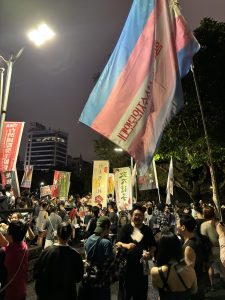
Photo captured by Yu-Yue Cheng.
Transgender Issues in Taiwan
Taiwan purports to be one of the most LGBTQ+-friendly countries in Asia, being the first to legalize same-sex marriage in 2019. However, transgender rights remain a rather marginalized topic. A lack of consensus and polarising views still haunts the debates on transgender issues, such as the requirements of changing one’s legal gender and the setting of unisex public toilets.
What are the legal challenges transgender people face in Taiwan? To put it simply, there has long been an absence of legislation regarding this. However, the courts in Taiwan hold a rather positive attitude in recognising transgender’s rights.
The administrative ruling by the Ministry of the Interior in 2008 requires people to submit several documents to change one’s registered gender: a diagnostic certificate signed by two psychiatrists, and proof of surgery that includes the complete removal of all genital organs.
This 2008 requirement has faced widespread criticism by human rights groups such as TAPCPR. TAPCPR has argued that the legitimacy of the administrative ruling is questionable compared to enacted legislation—especially when a policy concerns such a fundamental right. More importantly, the surgical requirements unduly burden some transgender individuals as some may face barriers to getting these surgeries due to economic or health conditions, or simply because other available measures (such as gender-affirming hormone therapy) are more suitable for them. Human rights groups and legal scholars have argued that a more flexible framework is needed, such as allowing individuals to choose between a certificate by psychiatrists, hormone therapy, or surgery. More emphasis should be placed on receiving assistance to change genders rather than offering “proof” of required medical “treatments” for transgender people. Professor Yi-Chien Chen advanced a similar argument in her 2022 policy research report.

Photo captured by Yu-Yue Cheng.
Despite inaction from the legislative and administrative branches, several court judgments have marked key milestones in advancing transgender rights in Taiwan. The Supreme Administrative Court ruled in favour of transgender individuals registering gender changes without undergoing surgeries. Specifically, the courts decided that the administrative ruling requiring surgeries is disproportionate, and violates the rights to health, personality, and human dignity—all of which are protected under the Constitution. While some courts have allowed complainants to change their legal genders without surgeries, these courts still require certification by two psychiatrists.
The courts in Taiwan have taken monumental steps in recognising transgender rights in Taiwan. However, a lack of enacted legislation makes the process of changing genders time-consuming—and even unpredictable—as each individual must first file their own lawsuit, then obtain an ultimate judgment to change genders without compulsory surgeries.
Despite the fact that many people showed up in support of the Trans March, trans rights in Taiwan remain unsettled, and still face much public opposition. As Trans March participants continue to advocate for an inclusive environment for transgender people, society awaits the government’s response to the people’s demands.
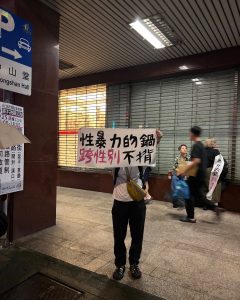
Photo captured by Yu-Yue Cheng.
