
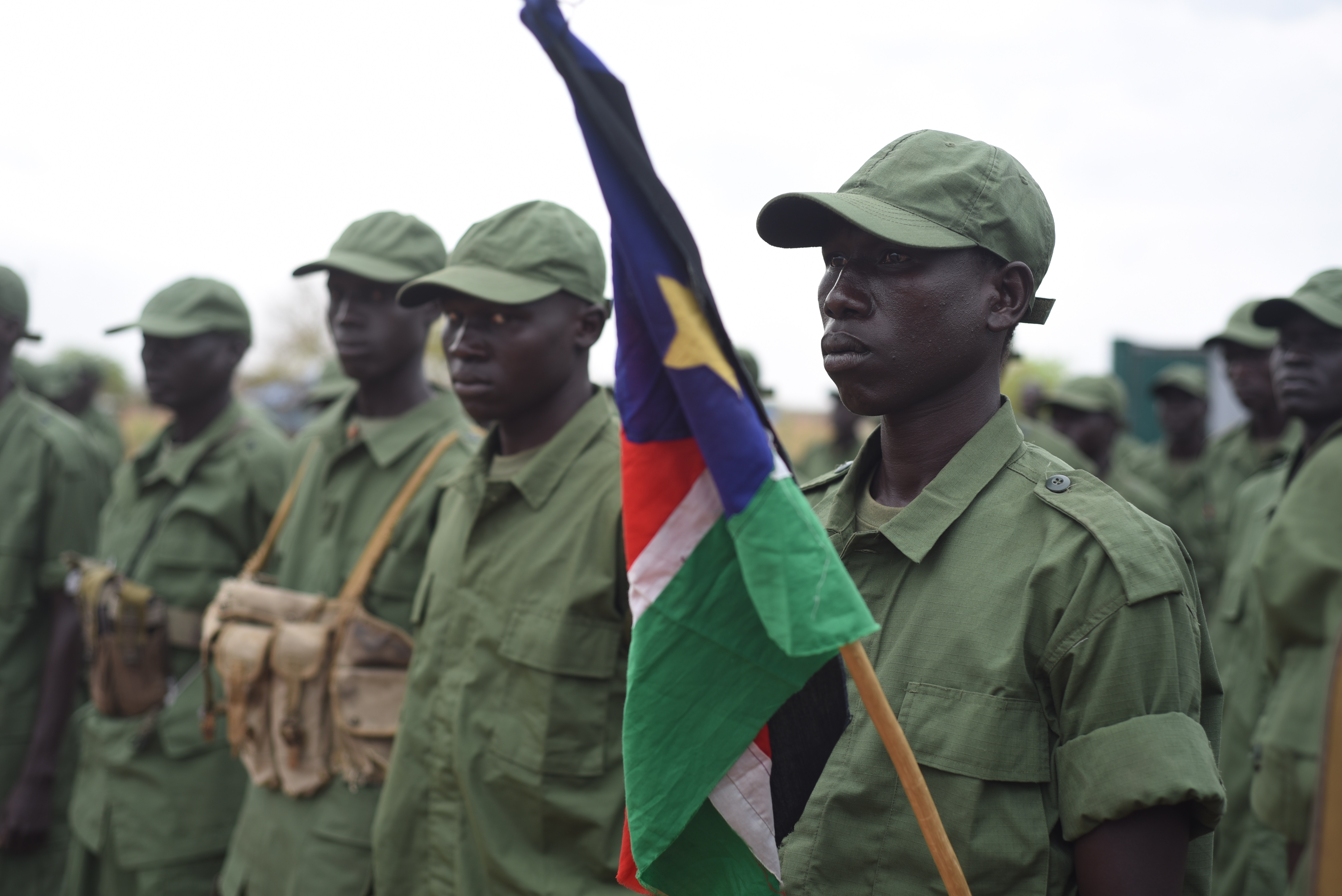
The UN Commission on Human Rights in South Sudan warned on Monday that the nation faces a renewed wave of armed violence, deepening human rights violations, and mass displacement, stating that the country’s political leaders have “deliberately stalled progress and brought South Sudan to yet another precipice.”
The Commission’s mission to the African Union revealed that armed clashes are occurring on a scale not seen since the 2017 cessation of hostilities, leaving civilians at extreme risk. In 2025 alone, approximately 300,000 South Sudanese have fled to neighboring countries, including the Democratic Republic of Congo, Ethiopia, Kenya, Sudan, and Uganda. The broader region now hosts over 2.5 million South Sudanese refugees, while an additional 2 million remain internally displaced.
Commissioner Barney Afako, who led the mission to the AU, stated that the “ongoing political crisis, increasing fighting, and unchecked, systemic corruption are all symptoms of the failure of leadership and consensus in implementing the commitments of the peace agreement and political transition.” He added that “unless there is immediate, sustained and coordinated political engagement by the region, South Sudan risks sliding back into full-scale conflict with unimaginable human rights consequences for its people and the wider region.”
Experts urged the AU and UN Security Council to prioritize justice and accountability, particularly through the establishment of the Hybrid Court–a mechanism agreed upon in the 2018 Revitalised Agreement on the Resolution of the Conflict in South Sudan. More than a decade after conflict erupted in December 2013, victims continue to await reparations and credible justice measures. Yasmin Sooka, Chair of the Commission, stated:
The promises made to victims years ago remain unmet. The Hybrid Court must move from paper to concrete action–the African Union has the mandate and the moral responsibility to ensure holistic transitional justice for South Sudan in line with its Transitional Justice Policy. A Hybrid Court that delivers accountability for past crimes–while at the same time strengthening South Sudan’s own justice institutions based on complementarity–can leave a transformative legacy, strengthening cohesion, the rule of law and human rights in the country.
The Commission highlighted how systemic corruption drives internal conflict, citing its recent report that describe how diversions of public resources have deprived citizens of basic rights and undermined governance, justice, and social stability. It also argued that renewed violence has hit women hardest, exposing them to displacement, sexual violence, and loss of livelihood. Humanitarian agencies warn that harm will persist and grow without urgent political resolution and stronger protection measures.
Historically, South Sudan’s conflict stems from ethnic divisions, political rivalries, and resource disputes, all of which erupted violently after independence in 2011. The 2018 Revitalized Agreement aimed to stabilize the country, but corruption and weak enforcement have repeatedly stalled progress. Regional mediation has prevented full-scale collapse, but the current surge in violence shows the fragility of these efforts. The Commission said that only a political transition that includes all groups, with regional and international support, can stop further decline.
Members of the AU Peace and Security Council and the UN Security Council will meet this week at the AU headquarters.

.jpg)