
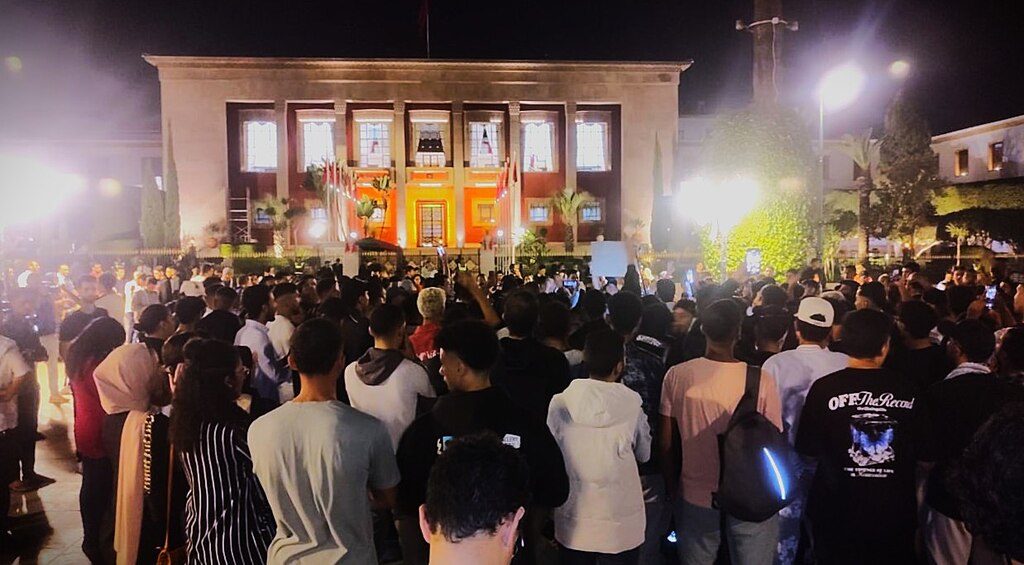
Amnesty International on Friday urged Moroccan authorities to immediately halt the use of excessive force against protesters, and to launch an independent investigation into the recent violent crackdown that has left at least three people dead, dozens injured, and more than 400 arrested across the country since late September.
The rights organization said it had verified credible reports and video evidence of Moroccan security forces deliberately driving vehicles into protesters, violently arresting demonstrators, and detaining bystanders during what began as peaceful youth-led demonstrations.
The protests, largely organized through social media erupted in late September in Casablanca, Agadir, Marrakech, Tangier, Salé, Oujda and Rabat. The “Gen Z 212” movement, named for Morocco’s country code, grew rapidly as young people voiced anger over failing public services, high unemployment, and corruption amid vast government spending on preparations for the 2030 World Cup.
The demonstrations were initially peaceful, but escalated into violent clashes by the night of September 30. Protesters set vehicles ablaze and vandalized public buildings, while security forces responded with tear gas, rubber bullets, and in some cases, live ammunition. Reports on Thursday said that 354 people were injured, including 326 members of the security forces, and that 80 public buildings and 271 police vehicles were damaged.
Amnesty International said that its researchers reviewed dozens of videos showing security forces—some in plain clothes—violently arresting peaceful demonstrators on September 28 and 29, before any violence had been reported.
One protester told Amnesty:
I saw a girl who was sitting on the floor, doing nothing, not even chanting or shouting slogans get carried forcibly by security forces, she was asking them “what did I do?” and saying “it’s my right to be here’”but they did not answer her and shoved her violently into the van.
Another eyewitness in Casablanca reported that police “specifically targeted anyone who spoke to the media,” describing an incident where officers forcibly removed a protester mid-interview with journalists.
Amnesty condemned the use of vehicles to strike demonstrators, calling it a “flagrant violation of international human rights standards.” It said that video footage reviewed by the group from Oujda showed a security forces vehicle driving into a group of protesters on the night between September 30 and October 1, causing at least one serious injury.
“Under international law, the use of lethal force by law enforcement officials is prohibited unless it is strictly unavoidable to protect life,” said Heba Morayef, Amnesty’s regional director for the Middle East and North Africa. “Authorities must adopt all available measures to avoid resorting to the use of force, and where force is unavoidable, it should be strictly necessary and proportionate, and they must ensure it is used with precaution to minimize harm.”
Many protesters, including minors, face charges under Article 591 of the Moroccan Penal Code, which criminalizes participation in gatherings deemed violent. However, Amnesty noted that several were arrested before any violence occurred, raising serious concerns about arbitrary detention and denial of due process.
Amnesty urged authorities to “immediately drop charges against anyone detained solely for exercising their right of peaceful assembly.”
Amnesty’s report was released the same day that the Gen Z 212 movement published a public letter to King Mohammed VI, invoking constitutional provisions to call for far-reaching political and judicial reforms. The letter followed Prime Minister Aziz Akhannouch’s first public statement since the unrest began, in which he said the government was “willing to dialogue.” Soon after, Gen Z 212 issued its letter—widely interpreted as a direct response—expressing skepticism toward the prime minister’s remarks and demanding concrete action instead of promises.
The eight-point document, entitled “Message of the Youth to His Majesty the King,” urged sweeping reforms, based on Morocco’s Constitution, including the dismissal of Prime Minister Aziz Akhannouch’s government, judicial proceedings against officials implicated in corruption, and the dissolution of political parties found complicit in corrupt practices. It further demanded the guarantee of equal opportunities in education, healthcare, and employment, the protection of freedom of expression and peaceful protest, and the release of detainees and prisoners of conscience. The youth also called for a national public session of accountability to be presided over by the King.
Declaring a loss of faith in political institutions, the group wrote:
Our message expresses the will of a new generation that refuses to remain trapped in the cycle of corruption and failure. We believe Morocco’s future depends on rebuilding trust between the people and the state.

