
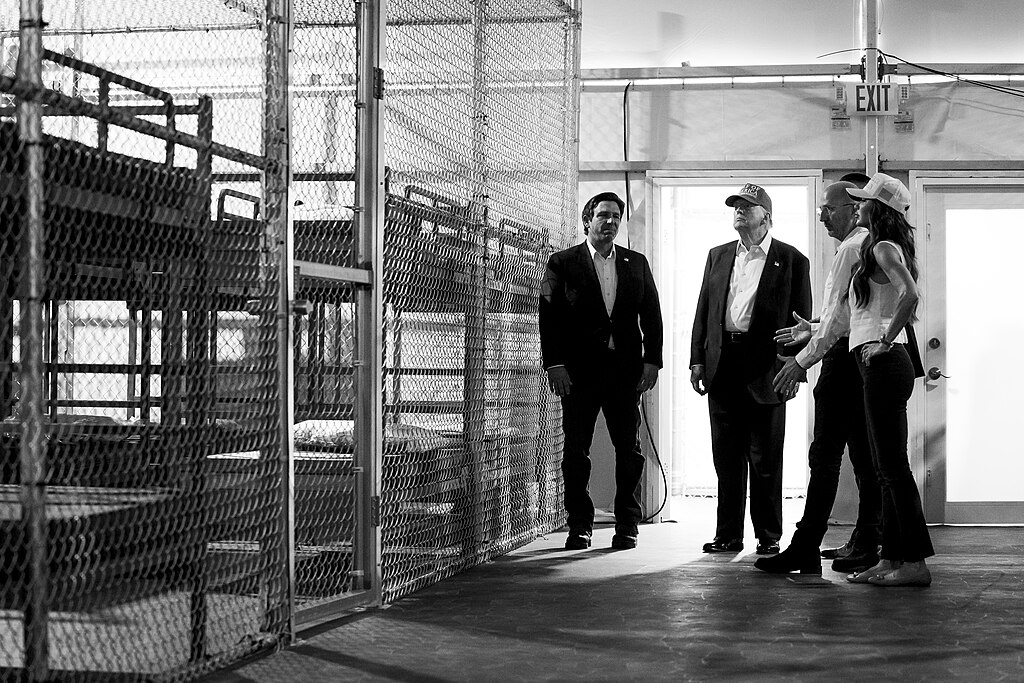
A US federal judge ordered Florida and federal officials on Thursday to halt further construction at the state’s controversial Everglades immigration detention complex—nicknamed “Alligator Alcatraz”—for 14 days while the court considers a broader request to block the project under federal environmental law. Detentions and day-to-day operations at the site may continue during the pause.
US District Judge Kathleen M. Williams issued the temporary restraining order (TRO), stopping new lighting, paving, fencing, fill, or placement of additional structures at the site, which has been established at the disused Dade-Collier Training and Transition Airport (TNT) facility in the Big Cypress ecosystem. It also binds any contractors “in active concert” with state or federal defendants.
Judge Williams declined to shut down the facility’s current operations, which Florida says already hold hundreds of detainees and could scale up to roughly 5,000 beds. According to the complaint, the complex could cost as much as $450 million annually once fully built. The judge’s order preserves the status quo on construction while testimony continues next week.
Environmental groups Friends of the Everglades and the Center for Biological Diversity sued the federal government in late June. They stated in their complaint that the state rushed construction without the environmental review required by the National Environmental Policy Act (NEPA). They asserted that the project is a “major federal action” because it was requested by the Department of Homeland Security and operates under a 287(g) agreement deputizing Florida officers to perform federal immigration functions under ICE supervision. The government’s authority to direct those operations, they contend, triggers NEPA.
At hearings on August 6-7, the court heard testimony that at least 20 acres—about 800,000 square feet—have been newly paved and that stormwater runoff from fresh asphalt could pollute the nutrient-poor Everglades wetlands absent a management system. A veteran panther biologist testified that industrial lighting, traffic, and human activity could displace Florida panthers from roughly 2,000 acres of habitat. Only an estimated 120–230 panthers remain statewide.
Florida and the federal government argued NEPA does not apply because the state “controls” the site. Judge Williams signaled skepticism, noting the 287(g) framework of the Immigration and Nationality Act (INA) places state personnel under federal direction for immigration functions. At this preliminary stage, she found the plaintiffs showed a likelihood of success on their NEPA-based Administrative Procedure Act claim, and that allowing weekend expansion during a recess in the hearing risked irreparable environmental harm.
The court also declined, for now, to decide venue challenges raised by Florida’s Division of Emergency Management chief Kevin Guthrie and federal defendants, including Secretary Kristi Noem and Acting ICE Director Todd Lyons, saying venue is not jurisdictional and that urgency warranted interim relief pending completion of the evidentiary record.
Plaintiffs hailed the pause as a necessary brake on a project they say was “requested by the federal government” but advanced without public process. Florida officials maintain the complex is a state-run facility supporting immigration enforcement and argue environmental reviews are unnecessary; federal lawyers similarly told the court NEPA does not apply because Florida controls construction and operations.
The TRO runs 14 days from August 7 and keeps any additional lighting, paving, fencing, fill, or building on hold until Judge Williams rules on the pending motion for a preliminary injunction. The hearing is set to resume on Tuesday, August 12.

