
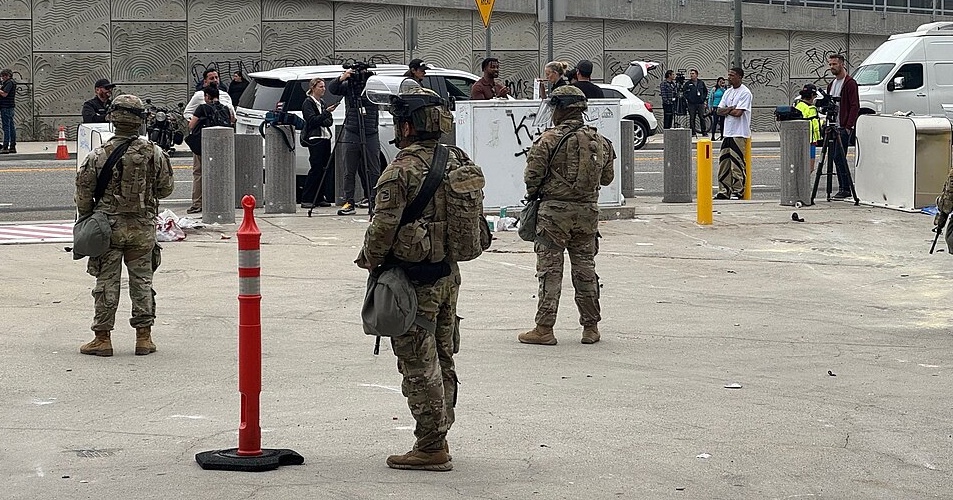
A three-judge panel for the Ninth Circuit Court of Appeals ruled on Thursday that US President Donald Trump likely had the authority to mobilize members of the California National Guard over the objections of Governor Gavin Newsom in response to protests against US immigration enforcement in Los Angeles. While the court wrote that Trump’s decision is not “completely insulated from judicial review,” it added that he likely exercised his authority lawfully under § 12406 of Title 10 of the US Code.
The decision follows a motion for a preliminary injunction filed by Governor Newsom, who asked a lower court to enjoin the Trump administration from permitting US military forces deployed in California “to execute or assist in the execution of any federal agent or officer’s enforcement of federal law.” The governor urged the court to return control of the California National Guard to him and the state.
While the lower court held that the US unlawfully federalized the California National Guard and interfered with the state’s exercise of its police powers, last week, the Ninth Circuit blocked the return of the California National Guard to the governor, awaiting further proceedings.
President Trump federalized the California National Guard after anti-Immigration and Customs Enforcement (ICE) protests erupted across the US. The protests followed numerous immigration raids ordered by Trump. A Department of Homeland Security press release from May stated that “Secretary [Kristi] Noem is fulfilling President Trump’s promise to carry out mass deportations.” Trump also established an initiative labeled Project Homecoming, encouraging “illegal aliens to voluntarily depart the United States.” The project “directs a full-scale, aggressive deportation surge … for illegal aliens who do not depart voluntarily.”
10 U.S.C § 12406 permits the president to mobilize the National Guard whenever the US is “invaded or is in danger of invasion,” if “there is a rebellion or danger of rebellion,” or if the president is “unable with the regular forces to execute the laws of the United States.” Friday’s decision emphasized that it concerned a case of statutory interpretation and that the “history of Congress’s statutory delegations of its calling forth power … strongly suggest[s] that our review of the President’s determinations in this context is especially deferential.”
Rejecting the argument under the political question doctrine that this case cannot be considered, the court recounted a lengthy history of instances in which Congress authorized the president to federalize military forces. The judges relied on typical canons of statutory interpretation, stating that § 12406 cannot be read “as a prerequisite that the President be completely precluded from executing the relevant laws of the United States in order to call members of the National Guard into federal service.” Trump, according to the court, had a “colorable basis” for invoking the statute, presenting evidence that protestors “threw objects at ICE vehicles” and “breach[ed] the parking garage of a federal building,” among other interferences.
The Ninth Circuit’s decision will remain in place while it considers further arguments from Newsom and Trump.

