
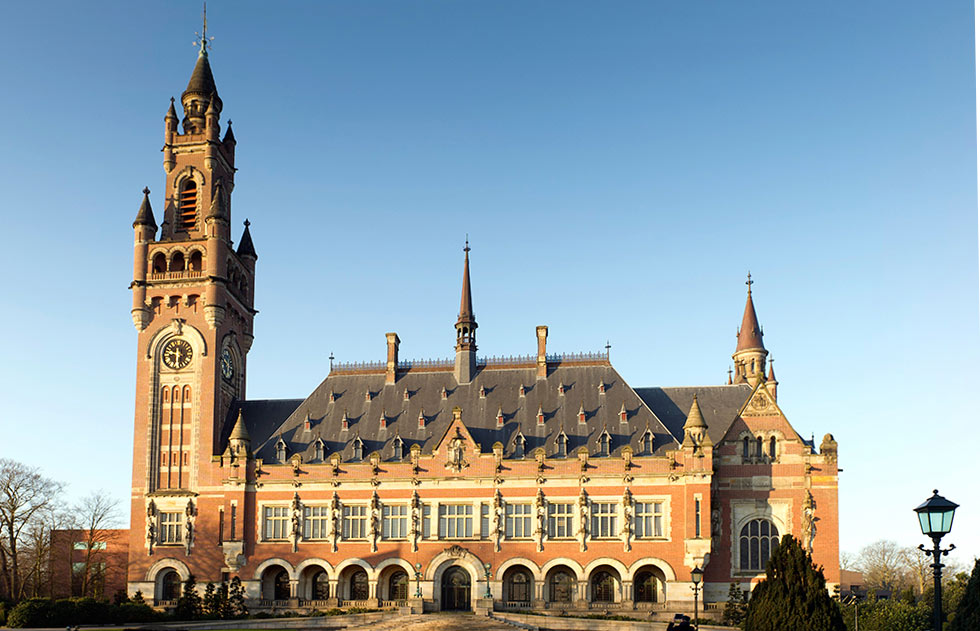
The International Court of Justice (ICJ) sided with Equatorial Guinea on Monday in a decades-long maritime boundary dispute with Gabon concerning three islands and their potentially oil-rich waters.
The ICJ ruled that Equatorial Guinea has sovereignty over the islands and the surrounding waters pursuant to the 1900 Treaty of Paris between France and Spain, and that Gabon must withdraw any military personnel stationed on the islands.
The dispute stems from a series of treaties during the early 20th century where France and Spain delineated control of the islands through the 1900 treaty and a series of subsequent modifications. The 1974 Bata Convention was the first boundary treaty between Equatorial Guinea and Gabon following their independence, but the ICJ found that it was not treated as legally binding by either state and thus does not meet the requirements of a treaty according to Article 1 of their submission to the ICJ. The court also found that none of the post-1900 agreement modifications were sufficiently enforced and that Spain maintained sufficient and uncontested control of the islands, allowing for Equatorial Guinea to inherit legal title under the principle of uti possidetis (as you possess) following their independence from Spain. As such, the Bata Convention was found unenforceable, and sovereignty fell to Equatorial Guinea as per the 1900 Treaty of Paris.
Gabon and Equatorial Guinea agreed to hand the dispute over to the ICJ in 2016 and officially submitted the request in 2021. The primary dispute involved competing claims of land and maritime boundaries, namely concerning sovereignty over the islands of Mbanié/Mbañe, Cocotiers/Cocoteros, and Conga. While the islands themselves are geographically insignificant (the largest island, Mbanié/Mbañe, is less than 0.3km squared), sovereignty of the islands would extend to the surrounding waters that are believed to be rich in oil.
The court noted that this decision does not bar either state from entering into a new boundary treaty.

