
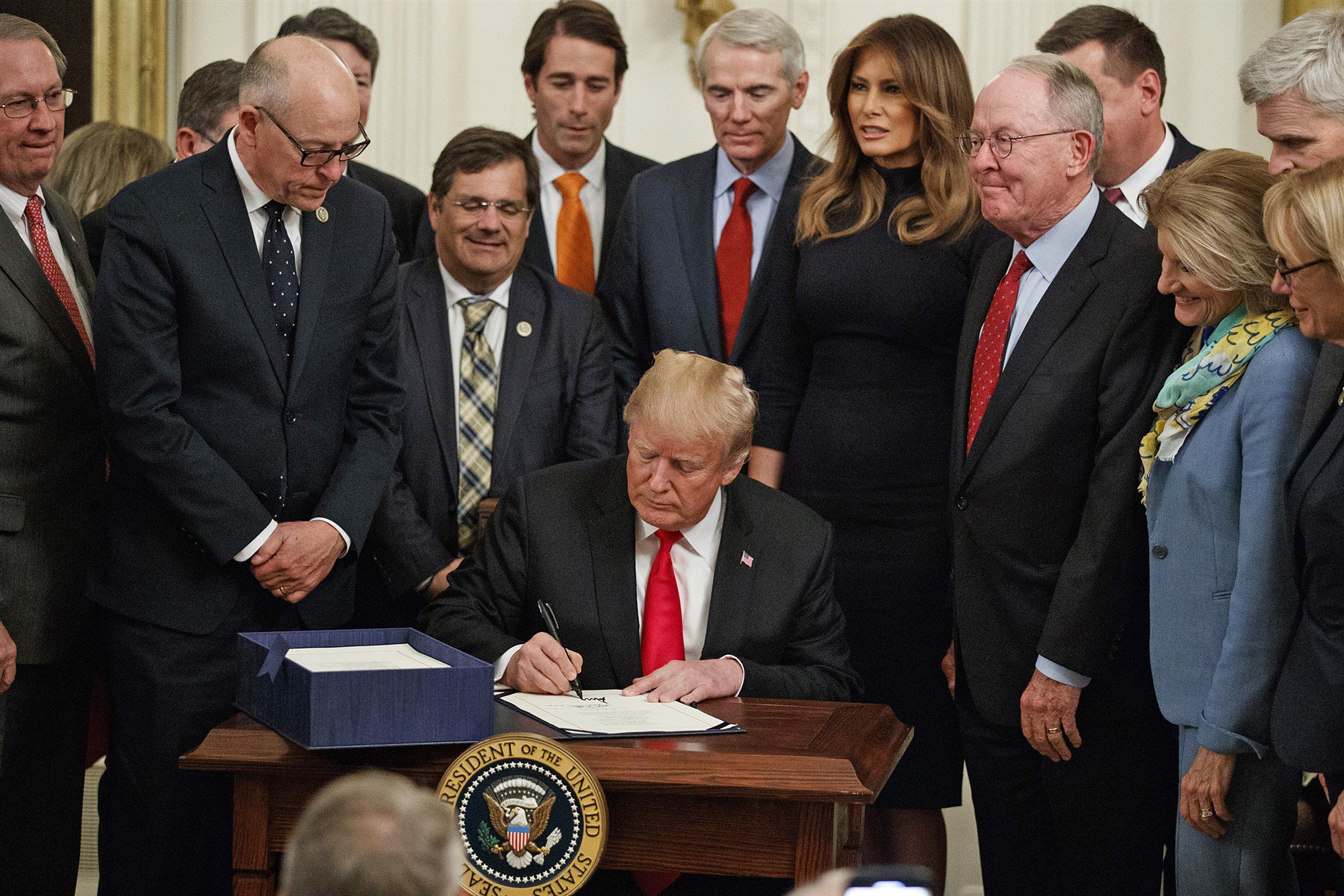
US President Donald Trump signed an executive order Thursday sanctioning the International Criminal Court (ICC) for issuing warrants for Israeli Prime Minister Benjamin Netanyahu and former defense minister Yoav Gallant.
The order imposes significant sanctions on ICC officials and their immediate families. Such sanctions include the blocking of property and assets as well as suspension of entry into the United States.
The order asserts that the ICC has improperly claimed jurisdiction over the US and Israel, and states that the ICC’s actions endanger US personnel and threaten US sovereignty and national security. It claims that the US remains committed to the “peaceful cultivation of international order,” but adds that other countries, as well as the ICC, need to respect the decisions of the US.
The order cites section 9 of the American Servicemembers Protection Act of 2002, which states that “members of the Armed Forces of the United States [and] senior officials of the United States Government should be free from the risk of prosecution by the International Criminal Court, especially with respect to official actions taken by them to protect the national interests of the United States.”
In November 2024, the ICC issued arrest warrants for Netanyahu and Gallant for alleged war crimes and crimes against humanity in Gaza. The US and Israel disputed the court’s jurisdiction, as they are not member states of the Rome Statute. However, the ICC rejected that argument, reasoning that Palestine’s territorial jurisdiction provided a sufficient basis for the court’s authority. IN December, 93 of the 125 ICC member states declared their “unwavering support” for the court to enforce its mandate.
Last June, the US House of Representatives voted to impose sanctions against the ICC for “investigating, detaining or prosecuting” protected persons under the US law, which includes the government officials of allies.
This executive order follows Trump’s executive order withdrawing the US from the UN Human Rights Council and Israel’s subsequent withdrawal from the Council.
Critics blasted Trump’s move and urged the international community to support the court.
Liz Evenson, international justice director at Human Rights Watch, said in a statement: “Trump’s executive order on the International Criminal Court effectively puts the United States on the side of war criminals at the expense of victims of grave crimes seeking justice… ICC member countries should publicly and forcefully support the court for doing the job it was set up to do: ensuring no one is above the law.”
Luis Moreno Ocampo, who served as the ICC’s inaugural prosecutor between 2003 and 2012, said of the sanctions: “We don’t know what President Trump will do. I know that I want to protect the only institution that is devoted to protecting the rights of victims of mass atrocities. I will do that.”
This article was originally published on Thursday, Feb. 6, 2025. It was updated on Friday, Feb. 7 with critical reactions.

