
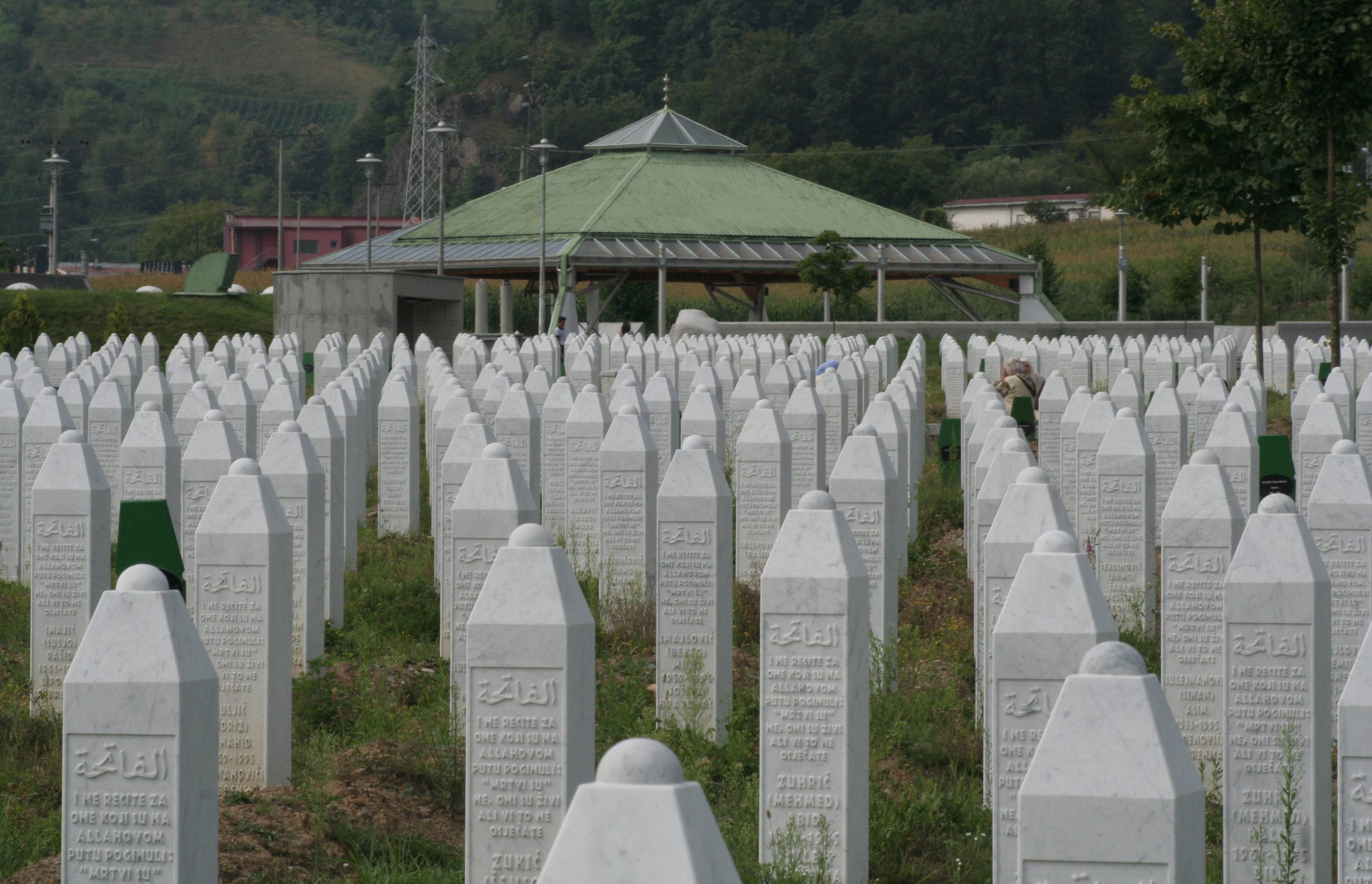
Few atrocities have been documented as extensively as the Srebrenica genocide. Yet three decades later, denial remains politically entrenched, while the evidentiary record painstakingly assembled by international courts faces an uncertain future.
JURIST’s Sarisha Harikrishna spoke with Iva Vukušić, Assistant Professor in International History at Utrecht University and Visiting Research Fellow in the Department of War Studies at King’s College London, about the persistence of genocide denial, the inevitable selectivity of international prosecutions, and growing concerns over the preservation of the archives of the International Criminal Tribunal for the former Yugoslavia (ICTY).
Vukušić’s research examines how evidence can constrain denial without necessarily defeating it. Her work on the Scorpions execution video, including her study Nineteen Minutes of Horror: Insights from the Scorpions Execution Video, demonstrates the power of visual evidence to narrow the space for revisionist narratives. But she argues that judicial findings alone cannot produce genuine societal reckoning. Historical research, memorialization, civil society engagement, and access to archival records are also essential to documenting atrocity, recognizing victims, and preserving the historical record.
At a moment when funding pressures threaten public access to parts of the ICTY’s vast evidentiary archive, Vukušić warns against treating international accountability as a temporary political priority. Preserving the record, she argues, is not simply an archival exercise: it is part of the continuing struggle over how atrocities are remembered, understood, and denied.
JURIST: Your work on the Scorpions video demonstrates how visual evidence can pierce denial, yet genocide denial remains entrenched across the region decades later. Given that the International Criminal Tribunal for the former Yugoslavia (ICTY) has closed and the International Residual Mechanism for Criminal Tribunals (IRMCT) is shrinking, what do you see are the most effective strategies for ensuring that the evidentiary record of Srebrenica continues to challenge denial in the public sphere, rather than gathering dust in a digital archive?
Professor Iva Vukušić: Thank you for your question. Indeed, it is timely. I think it’s also something that is present and visible in other countries as well. It’s very difficult for societies and nations as well as individuals to recognize the harms that are done by them or in their name. I want to make sure that we don’t necessarily single out this particular situation as completely unique. For example, I live in the Netherlands, and I would say that there’s a lot of maybe not outright denial in the same shape and form, but for example, when it comes to the history of slavery and colonialism, I think we are all aware that today there’s a lot of denial in various ways about the atrocities of the past. So, I don’t think genocide denial is anything particular as a phenomenon as it relates to Srebrenica. The denial of this genocide is maybe a bit more concrete, and a little bit blunter.
I think the impulse to try to deny past atrocities is something that is widespread and concerns different contexts, different times, and different societies. One thing that I also think is really important to say is that denial in itself has probably always existed and probably always will exist. I think there’s a bit of naivete when we think that all people on earth accept something because it’s a fact. We see this all over the world in different situations, like the climate disaster which many of us around the world are living through. There are still people who are outright denying it. This can also be said about our experience with the Covid pandemic. I think it was the same way that there were people ingesting horse medicine because they believed it was a cure, so this trust in facts is actually less widespread than many of us would hope.
And in that regard as well, that means that facts, evidence, science, concrete documentation that proves a certain point simply doesn’t reach some people. And I’m afraid that we need to just accept that and try to work with those that can be reached with facts. You also see this in people who think that the earth is flat. So, I don’t think that genocide denial is fully and completely separate from other forms of simply not accepting factual scientific realities. One thing that is interesting about genocide denial is how it is easily influenced by politics. Because genocide as a project and as an atrocity, is a series of policies and actions to remove a certain group from a certain territory, and it has a political goal. So, denying it as well is political. In that sense, we see the role of the state and politicians much more pronounced maybe than in some other situations.
I think when it comes to genocide denial as well, it’s very often an orchestrated thing. It’s not necessarily just a bottom-up citizens’ initiative. When it comes to genocide denial, it’s often a state project. The state of Serbia does not want to acknowledge the fact that it armed, paid for, supported, and more broadly directed the general war effort in Bosnia and Herzegovina. The genocide in Srebrenica was largely perpetrated by local Bosnian Serb forces with all the support from Serbia. So, this is a state effort then to deny it, to not acknowledge facts, to not acknowledge judgments, to not teach it in schools, to not have societal commemoration, for example, about it.
Finally, when it comes to evidence, in particular the Scorpions video, but also a lot of the other documentary evidence, testimonies, DNA evidence and mass grave related evidence from all of the Srebrenica trials that we had here in The Hague one thing stands out. Itis something that the American legal scholar called Diane Orentlicher wrote about the idea that evidence helps narrow the space of denial. The evidence comes into public space through media, through reporting from courtrooms, through sometimes witnesses giving interviews, through documentation being shared through academic research such as mine and that of many of my colleagues. This evidence narrows the space for denial. For example, in many ways, and I think this is even true in the most nationalistic circles in Serbia, nobody will say that absolutely nothing happened in Srebrenica. In that sense, it’s like the Holocaust. So very few people and at the very margins would say that it’s all invented.
Where the denial happens is in the acknowledgment that there were some killings, but it wasn’t genocide. Common justifications are that the Bosniaks had it coming because they were actually shooting at “us” (Serbs). It’s in constructing stories that justify the killings. This is what Diane Orentlicher meant when she said that it narrows the space of denial, like all of the evidence that we have collected, seen and shared publicly through the Srebrenica trials, helps make it just a little bit less possible to say that nothing happened at all. That is the vital societal purpose, and contribution, of investigations, prosecutions and trials. They allow people to know, especially those who are interested in knowing what exactly happened in 1995.
For example, I think I say that in that article (Nineteen Minutes of Horror) that Srebrenica is probably one of the most investigated atrocities, and sets of incidents, executions, that took place for around a week in July 1995. I think in that regard, trials really help us as individuals, as societies, to know a little bit more about what happened. Therefore, trials are fundamental not only for justice and accountability but also for fact-finding and the establishment of truth.
JURIST: The International Criminal Tribunal for the Former Yugoslavia (ICTY) archives contain an immense wealth of evidence about the Srebrenica genocide, but as you argue, prosecutorial selectivity means that countless crimes in smaller towns and hamlets remain unexplored. How does this imbalance shape what we think we know about the violence of 1995, and what alternative sources or methods could help us move beyond the judicial record to capture the full scope of the atrocity?
Vukušić: Like in many other contexts around the world, like in any war, any situation of violence that extends beyond a week and a small area, it is going to have probably more allegations of international crimes and more violations than any judicial system can cope with. Judicial systems as we know them, courtrooms, judges, prosecutors and defense counsel were designed for a situation in which a crime is an exception. For example, it’s a peaceful day here in the Netherlands. A murder happens; two murders happen. That’s what the judicial system is designed to do. That’s what it can deal with. If you have a situation where there’s a more general breakdown of the rule of law, where institutions either don’t work or are co-opted to proceed and advance a kind of a criminal purpose, then it’s a challenge. For example, the military and the police were participating and were perpetrating the violence after the fall of Srebrenica, and so then the local judicial system cannot provide justice for atrocity crimes.
In Bosnia, we had thousands and thousands of potential crimes to investigate. The same can be said about Ukraine, Gaza, in the Democratic Republic of Congo (DRC), in Sudan, in Colombia, literally everywhere where we have sustained protracted conflict or genocide, depending, of course, where we are. There is more to do than any judicial system can do. So here we come to the situation of selectivity. I was recently also with some colleagues from Ukraine and we were discussing how the prosecutor there has recorded over one hundred and seventy thousand allegations of perpetrated crimes. We don’t know if all of these are crimes. They need to be investigated. But there’s one hundred and seventy thousand records of something happening that is maybe a crime.
There is no way that any judicial system can cope with all that. If we are thinking of a traditional investigation, prosecution, courts, judges, judgment in a fair trial, with all the resources that have to be provided for the defendant, for it to not be a show trial… So here we come to this selectivity that any such process of dealing with those allegations will entail and we see this most visibly at the International Criminal Court (ICC) that has few cases from Sudan, which has been marred in violence and conflict escalations for twenty-five years now already in this modern period since the ICC has existed. We see this in Libya; we see this in Palestine. We see this in Ukraine. It’s going to be a minimal number of cases. Important, but minimal.
Two, three investigations, maybe five, maybe ten. But that’s it. Then, this act of selectivity has massive consequences that certain victims may feel that their plight, suffering, and experiences are taken into account and numerous others are not. So that nudges us in the direction of thinking about what are other complementary mechanisms that we can use. Rwanda is a good example of this. They organized after the genocide Gacaca proceedings. These are proceedings that were inspired by traditional conflict resolution mechanisms. But that’s an exception. They had over a million cases. And there were also critiques to that system. Basically, whatever we do, it’s going to be imperfect. Historically, we know that sadly, most crimes, most of the time, most suspects go unpunished. We need to really think about mechanisms that could exist to facilitate some normalization and some sense of justice for victims. Different victims will want different things. But we can think about social psychosocial support, reparations, return of property, finding missing persons so that they can be identified and properly buried. We can think about economic measures to help people to put them in a situation where they can be meaningfully employed and self-sufficient.
Historical research, documentaries, art, memorialization, all of these things can help where this legal approach simply comes up short. But I think that’s to be expected because experiencing mass violence, both with individuals but for societies, is a very complex experience. We can’t look at just one mechanism or just one approach to solve all our problems. There are things that the legal mechanisms simply cannot do and are not designed to do. Instead of being constantly frustrated by them, maybe it’s better to think of other ways we can also address this, such as truth commissions and fact-finding investigations. Proceedings at the International Court of Justice (ICJ) are against states and not individuals and maybe they can have a role too in some situations. All of these things can be employed to try to see what can provide some sense of justice and some sense of recovery to the people that that survived these kinds of atrocities.
JURIST: Your analysis of the Scorpions execution video reveals perpetrators who appear disturbingly casual and unrepentant about their crimes, yet you caution against the usage of simplistic labels like ‘monsters.’ Based on your broader research into paramilitary units and their ties to state security structures, what does the Srebrenica case reveal about how ordinary men become capable of systematic brutality, and how should historians approach that question without slipping into demonization?
Vukušić: It’s a very natural impulse for humans to see something terrible being done to another human and jump immediately to conclusions about that. Notions such as this person, the perpetrator, is disturbed, sadistic, or a whole range of sort of things that would somehow explain this behavior. This was actually a big question after the Holocaust, when there’s been a lot of research and there was psychological testing, for example, on the high-level Nazis in Nuremberg. From then on, there was really for probably a good decade or two, this idea dominating that people who perpetrated the Holocaust were monsters. Because the Holocaust was monstrous.
And then, of course, I would say since the 1990s we have a book by Christopher Browning that many people I’m sure will know, called Ordinary Men. That was a shift where more broadly, it became understood that, if you look at who these people are individually, their trajectories, and where they come from, interesting findings arise. Some of them can have all kinds of reasons for joining units or perpetrating violence. Other are indeed special and there’s something ‘wrong with them’ psychologically. At the end of the day, I think most research would show that most of the perpetrators are not monsters. People who have dealt with suspects like I have, and I used to work at the Prosecutor’s office in Bosnia, will probably say that interacting with most of them indicated that they can be quite ordinary-seeming people.
I’ve been here in The Hague for almost twenty years. Most people who sit in courtrooms, most people interacting with people who are defendants or suspects would agree. In many ways that’s also quite scary to most of us because if we can recognize the humanity, so to say, in some of the perpetrators, then we can also ask ourselves, would I ever be in a situation in which I would participate in such a thing? That’s actually really interesting. Most people in contexts that are peaceful, where they have the luxury of never being tested will say, oh, I would never have done that.
People always think they would be on the side of those helping and doing good—never those perpetrating. Sometimes I ask my students to think about this, for example, here in the Netherlands, where the Holocaust and the Second World War were very dramatic societal experiences. I ask my students to think about if the Nazis came to your street at night and they’re dragging people out of their houses and taking them away. Would you have risked your own life, the life of your partner? Maybe the life of your child by intervening, trying to protect a neighbor that is just a neighbor? Would you risk the life of your child for somebody that you know, casually, knowing that maybe your efforts to save them were not going to work anyway? Would you do it? Or would you stay quiet?
It is vital to look at research at what puts people on a trajectory to participate in mass atrocities. It’s peer pressure, it’s propaganda. There’s masculinity involved as well for male perpetrators who don’t want to look weak when they reject perpetrating violence. I think fundamentally that it’s important to realize that most perpetrators make choices about what they want to do, but they’re not all enthusiastic killers. Some of them lead others into violence. Some of them follow along. Some of them see what’s about to happen and say, you know what? I joined the war to fight an armed enemy. I’m not going to beat up old people or shoot at children. There’s a broad variety of behavior. And I think it’s important when we think about perpetrators to think about them as humans that found themselves in a certain situation and made the choices that they made. Sometimes they made choices very quickly. And just fundamentally and this is not trying to excuse any behavior, it is vital to dial back our tendency to say things such as oh, we would never do something, while sitting in a comfortable chair in a peaceful country because you really do not know. These are such extreme situations that maybe you would also be fired up with propaganda and hate speech. I think it’s fundamental to try to approach perpetrators individually, and to resist the self-righteousness and our need to state how we would never do such a thing.
JURIST: Your work places a lot of emphasis on the ethical imperative to protect victims and witnesses; however, you also advocate for greater access to the closed prosecution archive. With the passage of time and the aging of survivors, how do you see the balance between sensitivity and transparency shifting in the coming decade, and what responsibilities do historians have to advocate for declassification without re-traumatizing affected communities?
Vukušić: The situation of the archives of the Yugoslavia tribunal, and I’m sure you’ve come across it, is dire. Is it actually in danger of being removed from the internet. Essentially, there’s a UN funding crisis. I am very frustrated by that. A lot of states that pride themselves as advocates of transitional justice of prosecutions, investigations, rights of victims and the like have invested in the last certainly four or five years, a lot of money, for example, in Ukraine, for documentation. I’m sure you came across this civil society activity, and the need to document just in case we use this material at some point in the future for accountability purposes.
Millions and millions have been sent to that effort, and for good reason, while at the same time, these same states and others as well are not finding it interesting or valuable to keep running the essentially only archive of a tribunal in The Hague that is public and easily accessible. It’s an inconsistent approach. What are we documenting for if there is a danger that in a couple of years’ time, funders and donors lose interest in Ukraine as well. What if in the future funders lose interest again, and all this material ends up in basements around Ukraine, unsupported, and unused. Do donors and funders really care? If we’re interested in facts, investigations and historical truths, then we should also pay attention to something that we used to fund, which is the Yugoslavia Tribunal, and not let it just slip because we don’t care anymore.
There are always new things to focus on. We should really think consistently. We either care about facts and evidence or we don’t. If we used to fund that effort to prosecute and keep this evidence, and that’s actually something that other tribunals should move towards—to more transparency, especially in this time of misinformation, disinformation, political manipulation—then it is important to keep it running. It is vital that evidence is accessible to citizens, documentary filmmakers, researchers such as me. Donors don’t seem to care about that and now there’s a fear that the online access to ICTY archives will close. But we as the international community are now focusing on Ukraine for a little bit, and then we’ll focus on something else and it is always changing. There’s no consistency in our approach as the “international community.” I’m really deeply frustrated by that. Instead of having other tribunals, for example, such as the International Criminal Court moving in the direction of more transparency by putting as much as possible evidence and transcripts and other materials online, we are moving from a place of transparency in this one example of the ICTY to a place of secrecy.
I’m frustrated by this. It shows an incredible lack of thoughtfulness and commitment and long-term planning. It shows the “international community” and various donors are flimsy. It’s wasteful. So that’s one thing. The second thing is that there is no way in which a court or an archive by itself can fight denial. It’s really primarily up to the elites in the country itself. There’s no magic that the Yugoslavia tribunal or any other tribunal can pull off if the domestic political elites don’t want to talk about it or are propagating denial themselves. It really is a concerted effort.
In many ways we have civil society in Serbia, for example, just the other day, a person that was organizing a commemoration for the anniversary of the Srebrenica genocide was beaten up by a gang of young men. This is not the first time that this has happened. So civil society has tried and keeps trying for the last thirty years to put this conversation on the agenda to open space to these kinds of conversations about responsibility. But the political elites, the president and the nationalist elite around him are suffocating that and have been suffocating that for almost three decades. I think here, when it comes to the particular records that are classified that you mentioned, most of that is what relates to state security. These are not witness statements of survivors. A lot of the witness statements are out. Survivor statements are not that controversial. What states don’t want accessible, and Serbia in this case, is state security involvement in perpetrating crimes.
That’s what they don’t want others to see because they are denying it. And this would, of course, confirm the accusations. But also, I think because they don’t want all kinds of lawsuits, reparations, they all just want to have these accusations of perpetrating genocide go away. I think what is important is that historians keep pushing for access and this has already been going on. There are associations of historians in the region. But the problem is that there’s not enough of us. Fifty historians or five hundred, and a handful of journalists, a handful of filmmakers, some civil society organizations… That’s not enough to move the needle. But we keep trying. But I think fundamentally, when it comes to the archives, it’s a state responsibility and it’s the responsibility of donors, and it’s the responsibility of the UN as well. When you collect these statements and when you conduct these trials, you are making promises that you’re going to keep that material and use it a constructive manner. So, I would ask the same states that were funding the ICTY outreach, for example, and documentaries about the Yugoslavia tribunal, I would ask: where are you now? This material is already online and we should keep these archives there.
What we need here is probably some servers and a couple of people working on it. How expensive is that? It’s incredibly frustrating to potentially find ourselves in a situation that overnight, poof, gone, this material has evaporated. I think it will just open the space for more denial and attacks on facts that these donors and this institution, the court, but also more broadly, the UN says it’s fighting against. We cannot expect historians to be able to change that by themselves. So that’s where I would send the requests about this archive: to states that were very vocal and are still vocal when it comes to international justice, and who used to support this. Where are you now? We can’t have this accountability project to be subject to fashion and that’s what we have all the time. Ten years ago, people were talking about Syria or the Yazidis all the time. Then, Ukraine, then Palestine, then something else. It’s incredibly fashionable to change focus, and it’s just flimsy. It moves from one thing to the other. I think that’s incredibly frustrating to see because by paying attention for a while, you make implicit promises and then your attention is gone and the people are just kind of like left hanging. I think that’s deeply unfair.

