
 Features
JURIST Contributor Pitasanna Shanmugathas, in a previously unpublished interview, speaks with Law Professor Emeritus Steve Kanter, a distinguished American legal scholar, two-time Fulbright professor of law, and former Dean of Northwestern School of Law at Lewis and Clark College, with a career spanning constitutional law, criminal procedure, and international legal advising across China, Greece, Thailand, Russia, and Latvia. Most relevant to this interview, Professor Kanter served as one of three members of an international panel that assisted Kazakhstan in drafting its new constitution in 1992, alongside Danish comparative law professor Peter Grimmer and Sri Lankan human rights lawyer Dr. Neelan Tiruchelvam.
In this interview, Kanter traces Kazakhstan’s path from Soviet republic to independent state, reflects on the flaws the team identified in the country’s first draft constitution, and discusses the recommendations they made on language rights, ethnic and religious minority protections, decentralization, and the design of a new Constitutional Court. He also addresses internal debates among the three consultants, including a disagreement over positive rights such as healthcare and education, and the team’s decision to support a unitary rather than federal system. He closes with a deeply personal tribute to Dr. Tiruchelvam, whose warmth, intellectual courage, and commitment to human dignity left a lasting impression on him.
Although this interview was conducted in 2019 and portions of it appeared in the 2025 documentary titled NEELAN: UNSILENCED on the life and legacy of constitutional scholar Dr. Neelan Tiruchelvam, this is the first time Kanter’s interview appears in its entirety, exclusively on JURIST.
This interview has been lightly edited for clarity and concision
Pitasanna Shanmugathas: Professor Kanter, talk about the historical background of Kazakhstan and the circumstances that compelled the nation to seek constitutional reform.
Professor Steve Kanter: I did not know much about Kazakhstan before we got involved in this project, but it turns out to be a fascinating place. It affiliated with Czarist Russia about 300 years ago, choosing to seek the protection of the Russian empire against more warlike neighboring tribes, so it had already been absorbed into Russia long before the Soviet Union or the Communist revolution ever existed. It is one of the largest countries in the world by landmass, but when we were there in 1992 it had only about 17 million people, making it sparsely populated, ethnically and religiously diverse, and yet it had great natural resources that made it a very valuable part of the Soviet Union. When Gorbachev began his reforms, including constitutional reform, he instructed each Soviet republic to begin its own reform process. Then in the early 1990s the Soviet Union broke apart, and these countries really had no choice but to become independent. Kazakhstan had maintained close ties with Russia throughout this period. Its president, who had held office for a very long time, was actually appointed by Gorbachev himself, and the country had deep mutual interdependence with Russia. Still, the nationalist independence movement took hold. Since they were already mid-reform under Gorbachev, once independence came in December of 1991 Kazakhstan reinvigorated its constitutional reform process and essentially started from scratch, which is what led to my involvement and Dr. Tiruchelvam’s.
Shanmugathas: Could you discuss when, and at what stage in Kazakhstan’s constitution-making process, you, Peter Grimmer, and Neelan Tiruchelvam were invited by the government, and for what purpose the government sought your assistance?
Kanter: I was Dean at Lewis and Clark Law School in Portland at the time, and frankly I was not expecting to be invited. I had not applied and I knew nothing particular about Kazakhstan before the International Human Rights Law Group in Washington, D.C. reached out to me in 1992, looking to assemble a small international team. I believe they chose me partly because I was a law school dean with a background in constitutional law, criminal law, and procedure, and partly because I had held a Fulbright visiting professorship teaching American constitutional law in China, which borders Kazakhstan, and had had some prior contact with the Soviet Union as well. The Human Rights Law Group served as the intermediary between our team and the Kazakh government, and both sides agreed that an international panel would be useful. To be fair, the Kazakhs already had a fairly sophisticated drafting process of their own. President Nazarbayev had appointed a committee of relatively young and progressive thinkers right after independence to begin the drafting work, and we came in as outside consultants to give an international perspective and help them along. Most of the substantive work was theirs. I felt genuinely fortunate to be part of a three-person team that also included Peter Grimmer, a renowned professor of comparative and constitutional law in Denmark, and Dr. Neelan Tiruchelvam, the well-known human rights lawyer from Sri Lanka. None of us had met before the delegation started, but coming from three very different constitutional traditions meant that none of us was inclined to impose any single model, and I think that made us a genuinely effective team.
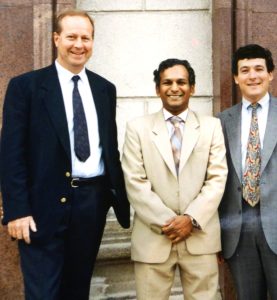
Left to Right: Peter Germer, Neelan Tiruchelvam, and Steve Kanter
None of us were paid for our work. Our expenses were funded by the Danish government, which at the time spent around 1.5 percent of its GDP on democracy-building and rule-of-law efforts around the world. I think, honestly, the government was hoping our involvement would lend international legitimacy to their document, partly to reassure foreign investors and Western governments that this new state would be a genuine rule-of-law society. Kazakhstan had major oil reserves and other significant natural resources, and it was at the time the fifth-largest nuclear power in the world, so it attracted a great deal of international attention. They wanted credibility, but I am not sure they fully anticipated how independent we would actually be. We were polite and respectful, but we did not hold back. We said exactly what we thought needed to change.
Shanmugathas: Could you talk about the draft constitution and what it envisaged and what elements it contained?
Kanter: Kazakhstan had an imposed Soviet constitution, and then began rethinking it once Gorbachev launched Glasnost and instructed the republics to begin their own reform processes. After the Soviet breakup, President Nazarbayev appointed both a working drafting group and a more senior, politically connected group to review and revise their output. The working group studied constitutions from all over the world, including other post-Soviet republics, Europe, the United States, and Asia, before producing their first working draft. It was a fairly lengthy document, and they had already made many tentative choices by the time we saw it. We received it in English translation from the original Russian well before traveling there, so we could research comparative models and prepare ourselves properly. Our role was to spend a couple of weeks meeting with the working group and many other interested parties, going through the provisions, suggesting modifications, discussing process, and generally helping to facilitate movement toward a document that would genuinely support a constitutional democracy.
The first draft was genuinely sophisticated, and the team had clearly done real work, but it had some significant flaws. The first was that it had far too much rigid detail in areas that needed flexibility for the future, while the rights of individuals, an area historically and culturally neglected under the Soviet system, were left underdeveloped and vague. We felt that was entirely backwards. Rights needed to be specific and robustly protected, while ordinary governmental operations needed to remain flexible and adaptable over time. The second flaw was that even the rights that were listed came with such significant qualifications that ordinary legislation could effectively override them, meaning they could not be reliably enforced as genuine rights at all. Third, the structure of government was a confused mixture of different systems that resulted in too much centralized power in the presidency and too little in the legislature or the courts. Fourth, given Kazakhstan’s deep ethnic and religious diversity, managing inter-ethnic relations was always going to be a central challenge. They explicitly rejected federalism, and their reasoning was actually sound. They worried that because different ethnic groups were already geographically concentrated in different regions, a federal structure would harden into separate ethnic enclaves and risk the kind of inter-ethnic violence seen in neighboring countries. But their alternative solution still concentrated too much power at the national level, to the point that even local officials were appointed directly by the president. To their credit, they substantially addressed many of these issues in the final draft. Language was probably the single most contentious issue throughout the entire process.
Shanmugathas: As a member of the consulting group, what were some of Dr. Tiruchelvam’s views and critiques of the draft constitution?
Kanter: We worked together so closely as a three-person team that it is genuinely difficult to separate his views from mine or Peter’s. We would spend all day with the working group, go have dinner together in the evening, and then continue working late into the night, and by the next morning the three of us would usually have arrived at a fairly unified position that drew from each of our perspectives. But what I can say with confidence is that his experience in Sri Lanka and his deep concern for inter-ethnic harmony were areas where he brought enormous wisdom and practical insight. Those concerns shaped a great deal of our collective work. At the time, Kazakhstan’s approximately 17 million people were roughly 40 percent ethnic Kazakh and 40 percent ethnic Russian, with the remaining 20 percent spread across groups that included about a million ethnic Germans, as well as Uzbeks, Tajiks, Koreans, and ethnic Chinese. It was a genuinely mixed society, which made the constitutional questions around ethnic and cultural coexistence absolutely central to the entire drafting project.
Shanmugathas: Given that Dr. Tiruchelvam had a vast amount of knowledge on ethnic conflict, partly owing to his situation in Sri Lanka and the civil society organization he had established, the International Centre for Ethnic Studies, could you talk about how the recommendation report addressed the issue of ethnicity and pluralism, given the 40/40 ethnic split?
Kanter: Kazakhstan was fortunate in that, even under Czarist and Soviet rule, the different groups there had developed real practice in working together and finding compromises. It was not artificially cobbled together the way some post-colonial states were. But there were genuine ethnic and religious tensions to manage constitutionally, and Neelan was critically involved in several key provisions. The first was language. Interestingly, even many ethnic Kazakhs did not read or write Kazakh well, since it had historically been an oral language and Russian had been the practical administrative language under Soviet rule. There was real sensitivity around this. Using Russian made practical sense, but the country was asserting its independence from what many felt had been a colonial relationship, and the Kazakh language carried real symbolic pride and national identity. The final constitution handled this by making Kazakh the official language while designating Russian as the language for interethnic communication, a deliberately vague formulation, and requiring that laws be published in both languages. This tried to balance the practical necessity of Russian for government and commerce with the symbolic and cultural importance of Kazakh, and the provision also extended protections to other minority languages and cultures. The second area was the separation of religion from the public sphere, ensuring that no single religion could hold dominance, along with broader bill-of-rights protections for ethnic and religious minorities. Third, there was a requirement that the president be able to speak fluent Kazakh, to ensure the country would not simply be governed indefinitely by ethnic Russians. Beyond these specific provisions, we also succeeded in persuading them to introduce meaningful local decision-making and local selection of officials, which gave different ethnic communities genuine representation not just at the national parliamentary level but in local councils, which I think mattered a great deal.
Shanmugathas: Would you say the people of Kazakhstan had largely resolved the language question and the question of pluralism themselves, and what specific recommendations did the consulting team contribute?
Kanter: I would not say they had solved it. I would say they were aware of the problem and had attempted a solution. They actually published their first draft publicly in newspapers, and the language provisions caused more public controversy than anything else in the document. Their original language article was much simpler and lacked the layered minority-language protections that ultimately appeared in the final version. That expansion was substantially our recommendation. The decentralization provisions were similarly our contribution. Their initial draft had the national government appointing all local officials and maintaining control over virtually everything from the center. We suggested essentially inverting that structure, leaving local matters to local control, and the final draft adopted almost all of those suggestions, at least theoretically creating a much less bureaucratic and more flexible system better able to accommodate the country’s different regional cultures and communities.
Shanmugathas: What specific language recommendations did you make in the consulting report?
Kanter: We agreed with their basic instinct to treat Kazakh and Russian as co-equal languages, but we pushed for explicit protective language ensuring that neither could be diminished or displaced, that no one could be prevented from studying their own language, and that even smaller minority languages beyond Russian and Kazakh would receive some constitutional protection. Those provisions appeared both in the dedicated language article and in various individual-rights sections throughout the document. Our final report contained roughly 70 specific suggestions, a good number of which were adopted. But a great deal of the real progress happened informally, in daily working sessions where the three of us sat with the drafting group and worked through the language word by word, rather than simply through the written report. Neelan was particularly effective in those sessions. He was very good with people, and those face-to-face working sessions were really the heart of what we did.
Shanmugathas: Did the people you met generally express enthusiasm for constitutional reform?
Kanter: Not universally. Some genuinely mourned the Soviet Union’s collapse and wanted no change at all, while others were impatient for much more rapid change than the government was prepared to allow. There was a real spectrum of opinion. But most of the young people on the president’s working group were genuinely driven to build a rule-of-law society, even if some were more idealistic and others more cautious about how realistic that ambition was in practice. There was of course a very popular and very powerful president sitting over the top of all of this, which had its own effect on the dynamics. But overall there was real enthusiasm, and the people we worked with were quite open to our ideas and genuinely willing to share their own.
Shanmugathas: Could you talk about the deliberations that took place between you, Tiruchelvam, and Grimmer during those two weeks, and speak to the exchange of ideas and opinions that still stick with you today?
Kanter: Before I get to the substance, I want to say that in just two weeks we became genuinely good friends. Neelan was warm, thoughtful, intellectually sharp, and had a real sense of humor. He was simply the kind of person you wanted to spend time with. He cared deeply about his own country’s struggles and ultimately gave his life for that cause. His wife traveled with him on the trip, and I got to know her a bit as well. They were a wonderful pair. Our deliberations as a group were intense, since we came from three very different constitutional backgrounds, but all three of us combined real assertiveness with genuine humility and a willingness to listen and learn from one another. We would meet with our Kazakh counterparts during the day, and then the three of us would go off in the evening to eat and continue debating and refining our thinking late into the night. Sometimes one of us changed our mind entirely based on the others’ arguments. Neelan’s experiences, instincts, and suggestions shaped how all of us approached the issues and the specific textual language we proposed, and a fair amount of the text he suggested ended up directly in the final document.
Shanmugathas: I know it has been nearly 30 years, but do you recall what some of those opinions were that Dr. Tiruchelvam expressed during those deliberations?
Kanter: The thread running through nearly everything he argued was that whatever kind of system emerged from this process, it needed to guarantee that every person, regardless of ethnic background, religion, or economic and social status, would have security of person, security of rights, and a genuine opportunity to fulfill their potential within society, without being unfairly targeted or stigmatized because of who they were. That principle animated almost every suggestion he made, and I believe it led to a significantly better document than would otherwise have emerged. He also brought real intuition to one of the hardest challenges of constitution-making in general, which is figuring out how far along the spectrum from where a society currently stands to where it ideally should be a constitution should actually sit. If you set the bar too close to current reality, there is no meaningful progress. But if the gap between the text and the reality is too great, people may find it impossible to follow, which breeds disrespect for the constitutional process itself and can leave you far worse off than before. Language alone does not solve this problem. You need a living constitutional culture and structure to back it up. We both understood from the beginning that this document would likely be, at best, an interim constitution, given how dramatically the country was still changing. I had hoped it might give them five to ten years in an optimistic scenario, but major amendments came considerably sooner than that.
Shanmugathas: Given that Dr. Neelan Tiruchelvam pushed for a federal solution in Sri Lanka, could you talk about how both of you approached the question of federalism versus a unitary system in the context of Kazakhstan?
Kanter: Initially both Neelan and I leaned strongly toward federalism. It seemed like the logical fit for such a large, multiethnic country in obvious need of real decentralization. But we came to agree that the Kazakhs’ objections were legitimate and worth taking seriously. Their fear was that true federalism would risk turning each geographic sub-unit into an ethnic enclave, since the various ethnic groups were not evenly distributed across the country. Ethnic Germans were concentrated around Baikonur where the space program was based, Russians and Kazakhs were most mixed in the capital, and other groups were concentrated in the east or west depending on the community. Their concern was that a formal federal structure would actively accelerate that self-segregation, eventually producing the kind of warring regional factions they had watched emerge in neighboring countries. So instead, both Neelan and I pushed for capturing the practical benefits of federalism, genuine local control over local decisions, within a formally unitary system. We drew on how U.S. states, while technically supreme within their own jurisdictions, devolve significant authority down to cities and towns. That became the model we advocated for, and I think it was the right call given the specific circumstances.
Shanmugathas: Could you talk about the press conference held at the end of your two weeks in Kazakhstan?
Kanter: That was a fascinating and somewhat tense experience. I think the government had initially assumed we would simply endorse their existing work and give it an international stamp of approval. They were genuinely surprised by how hard we worked and how actively we sought out people and groups outside the official approved list, including some groups they were openly suspicious of. As that became clear, they started making excuses about the planned press conference, saying it was inconvenient, that no suitable venue could be found, and so on. We eventually told them plainly that since they appeared unable to arrange it, we had already extended invitations ourselves and had cameras ready to go with or without them. At that point, they sensibly decided cooperation was in their interest and got back involved. The press conference itself went very well. I think they may have worried we would be harshly critical, but by that point we had developed genuine working relationships with these people and we were not there to be critical for its own sake. We told the truth, including naming real challenges, but we also sincerely praised the overall effort, which deserved that recognition. In the days afterward, walking down the street, ordinary people would stop us through our interpreter to say they had seen us on television and now felt more confidence in the constitutional process. That was quite something.
Shanmugathas: On January 20th, 1993, the legislature ratified the new constitution. Of the 70 recommendations in your report, how many were adopted, and which significant recommendations made it into the final document?
Kanter: I do not recall the precise count off the top of my head, but most of the significant recommendations were adopted in substance, even if the exact wording sometimes differed from what we had proposed. The minority language protections were one major example. The individual rights article was substantially strengthened, including free speech and property rights, though land itself remained state-owned. What the constitution did establish was a right to use land and pass that use on to one’s family, similar to how China’s system functions today. The decentralization provisions that Neelan worked on so extensively were largely adopted, removing many of the specific national-control limitations and leaving more to be resolved locally and through the legislature over time. We made less headway on the balance of power between the presidency and parliament, where we faced the most resistance. We also played a significant role in shaping the design of the new Constitutional Court, though it eventually, somewhat against our advice, issued some very assertive early decisions, including invalidating an entire parliamentary election. The president backed those decisions initially, but once it became apparent that the court might eventually enforce the constitutional provision limiting him to two terms, he moved to substantially weaken it through a constitutional amendment, filling it largely with his own executive appointees. That remains one of my biggest regrets from the whole process. The court had genuinely capable judges and real promise, and it never got the chance to fully mature as an institution.
Shanmugathas: Could you talk about what the Constitutional Court was, and what recommendations you, Neelan, and Peter Grimmer made with respect to it?
Kanter: Their prior court system was modeled on the Soviet structure and consisted of general courts handling family and criminal matters, and separate commercial arbitration courts for business disputes. What it entirely lacked was any judicial mechanism for enforcing individual rights or the constitution itself. Whatever the constitution said, enforcement was effectively left to the discretion of the president or the legislature, which meant constitutional provisions could be ignored whenever politically convenient. They were considering creating a dedicated constitutional court with genuine authority to interpret and enforce the constitution as binding law, independent of the political branches. We brought them many international models and made recommendations for ensuring the court’s independence, the professional qualifications of its judges, and its insulation from political pressure. The model we arrived at included seven justices with meaningful tenure and independence. For about a year and a half it functioned very well with genuinely capable people on the bench, before the political pressures I described ultimately undid much of what had been built.
Shanmugathas: Which of Dr. Tiruchelvam’s specific recommendations were adopted into the final constitution?
Kanter: Above all, the strengthened protections for ethnic, religious, and cultural minorities. Those were extremely important and he pushed for them with great persistence and real effectiveness, and we were quite successful in getting them through. The decentralization provisions were the second major area he championed. Both represented significant wins for the overall document and, I think, for the people of Kazakhstan.
Shanmugathas: Twenty-six years after the ratification of the Kazakhstan constitution, what is the state of the country, and has the constitution genuinely protected the interests of its diverse population?
Kanter: I will start with a small humorous aside. One of my recommendations was simply that they find a way to reach Kazakhstan that did not involve flying through Moscow on Aeroflot, as my own initial trip required three or four connecting flights just to get there. They have since built a new capital, Astana, in the center of the country, and have established direct flights to other European capitals. They also broke away from the Russian ruble and based their currency on their own considerable reserves, another recommendation I made in an article I wrote at the time. On the bigger picture, the positives first: they have largely avoided the inter-ethnic violence that has plagued many neighboring countries, and they mostly honored their commitment to eliminate their nuclear arsenal, returning weapons to Russia or allowing them to be destroyed under the START framework. That commitment deserves real acknowledgment, because Kazakhstan at independence was the fifth-largest nuclear power in the world, with the Soviet Union’s most advanced missiles positioned there aimed primarily at China throughout the Cold War, reflecting longstanding anxieties about Central Asian stability that both Moscow and Beijing still share. The entire Soviet nuclear testing program had also been based in Kazakhstan, leaving a terrible legacy of radiation-related health problems, including extraordinarily high rates of birth defects in places like Semipalatinsk. On the less positive side, many ethnic Russians and Germans emigrated after independence, eroding some of the multiethnic balance that had existed. Nazarbayev remained popular and in many respects performed reasonably well as a leader, but I genuinely wish he had honored the constitution’s two-term limit and peacefully transferred power to the next generation. He did not, choosing instead to amend the constitution to remain in power, which I consider a real step backward. Corruption also remains an ongoing challenge. All that said, given that Kazakhstan operates in a genuinely difficult neighborhood, I would give them a solid assessment overall. Not an A student, but doing meaningfully better than many might have predicted.
Shanmugathas: You disagreed with Peter Grimmer and Neelan Tiruchelvam on the question of including positive rights, such as healthcare, as fundamental constitutional rights. Could you talk about that?
Kanter: That disagreement was one of the more intellectually honest and productive tensions within our group. Under the Soviet constitution, all kinds of economic, social, health, and welfare rights had been guaranteed on paper while rarely being genuinely delivered in practice. Most constitutions around the world do recognize rights to adequate healthcare, housing, and education, and I am broadly sympathetic to that approach in principle. The American constitution notably does not go that far. My concern, however, was not with the underlying values but with conflating two very different kinds of rights within a single constitutional document without clearly distinguishing how each should be enforced. A court can relatively cleanly enforce a right to free speech. It is far more complicated for a court to enforce a right to a good education, because genuinely delivering education requires legislative appropriation, resource allocation, and sustained administrative capacity over time, not simply judicial restraint. My worry was that a still-developing country making constitutional promises it cannot yet fulfill risks breeding public contempt for the law itself, and that autocrats can then exploit that erosion very easily. Peter and Neelan were more inclined to include positive rights directly and robustly. If I were drafting a constitution today, including the American one, I would include some positive rights around a clean environment and basic healthcare, but I would place them in a clearly separate article from the judicially enforceable negative rights, framing them as legislative commands to be fulfilled progressively within the country’s actual economic capacity.
Shanmugathas: At the end of the day, were positive rights omitted from the recommendations, or how was that ultimately resolved?
Kanter: It was something of a divided outcome. The final constitution includes both negative checking rights and positive economic and welfare rights, but with some differentiation in how they are treated and enforced. Neelan held one position, Peter another, and I held a third, and the Kazakhs ultimately constructed their own blend after hearing from all three of us. None of us was entirely satisfied with how it came out, but it was a clear improvement over the original draft from all of our perspectives.
Shanmugathas: With respect to the fact that Kazakhstan was also multi-religious, how did the recommendations address that dimension?
Kanter: The constitution made clear that no single religion should hold any primacy over others. Ethnic Russians who were religious tended to practice Russian Orthodoxy, ethnic Kazakhs were primarily Muslim, but there were also Buddhist communities, entirely nonreligious populations, and various smaller groups spread across the country. The provision was deliberately framed to avoid privileging any one tradition and to ensure that religious identity could not be used as a basis for discrimination or exclusion.
Shanmugathas: Having worked with Dr. Tiruchelvam, what do you believe the world lost as a result of his death?
Kanter: We already have too few people of his character, and the world needs more of them, not fewer. Losing someone to violence is always a particular tragedy, but losing someone of his capabilities and commitments is especially painful when you consider everything more he could have done. My understanding is that he had already built a significant legacy by the time of his death, and people have continued that work in his name since then, which is something. There is always a risk that an assassination like his frightens others away from the kind of courage he demonstrated. But I hope his example does the opposite. He showed bravery, paid for it with his life, and accomplished a great deal because he genuinely believed in what he was doing and was willing to act on that belief. We are living through a genuinely perilous time in many ways, and the world still badly needs people with that combination of intelligence, courage, and character.
Shanmugathas: Finally, going back to the press conference at the end of your two weeks in Kazakhstan, you mentioned expressing some criticism during it. Could you talk about the substance of what was expressed?
Kanter: I would not characterize it as criticism, exactly. We applauded the genuine effort behind the constitution, which at that point had not yet been ratified, though we were hopeful and confident it would be. But we stressed that adopting a constitution, as significant as that step was, is only the beginning. A constitution alone does not guarantee it will be followed, that it will survive, or that a society will continue developing into a genuinely functioning civil society. The real responsibility lay ahead, and it fell on the president and everyone else who held power in the system to keep pursuing a dignified, rule-of-law society where every Kazakh citizen had a genuine opportunity to fulfill their potential. That was the message we left them with, and I think it was the right one.
Shanmugathas: Thank you so much for speaking with me.
Kanter: Thank you.
