
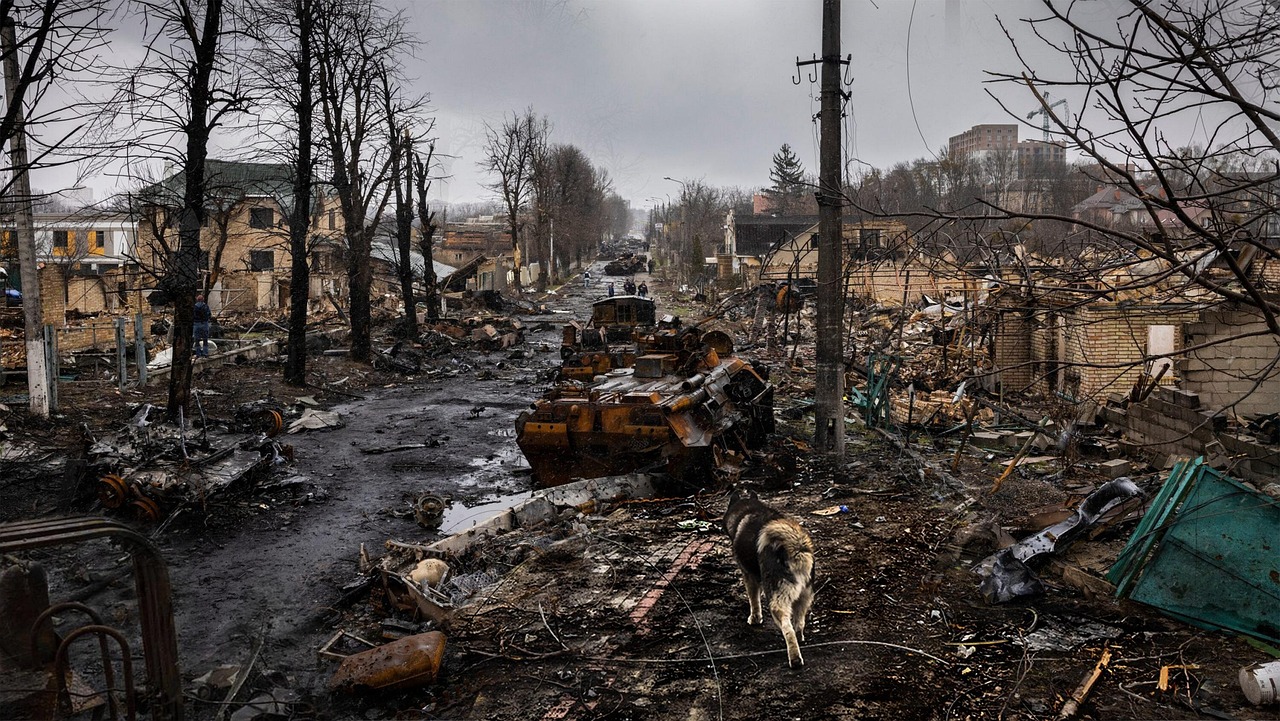
International criminal law has no crime that squarely covers the deliberate, large-scale destruction of civilian infrastructure—a gap a recent white paper proposes to close by recognizing ‘Mass Destruction’ as a new crime against humanity. Its author, Professor David M. Crane, is the founding Chief Prosecutor of the Special Court for Sierra Leone and an internationally recognized expert in international criminal law.
In this interview, he speaks with Aaryaa Shinge, Managing Editor for Long-Form Content, about the legal foundations of the proposal, its relationship to existing international crimes and the practical challenges of investigating and prosecuting large-scale destruction of civilian populations and infrastructure during armed conflicts. He also reflects on the evidentiary, technological and environmental dimensions of accountability and considers how international criminal law may continue to evolve in response to emerging forms of large-scale civilian harm.
The interview is lightly edited for clarity.
JURIST: Please tell us more about how the paper proposes an entirely new category of international crime and generally explore how often international criminal law actually expands in this way and what it takes for a new crime to go from legal paper to binding international law?
David M. Crane: There are several ways the international community can create new crimes [against humanity]. One is via convention, the other way is by amending existing treaties, and the third for crimes against humanity—one can charge new criminal conduct as an “other inhumane act”—to wit mass destruction. This has been found to be a valid way to create a new crime under law as we did this in creating the new “other inhumane act” of forced marriage in times of armed conflict which the UN-backed Special Court for Sierra Leone Appeals Chamber found appropriate and legal.
The concept of “Mass Destruction” began in my thinking during the aggression against Ukraine by the Russian Federation as the unfortunate conflict began. When the military options for Russia began to diminish, they began a foreign policy of attacking Ukraine just for the purposes of attacking it, and destroying civilian infrastructure with the knowledge that they cannot win the conflict in any way, shape, or form. There was no militarily necessary reason for their acts, and I began to think about this as a possible new crime against humanity and “other inhumane act”. Shortly afterwards we had the tragedy in Gaza in October 2023 and Israel rightfully reacted and retaliated, but then they kept moving forward and began to destroy Gaza; not with an intent to militarily defeat Hamas, but just to destroy Gaza, as that particular military operation moved forward. It began to crystallize in my mind that a member state of the United Nations chooses as a matter of policy to destroy a combatant in a conflict just for the purposes of destroying it, not with intent to destroy in whole or in part, but just beat down the civilian population almost out of revenge.
I realized that this is not genocide and it doesn’t quite fit in the other listing of crimes against humanity and so I looked at the “other inhumane act” portion of various statutes and said that we could probably create a new crime against humanity called “Mass Destruction.”
In the white paper that we recently published on Mass Destruction, we posit two ways by which we might consider a new crime against humanity either by amending the Rome Statute, or using the “other inhumane act” provisions as I’ve said related to the crime against humanity. That is my overall four corners approach to why I was thinking of creating a new crime against humanity called “Mass Destruction” based on the conflicts in Ukraine and in and around Gaza.
JURIST: The term Mass Destruction is used deliberately, rather than adapting existing language like “wanton destruction” or “urbicide.” What work is that name doing, and what would be lost by prosecuting the same conduct under a label that already exists in the legal lexicon?
Professor Crane: The term was deliberately chosen to describe the gravamen of the criminal conduct: the wanton destruction of civilian persons and objects with intent to destroy without any militarily necessary reason to do so. This is a general intent crime where a combatant who cannot win the conflict chooses to beat down and destroy the other party without any other purpose other than to destroy.
The beauty of the “other inhumane act” provision in crimes against humanity statutes, including the Rome Statute, is that it allows the international community and a prosecutor to adapt and adjust to new circumstances which were not contemplated when the Tribunal was put together. The “other inhumane act” provision allows a prosecutor to look at the facts and try to capture the gravamen of the offense in other words, which is different from “wanton destruction,” which could be limited.
This is a state policy to destroy and to beat down and destroy civilian infrastructure just to punish civilians — when a state party decides it can’t win and begins to punish civilians and civilian infrastructure for its inability to win on the battlefield. That’s why “Mass Destruction” is another possibility that a prosecutor can use to hold accountable those who are beating down a member state of the UN in a conflict for no apparent reason other than to punish and beat them down. This is adding to the crimes against humanity not taking away or moving aside other possible crimes against humanity like “wanton destruction”.
JURIST: International criminal law has historically moved to name new crimes only after the atrocities that prompted them have already ended. You have prosecuted atrocity crimes during and immediately after conflicts rather than from a distance. Does that proximity sharpen the legal analysis or complicate it?
Professor Crane: I don’t think it makes any difference, we prosecuted during times of conflict and when the conflict has ended. The key is that the crimes are being committed and it is important to seek justice for the victims of those crimes and capture the gravamen of the offenses being perpetrated by all parties within that conflict.
Practically speaking it is possibly more difficult to maybe investigate allegations of crimes because there’s an ongoing conflict, but from a legal point of view it doesn’t diminish the crimes of an ongoing criminal enterprise.
JURIST: If Mass Destruction were applied to a conflict the framework does not anticipate—one without the scale of Ukraine or Gaza, or one involving a non-state actor as the primary perpetrator—do you think the proposed elements would require refinement?
Professor Crane: The scale is important. The general intent of the combatant is to beat down a people, a society, and a country without reason or rationale. It does not have to be an international conflict. One can imagine a rebel force that has the capacity to destroy. The concept of “other inhumane act” under the crimes against humanity is related to mass destruction. It’s a general intent crime and is designed to be used both in an international as well as a non-international armed conflict. It has a legal effect if a party to a conflict is attacking civilians for no purpose other than just to attack them. They don’t intend to destroy—in whole or in part like genocide—but they’re just beating them down. It’s important to understand that there’s an actor who does these acts and intends for these acts to be perpetrated, that’s a general intent crime and can be prosecuted whether it’s an international armed conflict or a non-international armed conflict.
JURIST: Prosecutions for Mass Destruction would rely on satellite imagery and remote-sensing data gathered by private companies whose data collection, retention, and licensing practices are governed by commercial rather than legal imperatives. How should international criminal law establish authentication standards for such evidence?
Professor Crane: In today’s world of investigating and prosecuting international crimes, there’s a whole panoply of tools both governmental, non-governmental as well as commercial tools that can be used by a prosecutor to prove each and every element of the crimes beyond a reasonable doubt. Certainly, there are commercial entities that provide the ability for prosecutors to use that data to turn it into evidence to prove their cases beyond a reasonable doubt, but it’s not the only thing that can be made available. It’s just there for a prosecutor to consider using, but again, there are other tools that a prosecutor can use.
Witness testimonies, demonstrative evidence and expert evidence are also very important in crimes against humanity, namely a widespread or systematic attack on civilians and “other inhumane acts” such as mass destruction could be used in various ways. Commercial entities could be used if necessary. Something that I did, though, was slightly different when I was in West Africa; a prosecutor is going to want his own evidence that is picked up by his investigators, as opposed to just relying completely on commercial entities.
To answer your question, there are commercial entities out there, but we don’t need them necessarily. It does not make a difference. Though evidence available by commercial means is a tool and gives capacity to prove, the fact that mass destruction is a general intent crime one only has to show the resulting destruction by whatever practical means [to include commercially] and that the alleged perpetrator did it or caused it to happen. The key to evidence being proffered in court is that there’s a proper foundation laid and that the evidence is relevant along with the way that a prosecutor would look at proffering evidence in a court of law.
JURIST: Autonomous and AI-driven weapons systems are increasingly capable of destruction on the scale the framework contemplates. How do the principles of international humanitarian law apply to these emerging tools, and does Mass Destruction reach harm inflicted through them?
Professor Crane: There are two aspects of international humanitarian law, one of which is protecting people on the battlefield that’s mainly through the Geneva Conventions; and there’s also the Hague rules and various protocols and treaties related to how we use weapons systems. These are tools combatants can use for militarily necessary reasons to engage another combatant on the battlefield and the development of various types of autonomous and artificially driven weapons systems are just that.
They are tools of which a direct or indirect operator still must follow the principles of international humanitarian law and the laws of armed conflict in ensuring that their targeting is for a militarily necessary reason to target. If it’s not there, it’s automatically a war crime. As of now, as the tools are advancing with artificial intelligence and unmanned systems, we still have to overlay the principles that I have just mentioned in order to use these tools legally on the battlefield.
JURIST: Ecological damage in conflict zones—contaminated water sources, destroyed agricultural land, toxic rubble leaching into soil—tends to manifest years or decades after hostilities end, long after the political and legal momentum for prosecution has dissipated. Should environmental harm carry independent weight in satisfying the gravity threshold for Mass Destruction?
Professor Crane: It can be evidence of an intent to punish a civilian population for the reasons that we’ve talked about and those types of acts can be used to show that a state that is a party to a conflict has decided as a matter of policy to punish and beat down a civilian population. Reasons are that they cannot win the conflict and they choose to punish the population. Certainly attacks on the environment or similar targets are automatically potential war crimes if there’s no militarily necessary reason to do so, ecological damage could be shown as some evidence that a state party is intending to invoke mass destruction on another.
