
 Features
Dimitri Lascaris is a Canadian lawyer, journalist, and activist whose career has taken him from the upper echelons of corporate law to the front lines of some of the world’s most dangerous conflict zones.
After graduating from the University of Toronto Faculty of Law in 1991, Lascaris began his legal career at the Wall Street firm Sullivan & Cromwell, before joining Siskinds LLP in 2004, where he co-founded Canada’s largest securities class action team and recovered more than $450 million for aggrieved investors. Canadian Lawyer Magazine named him one of the 25 most influential lawyers in Canada in both 2012 and 2023, and Canadian Business Magazine called him the “fiercest legal advocate for shareholder rights.”
At the age of 52, having achieved financial independence, Lascaris walked away from what he estimates was $15 to $25 million in future earnings to devote himself full time to journalism, peace activism, and pro bono human rights legal work. He runs the YouTube channel Reason2Resist, through which he has reported from Lebanon, Israel, Venezuela, and most recently Iran during the ongoing U.S.-Israeli bombing campaign.
In this interview, conducted by JURIST Senior Editor for Long-Form Content Pitasanna Shanmugathas, Lascaris speaks candidly about his decision to leave corporate law, the moral failures of Canada’s legal establishment, his eleven days of on-the-ground reporting in Iran amidst US-Israeli bombing, the human cost of U.S.-led sanctions on Cuba and Venezuela, and what ultimately drives him to risk his life in the cause of justice.
This interview has been lightly edited for concision and flow.
Shanmugathas: Mr. Lascaris, you were one of Canada’s leading plaintiff-side securities class action litigators, representing plaintiffs in class actions against multi-million dollar companies. Despite still being relatively young, you chose to retire at the age of 52 from that extremely lucrative career to devote yourself full time to the cause of peace. You became a journalist and peace activist, travelling to war-torn regions and doing reporting in places like Israel, Lebanon, Russia, Venezuela, Cyprus, and most recently Iran amidst the U.S.-Israeli bombing. Most people at the age of 52 with a rich and thriving legal career would have been complacent and uninterested in such a radical life change, but you were different. What made you decide to leave such a lucrative legal career and pursue journalism, peace, and activism full time?
Dimitri Lascaris: I’m glad you asked, because I have a message for law students—especially those who want to speak out against injustices by Western governments but feel pressure not to. I come from a family that was not poor, but certainly not well off. My parents immigrated to Canada in the 1950s after surviving the Depression in Greece, the Nazi occupation, and a brutal civil war.
At the time, the Canadian government was actively seeking cheap labour and turned to southern Europe—countries like Greece, Portugal, and Italy—preferring this over recruiting from the Global South due to racial biases. My parents arrived through that system, leaving behind a devastated country they never wanted to leave. That history stayed with me.
I grew up in modest but stable circumstances. We always had food, shelter, public healthcare, and education. I’ve always considered myself fortunate, and I never forgot where I came from.
After graduating from the University of Toronto in 1991, I became a Wall Street lawyer and was never financially insecure again. As my career progressed, I reached a point—by age 52—where I realized I didn’t need to earn any more money to live comfortably and support my family. So, I asked myself: why continue accumulating wealth when I could give back?
Leaving when I did meant walking away from an estimated $15 to $25 million in future earnings. I knew exactly what I was giving up. I also made that decision with my wife’s support after carefully assessing our financial security. I’ve never regretted it.
That financial independence gave me something invaluable: the freedom to speak openly without fear. I’ve been attacked and labeled in the media in all sorts of ways, but I don’t care—I’m not doing this for money.
My message to young lawyers is simple: money is not everything. The legal profession is privileged, and once you achieve financial security, you have an obligation to give back. I understand that early in your career it can feel risky to speak out—this profession can be unforgiving. Many young lawyers tell me they fear consequences for expressing their conscience. That fear is real. But once you reach a position of independence, you have a responsibility to use your voice for those far less privileged.
Shanmugathas: I should also say that although you retired from your work as a class actions lawyer, you are still an active lawyer in good standing. You do work on legal cases, but now you do it pro bono. You are what I would describe as an activist lawyer, representing clients on human rights issues related to the Israel-Palestine conflict, for instance. Several of the law students I have spoken to are trying to navigate that balance. They are idealistic and socially justice oriented, but they wonder whether the legal profession has a place for them. What would you say to those students?
Lascaris: Just to clarify, I still have some residual involvement in class actions, but it’s minimal—mostly providing funding and occasionally consulting with the lawyers running those cases. I haven’t personally litigated in that space for a long time. I also represent about seven or eight clients pro bono, doing roughly 500 to 1,000 hours of pro bono work each year since retiring, all focused on human rights and international law. But the majority of my time now is devoted to journalism.
As for your question, I don’t have good news. The legal profession is dominated by ruthless scoundrels—I’ll be blunt about that. Let me give you an example.
I represent a group of current and former law students from Toronto Metropolitan University (TMU). They enrolled in what was supposed to be a social justice–oriented law school. Shortly after the genocide in Gaza began, they sent a private letter to the administration expressing criticism of Israel. The letter was leaked, and some of the most powerful lawyers in Ontario launched a campaign to destroy these students’ reputations—falsely accusing them of anti-Semitism, support for terrorism, and even promoting sexual violence. These were outrageous, defamatory claims, and some of those lawyers openly stated they would try to prevent these students from ever finding legal employment.
The university responded by launching an independent investigation led by a former Chief Justice from Nova Scotia. I, along with several other lawyers, represented the students pro bono. After months of reviewing extensive evidence, the investigator concluded that while the students may have expressed themselves inelegantly, nothing they said was anti-Semitic and there was no basis for any discipline.
What followed was deeply troubling. Some of the same lawyers doubled down, attacking the investigator and refusing to apologize or retract their statements. They continued efforts to damage these students’ careers. In my view, this reflects a profound moral failure within segments of the legal elite.
For what it’s worth, I’ve also had numerous complaints filed against me with the Law Society of Ontario because of my advocacy on Palestine and criticism of Zionism. Every one of those complaints was dismissed without requiring a defence.
I say all of this so you understand the reality of the profession you are entering. There are paths where you can work in accordance with your conscience, but they are not lucrative. You will likely struggle financially, especially given the debt many students carry. That, frankly, is an obscenity. When I graduated in 1991, I had $30,000 in debt. If I had gone into social justice work instead of corporate law, it would have taken me far longer to repay it.
So yes, meaningful, principled legal work is possible—but it comes with real financial sacrifice. And if you choose to work on Bay Street, you should be aware of the ethical compromises that environment may demand.
Shanmugathas: I should also say that I am fortunate enough to be a student at the University of Windsor Faculty of Law, where the dean is Palestinian. The student body and the administration are pro-Palestinian, to the point where our law school courses incorporate a great deal of Palestinian content. I had readings on Edward Said’s Orientalism, and professors would regularly refer to the genocide in Palestine as a matter of fact. It was not treated as a shock. You might be pleased to know, for instance, that when I took administrative law, my professor mentioned the case of Kattenburg v. Canada, where you legally represented Dr. David Kattenburg, a member of Canada’s Jewish community who challenged Canadian authorities’ labelling of wines produced in Israeli settlements in the West Bank as products of Israel. That was one of the pro bono cases you worked on after you retired as a class actions lawyer. So, when I hear about what is happening at TMU, I find it very hard to relate.
Lascaris: I was aware of this. The University of Windsor has been a genuinely social justice-oriented institution for a long time, even before this dean. But I understand this dean has really taken it to another level and has shown real courage. My hat is off to the University of Windsor faculty and administration for standing up to the pressures one confronts in Canada’s legal profession when one stands for the oppressed.
Shanmugathas: Let us talk about your most recent trip to Iran starting on March 20th 2026. You spent eleven days in the country, having just returned. Talk about how you were able to enter Iran to do your journalistic coverage, and the impact of the U.S.-Israeli bombing on the country that you observed.
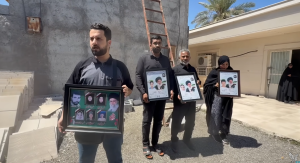
Family members hold photos of loved ones killed in a missile strike on a school in Minab, Iran — one of the deadliest civilian losses of the ongoing U.S.–led military campaign against Iran, which reportedly killed up to 168 students and teachers in the February 28 attack. © Dimitri Lascaris/ Reason2Resist
Lascaris: I want to say very clearly, to segue from our earlier discussion, that no one paid me a dime for what I did in Iran. Our YouTube channel, Reason2Resist, is monetized because I do a great deal of on-the-ground reporting that costs a lot of money, and we receive occasional small donations, though I almost never solicit them. All I am trying to do is make enough from monetization and donations so that I am not losing money on the journalism. But from the beginning until now, having operated the YouTube channel for about twenty months, my expenses have exceeded my revenue by thousands of dollars. I paid my own expenses in Iran. The state broadcaster, Islamic Republic of Iran Broadcasting (IRIB), which is their equivalent of the CBC or BBC, did offer to cover costs, but I declined. I did not want anyone to say I was doing it for money.
I was invited by IRIB along with about twenty other foreign journalists. For various reasons, some likely related to the danger of travelling in a country being bombed, only four of us ended up making the trip. One was Tim Anderson, a former Australian professor. Another was Ahmad Massoud, of Iraqi Kurdish origin, who lives in Florida and runs a YouTube channel called Propaganda and Co. The third was a young Turkish journalist, who joined us as far as Tehran before returning to other commitments. Tim, Ahmad, and I completed the full tour.
We eventually reached Bushehr on the Persian Gulf, which we were told was among the most heavily bombed cities after Tehran and is located near Kharg Island, a critical hub for Iran’s oil exports. From there, we travelled to Bandar Abbas on the Strait of Hormuz. We also visited Minab, where, according to local accounts, U.S. strikes killed 168 students and teachers on the first day of the war. We spent time speaking with victims’ families and visiting the site.
After returning to Bandar Abbas, we travelled by boat into the Strait of Hormuz, then took a 22-hour train back to Tehran, followed by a 12-hour bus ride to the Turkish border. By the time I reached the Turkish city of Van again, I was completely exhausted. From there, I eventually made my way back to Greece.
Shanmugathas: Talk a little more about some of the hardest hit regions you visited, what you observed, the extent of the damage inflicted by the U.S.-Israeli bombing, and your impressions from speaking with Iranian civilians who lost loved ones as a result.
Lascaris: By way of comparison, I’ve been to South Lebanon four times since October 2023, often in border villages less than a kilometre from Israel. There, I witnessed relentless bombardment, constant drones and warplanes overhead, and entire areas reduced to rubble—devastation that only worsened with each visit. I was also in the West Bank during Ramadan 2024, including the Jenin refugee camp in Tulkarem, where I again saw widespread destruction and a persistent military presence. In the lead-up to my trip to Iran, the impression I was getting—particularly from alternative media I respect, and occasionally from mainstream sources—was that the country had been completely devastated. That coverage conjured up the same kind of images I had seen in South Lebanon and the Palestinian refugee camps.
But that is not what I found. If I had simply been dropped into the country and allowed to travel freely, I might not have seen a single destroyed building. More than 99 percent of civilian infrastructure remains intact. That is not because the U.S. and Israel are exercising restraint—they have deployed significant firepower and have targeted civilian sites—but Iran is a vast country, much farther from Israel than Lebanon, and it has functioning air defences. Combined with the dispersal of its population and the relatively short duration of the war, the overall level of destruction is far more limited than what we’ve seen in Lebanon and Palestine.
That said, the damage that does exist is serious and undeniable. I personally inspected multiple residential towers—six or seven storeys high—that had been completely levelled. In the wreckage, you could see people’s furniture, clothing, dishes, and family photographs. I visited hospitals that had been so heavily damaged they were no longer operational and had to be evacuated. Near Bushehr’s airport, I saw a weather station that had been flattened. Outside Shiraz, I examined the site of a civilian emergency centre that had been destroyed in what appeared to be a double-tap airstrike—where a second-strike hits after rescuers arrive. I heard consistent accounts of this pattern in city after city.
I also visited a child in hospital who had been severely injured in an early strike on a school and sports complex. The weapon used was a ballistic missile designed to detonate above ground and disperse tungsten pellets—which radiate outward at blazing speed, extremely hot, to cause maximum carnage—they use this to maximize casualties. Children were playing soccer at the time. The boy I met had undergone multiple surgeries and had a metal rod in his leg. His father told me they had not yet told him that his coach and best friend had been killed in the blast. At the school in Minab, I spent hours carefully inspecting the site, approaching it as both a lawyer and investigator. Based on what I observed, I have no doubt it was a civilian facility and that it was knowingly targeted. I do not suggest that the Iranian government is without fault—it has committed human rights abuses. But based on what I witnessed, I believe Western governments are aligning themselves with actions that cause immense civilian harm, while continuing to present themselves as global defenders of human rights.
Shanmugathas: I know you also spoke with individuals directly affected by the bombing. You mentioned visiting family members of the 168 students and teachers massacred in Minab. Would you share one or two of the stories that resonated with you most?
Lascaris: Before we went to the site itself, we stopped at the cemetery where most of the victims are buried. Right at the edge of the cemetery was the family home of five of the victims. We met with members of that family who were holding photographs of their five relatives who had been killed. One of the men there was a father who had twin sons, very young boys. He was holding them in his arms as he told us about the murder of his wife, who had been a teacher at the school. The boys were sitting there listening. They were so young. I do not think they had entirely grasped what had happened, though I think they were old enough to sense something of it. That was heart-rending. We spoke to four different people at that home who had lost family members, five family members in total. Then we went to the cemetery and found that there were mothers camping there. We were told they wanted their children to feel safe. We also spoke to fathers. They were absolutely outraged by any suggestion that the school had any military connection. They angrily rejected those claims. They said they themselves had no military affiliation, that the teachers were not associated with the military, and that the facility had no military function. They demanded justice. The last man we spoke to was so devastated that he was not even able to be angry. He was simply sitting beside his son’s grave, spreading rose petals onto it.
From there we went to the site of the atrocity itself. I walked around the entire site. You can see it in my report. I would simply ask anyone who doubts what happened there to look at it and ask themselves: does that look like a military facility? And do they genuinely believe that the United States military, with all of its intelligence and surveillance capabilities, the same military that was able to locate the Supreme Leader of Iran and assassinate him along with his daughter and four-year-old granddaughter, could not figure out that site was a school? They knew. They are terrorists and mass murderers. But that should surprise no one, given what they have been doing to Gaza for two and a half years, with the full support of the American, German, British, and other Western governments.
Shanmugathas: Iran is under crippling U.S.-led sanctions. From what you observed, in what ways is that affecting the people of the country?
Lascaris: Surprisingly, they are largely able to lead normal lives, though with difficulty. If you exchange $200 US dollars, they will give you a stack of bills about six inches thick. The US dollar goes incredibly far there. You can fill up a tank of gas for twenty cents. It is the second cheapest gas in the world. There is a significant problem with inflation, and their currency has been crushed. Very few people are able to lead what one would describe by Western standards as a luxurious lifestyle. But most people, as far as I can tell, have everything they need. The grocery stores were full. People eat well. They have hospital care, at least in the vast majority of hospitals that have not been destroyed yet. They drive cars, not luxury vehicles, but modern ones. The streets are remarkably clean.
I will tell you something, Pitasanna. This was not my first time in Iran. I visited Tehran for a week last May. In all of that time, across seven major cities, I have not seen a single homeless person. Not one. Every city I have been to in my adult life in the West, whether it is London or Windsor or New York City, you see homeless people everywhere. How is it possible, under those crushing sanctions, that there is no visible homelessness in that country?
And furthermore, everywhere I go in Western cities, the streets are militarized. Police officers wearing bulletproof vests, carrying tasers, pistols, shotguns in their cars. In Iran, I could hardly see any armed police officers. Even last May, when the Americans and Israelis were openly threatening to destroy the country, I recall walking dozens of kilometres around Tehran without seeing a single armed police officer. I saw a handful directing traffic who did not even appear to be armed. And we are supposed to believe this is some kind of evil police state. I am not saying the government has an unblemished human rights record. But let us get some perspective. And if we are going to cast stones at that government, perhaps we should first try to fix our own.
Shanmugathas: You mentioned visiting the Strait of Hormuz, which Iran has, to a degree, restricted, preventing certain ships from passing through and triggering a spike in oil prices. What can you share from what you observed there?
Lascaris: We had hoped to visit two islands in the Strait of Hormuz—Hormuz Island and Kish, the largest island in the Persian Gulf, visible from Bandar Abbas. But the night before, the Israelis bombed the port on Hormuz Island, so our plans changed.
I should note a pattern that emerged on the trip: sites we visited were often struck shortly after we left. This happened three times in Bushehr. On our way to Minab, we examined a demolished civilian antenna facility and a drone strike hit nearby. Ten minutes after we left the Minab school, a drone strike hit the already destroyed school. On the bus, we all wondered why completely demolished targets were still being hit.
The organizers became alarmed. They had us turn off our phones, hand them to IRIB personnel, disperse, and wait separately at a safe distance. Emergency taxis took us back, giving the strong impression we were being sent a message. Despite this, we decided to go out on the water.
We were initially told we could stay out only twenty minutes and remain close to port, but we ended up spending an hour. I observed an extraordinary number of tankers and cargo ships, most anchored. A few were moving slowly, but the majority were stationary—many Iranian vessels, but some foreign ships waiting for permission to transit.
The bottom line: a vast number of vessels are stuck in the Persian Gulf. Some traffic gets through, but less than ten percent of pre-war levels. The Iranian military controls the Strait of Hormuz completely, and no ship passes without its permission. Donald Trump, Benjamin Netanyahu, or the United Nations cannot change that—it’s simply the reality.
Shanmugathas: In the Iranian diaspora, particularly in Canada and the U.S., there seems to be on the surface significant support for the Shah’s son—his father was the monarch who was ousted in the 1979 Iranian revolution. Did you have a chance to speak with ordinary Iranians inside the country, and if so, did you sense any desire among the population for the Shah to return?
Lascaris: That perception is largely a fabrication of Western media. They portray both the diaspora and Iranians inside the country as supportive of the Shah, which is absurd.
Starting with the diaspora: in the two months before my departure, I spoke with pro-Shah, pro-Trump, pro-Netanyahu Iranians in Montreal, Ottawa, and Toronto. My assessment is that those individuals are essentially fascists—murderous, traitorous, and a disgrace to the Iranian community. Most Iranians in Canada are horrified by what Trump and Netanyahu are doing. Most despise the Shah and despise Trump and Netanyahu even more. For insight, I recommend visiting the website of the Iranian Canadian Congress—despite corporate media framing it as a regime mouthpiece, it represents secular, well-educated, progressive, humanitarian Iranians.
Inside Iran, I spoke with roughly 200 people across seven cities. I did not hear a single person criticize the government. I saw repeated pro-government demonstrations. In Shiraz, for example, people gathered at multiple intersections nightly, waving flags and denouncing the Shah, Trump, and Netanyahu. I did not witness any anti-government demonstrations.
One exception: Ahmad, a journalist who part of our group, spoke to a young couple at a Tehran mall. The woman expressed discontent with the government and the hijab requirement. I would note, though, that in every city I filmed, many women walked freely without hijabs, as visible in my videos.
My friend Sarah, a secular Iranian Canadian who returned to Tehran three years ago, observed that there is a significant segment opposing the government, though she couldn’t say whether it’s a majority. There’s a large middle, which swings with economic and political conditions, and right now, that middle is largely pro-government. Many who might otherwise oppose the regime stay silent in public due to the war. Their priority is national survival. I saw young secular women in pro-government demonstrations acknowledging they do not support the government but are standing with their country, shoulder to shoulder with women in hijabs.
The war has fostered a strong sense of national unity. Iran is an ancient civilization with extraordinary achievements, and its people have a deep, resilient national identity. I witnessed that unity firsthand, as citizens rally in defiance of external aggression.
Shanmugathas: You visited Venezuela recently, after the United States kidnapped its leader Nicholas Maduro and his wife and brought them to New York, where the U.S. government pursued charges against him for narco-terrorism and conspiracy to import cocaine, among other things. What was the mood of the country at that time? Were people supportive of Maduro?
Lascaris: The mood was not like Iran. There were some pro-government protests when I was there, but they were small. I did not see any anti-government protests, and I certainly did not see anyone protesting in support of the United States. But I think the Venezuelan people are somewhat dispirited. I saw something similar in Greece. Greeks used to be very militant about their rights and their social safety net, but starting in 2010 when the IMF, ECB, and European Commission began imposing punishing austerity, every time they went into the streets they were beaten, gassed, and tasered, and the austerity just kept getting worse. The spirit of resistance is nowhere near what it was. I got the same sense in Venezuela. The vast majority of Venezuelans want nothing to do with the Trump regime, and they regard it as an affront, whether they like Maduro or not, that the Americans sent helicopters to kidnap him. They know the drug trafficking claim is nonsense. But there is not as much open defiance as there was on my prior visits.
Shanmugathas: The argument goes that Trump was emboldened by that so-called successful operation in Venezuela and felt he could do the same thing in Iran, which obviously has not worked out. Venezuela has been under harsh U.S. sanctions that have crippled the country. What was the economic situation like from what you observed?
Lascaris: The situation there is worse than in Iran. That probably has something to do with the state of the respective oil industries. Iranian oil and gas is much easier to extract and refine than Venezuelan oil and gas. Iran is much farther from the United States, and it has a strong relationship with China, which is a massive consumer of energy. Iran has also managed to maintain relatively high levels of oil and gas sales. Beyond that, Iran has a diversified economy. It has minerals, impressive technology, it enriched uranium domestically, it has a civilian nuclear program, and it has quite formidable cyber warfare capabilities. It is a genuinely technologically advanced society. Venezuela is not as developed, and the United States is simply able to inflict more harm from closer proximity. So economic conditions in Venezuela are harder.
I do agree with you that the kidnapping of Maduro emboldened Trump. And he made a fatal mistake in assuming this was going to be a quick operation. What he has walked into in Iran is a debacle of epic proportions. If he does not make at least some of the concessions the Iranian government is demanding, there is going to be a global economic crisis that will make the 2008-2009 financial crisis look mild by comparison.
Shanmugathas: Since Israel launched its assault on October 7th, you have visited Lebanon four times. Lebanon has been subject to routine bombing since then, and the Hezbollah leadership, including Nasrallah, has been killed. What did you observe during those multiple visits, and how did things progress as you went back?
Lascaris: With each passing trip, I saw fewer and fewer buildings still standing in South Lebanon. On my last trip, in February 2025, I attended the funeral of Hassan Nasrallah. I want to be clear that I reject the claim that Nasrallah was a terrorist. I do not agree that Hezbollah is a terrorist organization. What is particularly absurd is the designation of Hezbollah as a terrorist organization while the Israeli military, the Israeli government, and the United States government and military are given no such designation. The number of civilians the Israelis have killed vastly exceeds those attributed to Hezbollah. By forty-five to sixty times. The same is true of the United States military, which has killed hundreds of thousands of civilians in West Asia since George Bush came to power, perhaps in excess of a million people. So, I would ask, who are the terrorists in this situation?
By the time of my February 2025 trip, major villages in the south had been completely flattened. Virtually no building was standing in many areas. People were trying to return and rebuild their homes and being killed in the attempt. It is obvious what Israel is trying to do in South Lebanon. They are trying to expel the civilian population because they want the land.
Shanmugathas: One of the correspondents for your news program, Reason2Resist, visited Cuba in February of this year. The Trump administration has pursued a maximum pressure campaign on Cuba designed to oust the communist government. What can you tell us about the impact this campaign is having on the Cuban people?
Lascaris: It is horrifying. They are gravely compromising Cuba’s ability to deliver medical services, to allow people to get to work and perform their jobs, and to deliver education to the country’s children. It is an appalling humanitarian catastrophe created by the person in the White House, and no one in the West is doing a thing about it. While they sanction Iran, they are simultaneously impoverishing the entire population of Cuba in the name of democracy. We are supposed to believe that bombing Iran is about liberating the Iranian people? The hypocrisy is outrageous. What Donald Trump is doing to the Cuban people is one of the great crimes of our time, and I am genuinely amazed they are still standing. The fortitude and endurance of those people is a marvel.
Shanmugathas: In response to a recent announcement that Ottawa will be providing an additional $51 million in aid to Ukraine for food and shelter in the country among other things. In response to this announcement, New Democratic Party Member of Parliament Don Davies said, “How about additional aid for Cuba – where people are dying from an illegal blockade by another imperialist superpower?” Given Canada’s public policy of engagement with Cuba, never having severed ties with the country even after the Cuban Revolution of 1959, why hasn’t Canada provided humanitarian aid to Cuba?
Lascaris: Because Mark Carney is an abject vassal of Washington. It is as simple as that. He does not want to anger Trump. But it is not simply a matter of fear. Mark Carney has demonstrated over the course of his life that he essentially favours the same policies Trump favours. He is a neoconservative. He recently met with Doug Ford, and Ford told the press that Carney said to him, “I am more conservative than you are.” I had already reached that conclusion before he reportedly said it to Ford. It was obvious. The man is raising military spending to five per cent of GDP. He is going to bankrupt the country. He is going to eviscerate social services. Why are Canadians not in the streets? Why are they putting up with this?
We are the least threatened country on earth, assuming the United States is our ally as we are constantly told. We share a border only with the United States. We are protected on three sides by vast oceans. Ninety per cent of our population lives within one hundred kilometres of the US border. We are in a military alliance with a country that has a $1.6 trillion military budget. We do not need to spend five per cent of GDP on defence. We do not need to spend one per cent. Why is he doing this? Because he is a bloodthirsty neoconservative and a vassal of Washington. So, is he going to send massive humanitarian aid to a socialist Cuba? Of course not. Instead, he has committed $25 billion to the NATO proxy war in Ukraine, while there is homelessness all over this country. And I suspect the actual costs associated with our military presence in Eastern Europe and Ukraine, including troops and intelligence systems, are not fully captured in those figures. We are pouring money with reckless abandon into a war that Ukraine cannot win.
Shanmugathas: You ran for the Canadian federal Green Party leadership and came close to winning, securing roughly 42 percent of the vote. Many believe you would have won if not for incumbent leader Elizabeth May’s interference, which tipped the scales toward leadership candidate Annamie Paul in a way some found unethical. What advice would you give law students who are socially justice-oriented and progressive and want to enter politics? How can they be successful?
Lascaris: My advice is simple: start a new political party. I let my Green Party membership lapse, and no force could get me to run for its leadership again. After Annamie Paul’s disastrous tenure—she was May’s preferred candidate—I had the chance to run again, but I chose not to.
Paul’s leadership destroyed the party. Five months after she became leader, Israel launched an operation in Gaza in May 2021. Two of our three MPs, Paul Manley and Jenica Atwin, correctly called Israel an apartheid state. Paul, however, had appointed Noah Zatzman, a fanatical Zionist, as her spokesperson. He publicly accused our MPs of anti-Semitism for accurately describing Israel as an apartheid state. When the grassroots reacted, Paul claimed she herself was the victim of racism, portraying the party as fundamentally hateful because she was a Black Jewish woman.
By the 2021 election, the party was decimated: Jenica Atwin defected to the Liberals, Paul Manley was defeated, and the party’s popular vote fell from around six percent to 1.8 percent—the lowest since 2007. Paul resigned and vanished, only resurfacing in a photo meeting a Netanyahu government minister during the genocide. That alone tells you everything about the Green Party: it is finished. Do not run for it. Do not support it.
I was encouraged to see Avi Lewis enter politics. He is principled and genuinely progressive. I even joined the NDP briefly to vote for him. But I doubt the NDP establishment will allow him to pursue the radical reforms our country needs. By “radical,” I mean addressing the root of society’s problems—inequality.
So, my advice to young people wanting to create real change through politics: build a new party, one capable of resisting the pressures that entrench the status quo. Because, in truth, Canada is ruled by an oligarchy, and meaningful change will not come from the existing parties.
Shanmugathas: I want to end this interview with a story about a person you have probably never heard of, from a conflict you may not know much about. I am of Sri Lankan Tamil origin, and during Sri Lanka’s twenty-five-year civil war there emerged a Tamil constitutional scholar, Dr. Neelan Tiruchelvam. Educated at Harvard Law School, he became internationally recognized as a leading constitutional law scholar, even being invited by Kazakhstan to consult on their post-Soviet constitution and was widely praised in human rights circles. He could have pursued a comfortable, lucrative career at the United Nations or as a corporate lawyer anywhere in the world.
But he chose to remain in Sri Lanka throughout the civil war, amid bombings and atrocities, because he believed his expertise could make a meaningful difference. He dedicated himself to drafting constitutional reforms that would grant minority communities genuine political autonomy and address the root grievances of the conflict—proposals regarded by Sri Lankan scholars from both the Tamil minority and Sinhalese majority as the boldest and most progressive in the country’s history.
For rejecting the separatist agenda of the Tamil rebel group and advocating a peaceful federal solution, he was vilified by the rebels and ultimately killed by one of their suicide bombers. When he died, Kofi Annan and human rights organizations worldwide issued statements of condolence. I recently completed a documentary about him.
I raise Dr. Tiruchelvam because when I see you traveling and doing journalistic reporting in war zones in places like Iran, Lebanon, Israel, risking your life, I think of a man like Dr. Tiruchelvam who had every reason to live safely and comfortably but chose conviction over comfort—and paid for it with his life. Dr. Tiruchelvam had a wife and two children, as you do. What drives you to do what you do?
Lascaris: I am glad you asked. Let me begin with my wife and children, because they are the most important thing in the world to me. What I do is very stressful and nerve-wracking for them. They prefer I do not go into war zones, they try to discourage me, and yet they support me nonetheless, albeit reluctantly.
But I have to be honest with myself, and we have had this conversation many times as a family. My wife and children are financially secure because of the success I had as a lawyer. They do not need me in that sense. They will be okay if something happens to me. I do not want to overstate this, but the reality is that as a provider I have fulfilled that obligation. That gives me some comfort.
But that does not fully answer why I do it. I do it partly because of what I said at the outset of our conversation about feeling deeply aware of how fortunate I have been in life and feeling a duty to assist the many people in this world who are far less fortunate and who are being brutally oppressed. And the other reason, Pitasanna, is something the people of West Asia have taught me. Those trips to Lebanon, to Palestine, and now to Iran have changed me.
I am 62 years old now. At this age you become acutely aware that you do not have a lot of time left. And you start to ask yourself; how do I want to die? I used to think I wanted to die peacefully in a bed, surrounded by my family. While I still want to be close to my family when I die, I no longer want to simply fade away. I want to go out in the cause of justice. To me, that is the greatest death possible. This is what the peoples of West Asia have taught me.
When I was out on that boat in the Strait of Hormuz, as I had been numerous times in South Lebanon and Palestine, you are acutely aware that any second, some missile could blow you to bits. And I was completely calm. Not because I am extraordinarily courageous, but because I thought to myself, what better way to go. I have to leave this earth. I would love to live forever, but that is not reality. If I am lucky, I have twenty good years left. And I do not want to die in any other way than in the cause of justice. In other words, I want to be a martyr.
