
 Features
Noam Chomsky is one of the most cited living intellectuals, described by The New York Times as “arguably the most important intellectual alive,” and widely regarded as the father of modern linguistics. Author of numerous influential works, including Manufacturing Consent, Hegemony or Survival, and Who Rules the World?, Chomsky has shaped both linguistic theory and global political discourse. In January 2020, Chomsky sat down for an in-person conversation on power, foreign policy, and international law with Pitasanna Shanmugathas, now JURIST’s Senior Editor for Long-Form Content, at his Arizona State University office, where Chomsky is Laureate Professor of Linguistics. Chomsky discusses Canada and the West’s role in global conflicts, the origins and operation of NATO, legal justifications for military intervention, and the treatment of international norms in contexts ranging from armed conflict to climate policy and Israel–Palestine. Although conducted nearly six years ago, the interview remains strikingly contemporary, closely mirroring many of the legal and political debates shaping world affairs today. The interview was originally filmed for the six-part documentary series Truth to the Powerless: An Investigation into Canada’s Foreign Policy, released in August 2022, which explored Canada’s foreign policy in the post-WWII era through interviews with former Canadian defense and foreign ministers, Members of Parliament, ambassadors, and leading foreign policy critics. While excerpts of Chomsky’s interview appeared in the series’ 2022 release, the complete interview is published here in full for the first time, exclusively on JURIST.
This interview has been lightly edited for clarity.
Pitasanna Shanmugathas: Professor Chomsky, can you explain this notion of speaking truth to the powerless?
Noam Chomsky: There is a famous slogan that we should speak truth to power. It goes back to the Quakers. I understand and respect the sentiment, but I think it’s misformulated. The powerful already know the truth; we don’t have to explain it to them. The people who need to know the truth are the powerless—the ones who should overthrow those in power and move towards a more free and just world. They are the ones we should be trying not to speak truth to, but to get to understand the truth in their own way, by their own means, and assist them in doing so.
Shanmugathas: You were in Canada being interviewed on a Canadian radio program, and during the interview you said to the host that Canadian Prime Minister Lester B. Pearson was a war criminal. The remark enraged the host. Talk about that.
Chomsky: There was a radio talk show host, Peter Gzowski, and I used to be on his show pretty regularly whenever I was in Canada. One morning, he asked when I had arrived. I said I had just come an hour ago at the “war criminal airport.” He asked, “What do you mean?” I replied, “You call it the Lester B. Pearson Airport, I call it the war criminal airport.” He got upset and asked for clarification, so I began explaining why I considered Lester B. Pearson a war criminal. He went berserk, wouldn’t let me speak, and screamed, which I found kind of amusing. As I walked out of the studio, I was told the lights were flashing on their screen and people were calling in to demand an apology and my return. We later had a polite conversation, and that was the last time I ever heard from him.
Shanmugathas: How was Lester B Pearson a war criminal?
Chomsky: Just look back at the Pentagon Papers. I am a friend of Dan Ellsberg; he leaked the Pentagon Papers to me before they were published. In fact, I was one of the people who was helping to distribute them when he was underground. But he withheld one volume, the negotiations volume, because there were ongoing negotiations. He didn’t want to interfere with them. But he did let me read it. It wasn’t released, and he just asked me not to talk about it. It was finally released. It includes things about Lester Pearson. For example, when US President Lyndon Johnson was planning to expand the war to North Vietnam, he consulted with allies, and one of the ones, of course, was Lester Pearson. Pearson said he thought it was a good idea, but he counseled against using nuclear weapons. He said, what he called iron bombs, plain weapons will be enough to bomb North Vietnam. So, if you want to attack it, that’s fine. We can go beyond that, but that’s enough to establish the point.
Shanmugathas: Yes, and Pearson also used Canada’s seat on the International Control Commission (ICC) to send bombing threats to the North Vietnamese on behalf of the United States. [Threats of aggression are an egregious violation of international law]
Chomsky: Canada was cooperating with the United States all the way through. The ICC was supposed to be independent, but one member was Poland, which was surely informing Russia of everything, and another member was Canada which was playing the same role for the United States. And this was an attack that was destroying Vietnam. It wasn’t a small thing.
Shanmugathas: Lester B Pearson believed the Korean War was NATO’s first real test. The rationale given for the Korean War is that the North invaded the South and therefore NATO had an obligation to protect its ally in the South. Your thoughts on this rationale.
Chomsky: If you look back at the history, just a few years, in 1945, Japan was defeated—it was over. Mainly the United States organized the Far East. There was a conflict over Korea. The official goal was Korean unification. US troops entered the south and installed their favored dictator, Syngman Rhee. In response, Russian troops moved south. The peninsula was split. Russia did support unification, which the population wanted. Conflicts went back and forth, and there was harsh repression in the south—perhaps 100,000 people killed—before the Korean War.
There were troop movements in both directions, south to north. Then came the big one: North Korea, with the support of China and Russia, invaded the south. One could argue it was correct to repel the invasion and restore the previous line, the 40th parallel—and that was done within a couple of months. But then US forces invaded the north, reaching the Chinese border. China repeatedly warned that if troops approached the Chinese border, the Yellow River, they would strike back. US General MacArthur, who was in charge, ignored the warnings. In fact, he carried out one of the most incompetent military operations in history: two major columns of American troops advancing to the Yellow River with no protection in the rear, while Chinese irregulars infiltrated North Korea. When China finally reacted, the US troops couldn’t withdraw—they were surrounded and decimated.
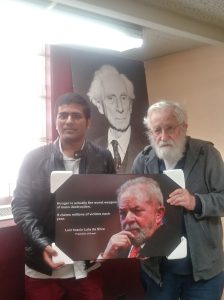
The author with Noam Chomsky, January 2020, presenting him with a belated birthday gift: a framed poster of Brazilian President Lula da Silva featuring Lula’s quotation, ‘Hunger is actually the worst weapon of mass destruction. It claims millions of victims each year.’
Finally, the border was reestablished at roughly the original line, and peace negotiations began. That’s when the real devastation started. The US—they call it NATO, though it was primarily the US—bombed North Korea almost to oblivion. When there was nothing left to bomb, they targeted dams—a major war crime for which Nazi criminals were hanged. Official histories, like the Air Force Quarterly, exult over these bombings. Huge torrents of water flooded valleys, destroyed crops, and killed people dependent on rice for survival. It’s monstrous, the praise for massive war crimes. This continued to the end, even though there were clear options for settlement. So, it’s not 100% black and white, but it’s a pretty ugly story.
Shanmugathas: What role have Western countries, including Canada, played in driving or intensifying the climate crisis?
Chomsky: They’re all liable for serious damage, but the United States is unique. Most countries in the world are at least trying to do something to mitigate the impending catastrophe. The United States is the only country that is not only refusing to participate in these efforts but is energetically trying to create the worst possible catastrophe in the shortest possible time.
The US alone is committed to maximizing fossil fuel use and dismantling environmental protections, including those limiting dangerous substances poured into the environment—mercury, lead, and others—as well as regulations aimed at reducing fossil fuel use more generally. Fossil fuel corporations, big banks, and related interests are delighted. Future generations will curse us for having destroyed the possibility of a decent life—or perhaps any organized social life at all. The potential catastrophe is enormous.
And they all know it. This is not a lack of knowledge. For example, when Donald Trump discovered that his elegant golf course in Ireland was threatened by rising seas, he appealed to the Irish government to build a wall to protect it, explicitly citing global warming. So they know it. The big banks know it, and so on.
Canada knows it as well—when it exploits the tar sands, the most lethal fossil fuel known, and when it remains a major producer and exporter of fossil fuels. Canadian mining corporations are also having a devastating impact around the world. I’ve seen it firsthand in third world countries where small communities try to protect their water sources and livelihoods from destruction by a Canadian gold mining enterprise, working in league with the government and local elites.
This is happening globally, so there is plenty of guilt to go around. But some cases are unique. The United States is one. Australia is the only real counterpart I can think of in the wealthy world. What’s happening there is astonishing. They are literally committed to destroying the continent. The continent is burning, while Prime Minister Scott Morrison goes off to Hawaii on vacation, then returns to say he feels people’s pain but insists fossil fuel exports must continue.
At the same time, the opposition leader from the Labour Party, Anthony Albanese, tours the mines and calls for expanded mining—especially coal, the most destructive fossil fuel of all—while the country continues to burn.
If there are future historians—assuming society is not so devastated that no one is left to care—and they look back on this period, they won’t believe it. It brings to mind the Fermi paradox. Enrico Fermi pointed out that there are vast numbers of planets capable of supporting intelligent life, so why do we see no sign of it? One possible answer is that intelligent beings are everywhere, but when they see this planet and what humans are doing to it, they decide it’s best to stay away. We don’t want anything to do with them.
Shanmugathas: What is the official reason given for the creation of NATO and the real reason why NATO was created?
Chomsky: The official reason is to deter the Russian hordes, supposedly planning to sweep over Western Europe and destroy us. There never was a realistic threat of Russian aggression. The real purpose of NATO was for the US to ensure Europe remained enclosed within a US-dominated system. Over the years, there were efforts in Europe to pursue an independent course, but they were crushed. NATO was one of the devices. French President De Gaulle famously called for a Europe from the Atlantic to the Urals, an independent domain—but that was beaten back. German Chancellor Willy Brandt proposed Ostpolitik, rapprochement with Eastern Europe—but that too was blocked.
The most interesting case was Soviet leader Mikhail Gorbachev, one of the few authentic statesmen in the modern world. He aimed to move Russia toward a social democratic future step by step. The West insisted on rapid “shock therapy,” imposing market systems that devastated the economy—destroyed it by about 50%, causing millions of deaths, and enabling oligarchs, many former Communist officials, to steal state resources, turning Russia into a monstrosity.
Even as the Berlin Wall fell, Gorbachev engaged in negotiations with the West. US President George H. W. Bush, Secretary of State James Baker, and European leaders discussed a post-communist future. Gorbachev proposed a Eurasian security system stretching from Brussels and Lisbon to Vladivostok, with no military blocs—just cooperation. The West wasn’t interested. Led by Bush and Baker, they sought to incorporate the former Eastern European satellites into the Western domain.
For Gorbachev, the critical issue was Germany. Germany had virtually destroyed Russia twice in the last century—the First and Second World Wars—so a unified, militarized Germany within a Western military alliance was an enormous threat. Gorbachev nevertheless accepted that unified Germany would join NATO. But there was a quid pro quo. The quid pro quo was the phrase “not one inch to the east,” meaning that NATO would not move into East Germany. Bush and Baker agreed verbally, but there was nothing on paper, and NATO immediately expanded eastward.
And when Gorbachev complained, they said it is basically a gentleman’s agreement. If you’re dumb enough to accept our word, that’s your problem. They didn’t say that, but that was the hidden meaning.
Later, US President Bill Clinton moved NATO all the way to Russia’s borders. By 2008, under George W. Bush, there were proposals to incorporate Ukraine into NATO. By 2013, this reached what Russia sees as its geostrategic heartland. George Kennan and other senior statesmen had warned this was madness—that Russia could not accept it and that it would lead to war. Well, it has led to plenty of conflict.
Gorbachev had proposed resolving tensions by creating a mutual security zone across Eurasia with no military blocs. But the United Kingdom, and secondarily Western Europe—subordinate to the US—refused to accept it.
Shanmugathas: So, if NATO’s main purpose was to keep Europe under US control, what are the consequences of that strategy, and how does NATO function as a tool for maintaining that dominance?
Chomsky: I should say there’s a nice comment about that by a leading Eastern European historian, Richard Sakwa. He says NATO is needed to deal with the security problems caused by NATO’s formation, which is essentially correct. When you move hostile troops up to the border of a country that’s under threat, there are going to be security problems. If the Warsaw Pact were on the Mexican-US border, there would be problems. And that’s what it means to send NATO forces and advanced armaments and dangerous weapon systems up to the Russian border. So, what is NATO really for? To keep Europe under control. It provides the US with multiple tools to ensure that allies don’t pursue an independent path. One of the most important ones, which is rarely talked about, is the Middle East.
Why are US forces in the Middle East? You know, columnists say they can’t understand this—it doesn’t make any sense. What do we need the Middle East for? Well, we need the Middle East for a simple reason: it is the main oil producer in the world. When the US controls those resources, it doesn’t necessarily use them, often doesn’t need them at all, but it wants to control them. And there’s a good reason for that.
It’s been explained by senior statesmen from George Kennan to Zbigniew Brzezinski. You control the oil sources of the world; you have leverage over allies. If they try to do something you don’t like, you can cut off their sources of energy supplies.
What Kennan called “veto power” over allies. And, of course, it means you can control everyone else as well. So that’s another device for controlling Europe. NATO is one of them.
Shanmugathas: You once asserted that “Canada had enormous leverage over the slaughters in East Timor and never used it.” Could you expand on your assertion?
Chomsky: Yes. That is a very important story. Indonesia invaded East Timor in December 1975, had a green light from Washington. The US-UN ambassador, Daniel Moynihan, who is lauded for his dedication to human rights and international law, just take a look at his memoirs – he said, “I was able to render the United Nations utterly ineffective in responding to the Indonesian invasion.”
And then he mentions, this was a couple of months after the invasion, he said, well, 60,000 people have been killed, but, you know, who cares? It’s going to go on. It did go on to be the worst genocide relative to population in the post-war period. Canada had a major role in supporting the invasion. It had interests in Indonesia, resources, mining, supporting the United States, never lifted a finger to try to do anything to stop it. The US supported it all the way through.
Bill Clinton, in 1995—20 years later, after virtual genocide—welcomed General Suharto, the Indonesian leader, to Washington. He said Suharto is, “our kind of guy, the kind of guy we like.” Later Clinton in 1999 ordered an end to the invasion. That could have been done 25 years earlier. And the Canadian role was extremely ugly all the way through, in support of these atrocities.
Shanmugathas: I interviewed Michael Kergin, who was the foreign policy advisor to Liberal Canadian Prime Minister Jean Chrétien during the 1999 NATO bombing of Yugoslavia. During the time that Canada took part in the 1999 NATO bombing of Yugoslavia, he conceded—when I interviewed him—that although the NATO bombing could be considered illegal, given that there was no UN Security Council resolution, he nevertheless justified the bombing as legitimate because he claimed it was a humanitarian intervention, as Yugoslavia President Slobodan Milosevic was taking a “genocidal approach” against his own people and had “gone beyond all bounds of human decency.” What is your response to this assertion?
Chomsky: We have extensive evidence about what was happening on the ground from Western sources and UN sources.
What they showed is that it was a pretty ugly place. Guerrillas—KLA guerrillas, Albanian guerrillas, Kosovo guerrillas from Albania—were coming in to attack Serbian concentrations, hoping, as they said straight out, to elicit a harsh Serbian response, which could then be used as a justification for Western intervention.
If you look at the atrocities, they’re kind of balanced. While it was ugly, a couple of thousand people were killed, but not genocide, and both sides were involved. When NATO decided to bomb, the NATO general, Wesley Clark, informed the security establishment in Washington that bombing would provoke huge Serbian atrocities in response.
And they said, okay, bomb anyway. He informed the press on the day the bombing began, saying, “This is going to cause Serbia to respond with massive atrocities,” which, of course, is what happened. When NATO started bombing, they understood that the Serbs were not going to say thank you.
They had no other way to respond, so they responded on the ground. That led to the atrocities. The bombing—Canada and others—is the direct cause of the atrocities, and they were perfectly aware of it, including Canada’s foreign policy advisor. At least if they could read the statements of their own commander, who made it very clear. I’m sure he briefed Canada too; we know he briefed the United States. So yes, there were atrocities caused by the bombing—consciously.
Finally, after 78 days of bombing, an agreement was reached. It was approximately what was on the table before the bombing. If you take look before the bombing at late March, around March 24th, there were two proposals on the table: NATO’s and Serbia’s.
The end result was a compromise between them. But Canada was involved, and there were real war crimes carried out. For example, they bombed the Chinese embassy and the major Serbian television station on the grounds that it was producing propaganda, killing a couple of dozen journalists. These are major war crimes.
Shanmugathas: So why did NATO bomb Yugoslavia? NATO argues that it was still a humanitarian intervention. Sure, it may have escalated casualties, but we did a humanitarian intervention.
Chomsky: If you look over history, it’s hard to find an act of aggression that wasn’t called the equivalent of humanitarian intervention. So, when Hitler invaded Poland, it was totally humanitarian. He had to defend Germany from what he called ‘the wild terror of the Poles.’ What else could he do? When Japan invaded Manchuria and North China, they were going to bring an earthly paradise to the poor Chinese, who were being subjected to terror by Chinese bandits. If we had records from Genghis Khan, we’d probably find the same thing. So, any act of violence and terror almost automatically comes from the deepest humanitarian interests. But the purpose of the bombing was perfectly straightforward. Serbia, the last remnant of Yugoslavia, was not being incorporated into the Western system. They were resisting. In fact, that’s stated. Strobe Talbott, a leading Eastern European specialist for Bill Clinton, wrote the preface to a book—Collision Course: NATO, Russia, and Kosovo—by a State Department authority on the Balkans, John Norris, praising it to the sky, saying that it tells us exactly what the thinking in Washington was, and so on.
Read the book, he says: Serbia was refusing to be integrated into the market economy. What they say is that Serbia was refusing to carry out the reforms they were calling for—meaning integration into the Western-dominated market economy. I actually quoted this.
Talbott denied it. He said, “No, I never said anything. These were total lies,” and so on. But it’s there in black and white, no ambiguity. Take a look at it.
Shanmugathas: What were the underlying reasons behind the US-NATO-led war in Afghanistan?
Chomsky: This was right after 9/11. And George Bush, then dragging NATO in, decided that they would bomb Afghanistan to force it to turn over the perpetrators of 9/11. Interestingly, they didn’t know who they were. They blamed al-Qaeda, but they really had no evidence—and we know that from the FBI.
Robert Mueller, who was then head of the FBI, was questioned by the press eight months after September 11 about what had been discovered, after what must have been the most intensive international investigation in history. He said, “Well, we suspect al-Qaeda, but we really don’t know.” That was eight months afterward.
But they decided to threaten the Afghans with bombing, and the Taliban with bombing, unless they handed over Osama bin Laden. In fact, they offered to do so. They made some offers—tentative offers—about establishing an international tribunal to investigate Osama bin Laden’s possible role in this. Various tentative moves were made. The Bush administration didn’t even consider them. It wasn’t even a matter of discussion. No—you do what we say or else we bomb you to rubble.
And then they bombed. A prominent anti-Taliban figure in Afghanistan, Abdul Haq, bitterly attacked the bombing. He said, “You’re undermining our efforts to overthrow the Taliban from within.” He added that the United States was doing this because it didn’t care about the lives of Afghans and wanted to show its muscle—to show that it could frighten everybody in the world.
It turned out later that either moving forward with the Taliban’s offers or conducting something more like a police operation—what you do when you have a suspect in a crime—could have solved the issue without the bombing.
Now Afghanistan is a total wreck. The Taliban are back. They control, probably, a majority of the country. Billions of dollars had been spent to do nothing. NATO was pulled in but it was primarily the US.
Shanmugathas: There was a great deal of emphasis by US and NATO leaders on political reconstruction, economic and social development, and peace and security for the Afghan people. There was a lot of testimony claiming that great progress was being made—that political and economic reconstruction was being achieved. However, why have US and NATO leaders largely been unsuccessful in actually achieving political and economic reconstruction in Afghanistan?
Chomsky: Why? Because the Afghans don’t want—I mean, if you take a look at the Russian invasion, which was much worse, they killed far more people. But toward the end of the Russian invasion, in the last couple of years, they were carrying out the same kinds of activities.
In fact, Kabul under the Russians was probably as free as it had ever been. Women could dress as they wished and attend college. We have reports on this from the UN representative for women in Afghanistan, Rasil Basu. She wrote several articles about it, which the US press refused to publish—even Ms. Magazine, a feminist publication, declined to publish them.
The reports focused mostly on women’s rights in Kabul. There were dangers, primarily from the Mujahideen, especially Hekmatyar—the most violent, and a recipient of US aid—who would throw acid in the faces of women who weren’t “properly dressed.” So in many ways, the Russians were enforcing similar rules. After the Russians left, the political leader they had installed, Najibullah, was apparently reasonably popular and lasted a couple of years.
The situation then became extremely violent. When US troops arrived, they had no real understanding of what was happening. This is now conceded. Various Afghan strongmen were using US forces to attack rivals and expand control over the opium trade. If one of them wanted to eliminate an enemy, he would feed intelligence to the Americans claiming those people were working for the Taliban. The Marines would come in, smash the place, and the strongman would gain a larger share of the opium trade.
This is now well documented, notably by correspondents like Anand Gopal. The Americans had no real knowledge of Afghanistan; they were an outside force imposing a system that became corrupt. Some outcomes were beneficial, but overall, it is widely acknowledged to have been a disaster.
Shanmugathas: On February 29, 2004, the first democratically elected leader of Haiti, Jean-Bertrand Aristide, was ousted from power in a US-backed coup supported by Canada, France and Chile. If you can give context, talk about who really was Jean Bertrand Aristide, what policies was Aristide carrying out that made him a threat, and why he was ousted from power?
Chomsky: Haiti has a horrible history. Focusing on the 1980s, before Aristide was elected, the country was ruled by the last of a long line of brutal dictators, Jean-Claude Duvalier, strongly backed by the US and Canada.
In 1990, Haiti held its first genuinely free election. The expected winner was the US-backed candidate, Marc Bazin, a former World Bank economist with full elite support. But he was defeated. Nobody had paid attention to the grassroots movements in the countryside—they were dismissed—but they came out to vote for Aristide, a liberation-theology radical priest who wanted social reforms.
The only question was how long he would last before a military coup removed him. It was seven months. That brief tenure was highly praised, even by institutions like the World Bank and IMF, for fighting corruption and trying to rebuild the country. Seven months later came the anticipated coup, strongly backed by the US under Bush. It unleashed a reign of terror. I visited Port-au-Prince during that period. I’ve been to awful places, but I’d never seen such not only poverty but sheer terror. People in the deep slums wouldn’t speak. Even with a well-known sympathetic journalist accompanying me, they would say only, “There are eyes everywhere. I can’t say anything.” There was terror, torture, and destruction everywhere—always with US involvement.
Of course, the US claimed it opposed the military junta and imposed sanctions, notably on oil, which the junta could not survive without. CIA testimony claimed the US had cut off all oil. I was there in Port-au-Prince. You could see the oil terminals being built. There wasn’t a cutoff. Finally, Clinton decided this was enough and sent in the Marines.
The day before the Marines were sent in, there was a leak from the Treasury Department. It was in the Associated Press reports. I happened to be reading AP reports at the time; the material comes in constantly, every second. Editors pick out one major story to focus on and disregard the rest.
The major story was that the Clinton administration had authorized the Texaco Oil Company to send oil illegally to the military junta, in violation of US sanctions. I was going to write an article about it, but the article wouldn’t come out for two months, so I figured that by then everyone would know. I barely mentioned it. It wasn’t reported in the mainstream press. It appeared as a small item, if at all, and was buried.
This was a dramatic event. I gave all this material to my friend Alex Cockburn. I also pointed out an interesting historical parallel. During the Spanish Civil War, the West, including the United States, was supposed to be neutral and not intervene. But they did block oil shipments to the Franco forces—the one thing the Franco forces couldn’t get on its own.
At the time, the left-wing press claimed that the Texaco Oil Company, run by an outright Nazi, had been authorized by the Roosevelt administration to send oil to the Franco forces. That sounded like a conspiracy theory—until documents emerged after the war showing it was exactly true.
The same Texaco Oil Company, under Clinton, was sending oil to the Haitian military junta terrorizing the country.
Finally, the Marines came in and restored Aristide, but under strict conditions: that he accept harsh neoliberal policies. That meant Haiti could not protect its rice crops—the staple people lived on—from heavily subsidized US agribusiness, much of it based in Arkansas, Clinton’s home state.
Haiti was forced to import American rice, wiping out Haitian rice farmers, along with other similar conditions. These policies reduced an already battered country to even greater poverty and suffering.
Now, we come to 2004. Aristide was again elected, the most popular figure in the country. Then the United States, Canada, and France sent in forces that essentially kidnapped him with all sorts of charges, flew him to Central Africa, and barred his party from participating in politics. He remains barred. They later let him back into the country.
Shanmugathas: When I interviewed Canada’s defense minister, David Pratt, who was the defense minister at the time of Aristide’s removal from Haiti in 2004, he rejected Aristide’s characterization that what happened to him was a coup and said, “Haiti had a long history of big man leadership, people who felt it was their divine right to rule. We saw that with Duvalier going back many years, and I think that tradition continued under Aristide. And under the circumstances, I think Canada, US, France did what was necessary to remove him from power because of his abuses of power.”
And I also interviewed Colonel Lawrence Wilkerson, who was the chief of staff to US Secretary of State Colin Powell. And Wilkerson told me that the US ambassador to Haiti, James Foley, saved Aristide’s life by removing him from Haiti, when Aristide was surrounded by people with machetes who wanted to kill him. Wilkerson said, “what Ambassador Foley did was not only to prevent the murder of Aristide, but also prevent a civil war in Haiti, and the country returned to a measure of stability for a short period of time.”
Wilkerson further asserted, “what does Haiti mean to the United States? It just means more Marines and more soldiers, you know, having to help people drink water and eat food and so forth. Because the country is a basket case country. Aristide was exploiting the country. My daughter was a secret service agent on Aristide’s detail when he was in the US. I know Aristide through my daughter. This was a man who had no intent for the best interest of Haiti, and every intent for the best interest of Aristide, Aristide, Aristide.”
Prof. Chomsky, your response.
Chomsky: My opinion doesn’t matter, but Haitian opinion does. They had just elected him president. He was the most popular figure in the country. Maybe all the charges are correct. Is that up to us to decide?
I mean, did Canada intervene to overthrow Duvalier or any of the dictators that the US and Canada supported? Of course not—they supported them. But even if the charges are correct, it’s irrelevant. It’s up to the Haitians to decide, not Canada. Not that Canada has any record of having the right to do this. They were supporting the worst dictators.
I won’t go into the whole history, but starting at the beginning of the century, in 1915, Woodrow Wilson sent the Marines to conquer Haiti. They killed maybe 10,000 or 15,000 people, virtually restored slavery under another name, imposed US rule, and kicked out the parliament with ridicule. The US Secretary of State said, “Isn’t this funny—niggers talking French? How can we allow that?”
They imposed one brutal dictatorship after another, all the way up to [1990], when they finally allowed an election, which Aristide won. Then came what I described.
So, yeah, let’s say he was an autocrat. Let’s say he intended to do this or that. Canada has a right to say a word about this, after that history? And it’s not just Haiti. It’s everywhere. The same thing happened in the Dominican Republic next door.
Shanmugathas: The United States and Canada are settler-colonial countries that have committed horrendous atrocities against Indigenous populations—atrocities that are still ongoing. It is also significant that the US and Canada are two of the most important supporters of Israel on the global stage.
Is there a correlation between the fact that the US and Canada are settler-colonial countries and their exceptionally strong support for Israel, which is also a settler-colonial country?
Chomsky: Well, it’s hard to prove, but there has long been a suspicion that part of the sympathy for Israel—one of many sources of support—comes from the sense that “they’re basically like us.” If we did it, how could it be wrong?
It’s interesting that the three strongest supporters of Israel on the world stage come from what’s called the Anglosphere: the three settler-colonial societies that emerged from England—the United States, Canada, and Australia.
Shanmugathas: We know what the United States can do to stop Israel’s occupation of the Palestinian territories. But what can a middle power like Canada do?
Chomsky: Canada could join those parts of the world that are calling for an end to the illegal occupation. Canada could insist on boycotting products that come from the occupied territories, as the Presbyterian Church does. Canada could do that. Canada is not powerful enough to force the United States to end it.
The United States, incidentally, could end this very easily by simply applying US law. All US aid to Israel is illegal under US law. Nobody talks about this, but it’s absolutely straightforward. The Symington Amendment of 1974 bans any aid to countries that produce nuclear weapons outside the framework of the Non-Proliferation Treaty.
You’ll notice that the United States never concedes that Israel has a nuclear arsenal. Of course, they know it—it’s an open secret—but they cannot admit it. Because if you admit it, US law would intervene. All aid to Israel would have to stop. Israel would then be compelled to do what the US would call on it to do: withdraw from the occupied territories. It could end with the flip of a switch.
This has much broader implications. The regular review meetings of the Non-Proliferation Treaty are coming up again in a couple of months. At every review meeting—held every five years—the same proposal comes up: a call by Arab states, Iran, and most of the rest of the world to establish a nuclear-weapons-free zone in the Middle East.
If that were implemented, it would eliminate any conceivable threat of Iranian nuclear weapons, whether you believe such a threat exists or not. This is supposed to be one of the major issues on the global stage. Here’s a way to resolve it. Establish a nuclear-weapons-free zone. Who opposes it? Arab states strongly support it. Iran strongly supports it. The non-aligned countries, the G-77, strongly support it. Europe supports it. What stops it? A US veto. The last one was under Obama in 2015.
Why can’t this problem be solved? Because doing so would expose Israel’s nuclear weapons to international inspection and require the United States to concede their existence—meaning US aid to Israel would have to stop. So instead, the alternative becomes war with Iran.
Does anyone talk about this? Have you read about it anywhere? If you’ve read what I’ve written, you’ve seen it. You can find it in arms-control journals. But it’s not the kind of thing the press or mainstream commentators are willing to discuss.
Shanmugathas: Canada was a strong proponent of the doctrine of the Responsibility to Protect. Could you talk about this reasoning of the responsibility to protect and why the concept of Responsibility to Protect is so problematic? NATO invokes it frequently. Could you discuss that notion and why it raises such serious concerns?
Chomsky: That’s a very interesting point. There are actually two versions of the Responsibility to Protect. There is the official version, which has the status of international support. The UN General Assembly adopted a resolution 2005—it’s not the technical name, but it’s essentially the Responsibility to Protect resolution. It keeps the UN Charter completely intact. It explicitly states that no changes are being made to the Charter, with all of its restrictions on the use of force and so on. It simply calls on countries to take greater measures to protect populations and pledges support for such measures. It is a fairly innocuous resolution and has essentially no concrete implications.
There is another version, which actually emerged in Canada. Canada was a co-sponsor. This version is associated with Gareth Evans, the former foreign minister of Australia, and I believe it was finalized in Canada. It is essentially the same as an earlier formulation from around 2000, developed in response to Kosovo. It mirrors the UN resolution in every respect except one crucial difference: it asserts that regional alliances, within their own regions of authority, are permitted to carry out military action without Security Council authorization, so long as that action is later accepted.
In other words, Kosovo. In other words, NATO—the only regional alliance capable of doing this. Under this formulation, NATO can carry out intervention, label it “humanitarian intervention,” and do so in violation of the Security Council. That provision does not exist in the UN resolution. That is the sole difference between the two.
Yet when Canada, the United States, or other countries want to invoke a right of humanitarian intervention, they rely on the Evans–Canada version. For legitimacy, however, they appeal to the UN version. It’s a remarkable farce—astonishing that they get away with it, often with the support of international lawyers and intellectuals. Just read the resolutions. There is nothing ambiguous about them.
Shanmugathas: Thank you so much Prof. Chomsky for speaking with me.
