
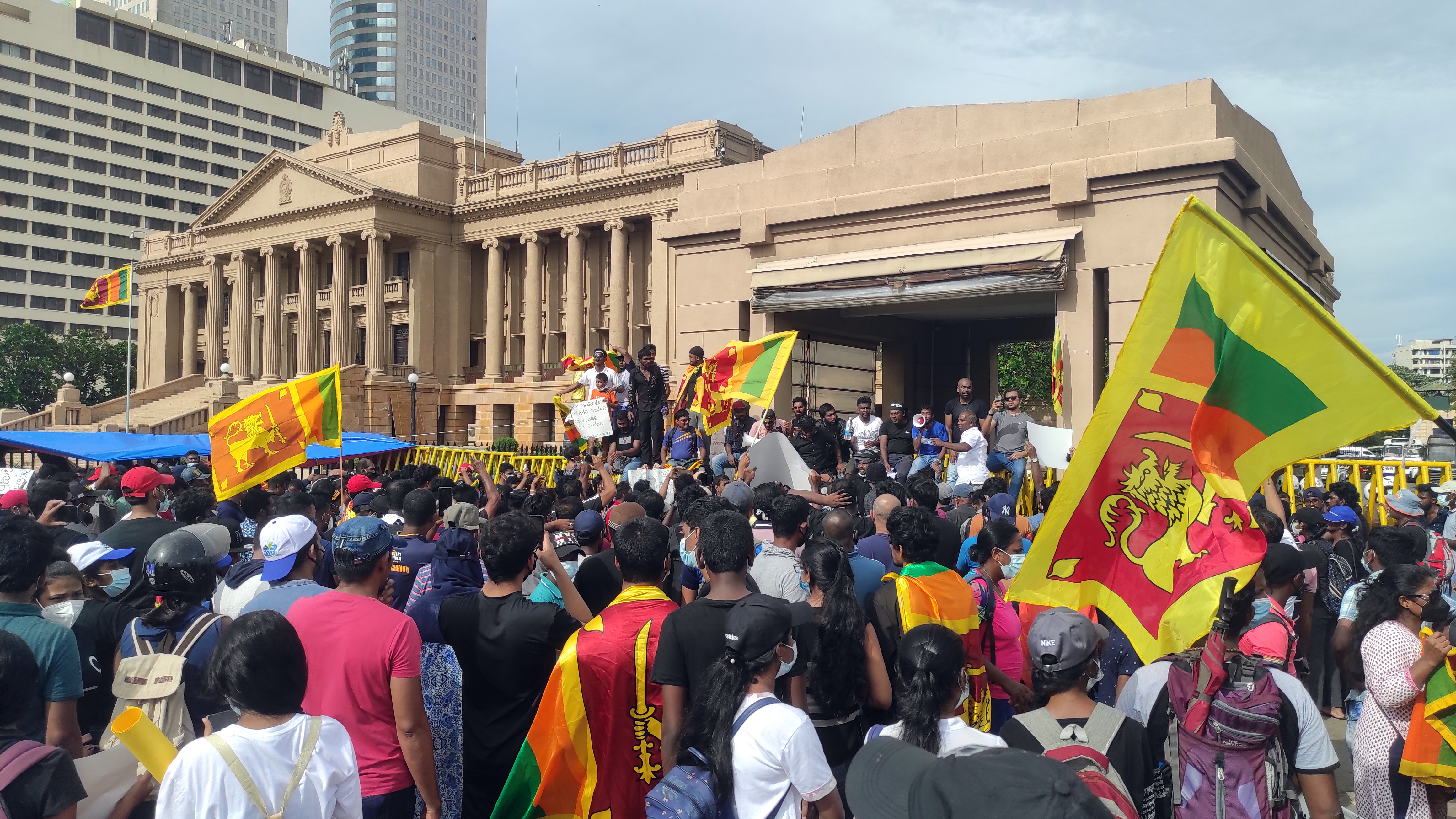
A year after the leftist National People’s Power (NPP) coalition won an unprecedented supermajority in Sri Lanka’s November 2024 parliamentary elections—with support from both the majority Sinhala and minority Tamil communities—it has fallen short in terms of delivering on its sweeping promises. As the first party to govern Sri Lanka outside the two-party system, the NPP during its election campaign promised to eliminate corruption, revive the economy, invest in public education, introduce a new constitution devolving power to the regions, repeal draconian anti-terrorism laws, and end decades of failed two-party rule. Instead, the government of President Anura Kumara Dissanayake (popularly known as AKD) has largely maintained the status quo under the guise of anti-corruption rhetoric.
Since 1977, nearly every Sri Lankan government has pursued neoliberal policies. Sri Lanka’s traditional two main political parties, United National Party and Sri Lanka Freedom Party, converged on what political economist Balasingham Skanthakumar describes as “the irresistibility of internal deregulation, external liberalization, and privatization for economic development.” This approach widened inequality: in 2012 with Central Bank of Colombo statistics showing the richest 20 percent of households accounted for 54.1 percent of income, while the poorest 20 percent earned only 4.5 percent. Public spending on education collapsed from 15 percent of government expenditures (3–5 percent of GDP) between 1955–1970 to just 1.5 percent of GDP by 2022—the third lowest globally—a stark reversal from Sri Lanka’s pioneering free universal education program established in 1945.
The NPP emerged as a supposed alternative to this neoliberal orthodoxy. Its Marxist-Leninist roots through the Janatha Vimukthi Peramuna (JVP) party, grassroots organizing among workers and youth, and outspoken critique of IMF-imposed austerity suggested it could break the cycle of destructive policies. A year later, that promise lies in ruins. The NPP’s tenure exposes a clear truth: changing faces in power does not break the nation’s political duopoly if the so-called alternative merely replicates the same policies, priorities, and failures.
Anti-Corruption Theater Without Structural Reform
The NPP has made anti-corruption its central selling point, yet these efforts remain largely cosmetic, failing to address the structural reforms Sri Lanka urgently needs. While the government has staged highly publicized arrests of lower- and mid-level officials and passed the Proceeds of Crime Act in April 2025, systemic reform has been absent. As Harindra B. Dassanayake and Rajini Gamage note in their September 2025 analysis, Sri Lanka’s NPP Government from Systemic Change to Structural Compliance, the administration has “largely continued the previous administration’s macroeconomic policies,” retaining top bureaucrats in institutions like the Central Bank and Ministry of Finance. This is systemic preservation, not systemic change.
The government’s “Clean Sri Lanka” initiative has achieved symbolic victories, such as the recent arrest of former President Ranil Wickremesinghe on allegations of misappropriating public funds. Yet political analyst Mevan Ariyasinghe observed, “Despite Wickremesinghe’s arrest, Sri Lanka’s politics is stuck in its old loop.” The NPP has proven adept at theatre—reducing cabinet size, cutting MP privileges, and holding anti-corruption raids—while avoiding the difficult work of dismantling patronage networks, reforming loss-making state enterprises, or addressing the oversized military that continues to drain resources.
Independent analysts stress that meaningful reform requires more than arrests. A comprehensive July 2025 growth study by ODI Global and the Centre for Poverty Analysis (CEPA) emphasizes that real reform requires “significantly upgrading training on public policy and administration for public servants,” establishing rigorous project monitoring systems, and fundamentally restructuring how the state operates. Instead, the NPP has focused on arresting individuals while leaving intact the very systems that enabled their corruption. This represents what one might call “performative accountability”—visible action that generates headlines but produces little substantive change in how government actually functions.
IMF Austerity: Continuity Over Change
Perhaps nowhere is the NPP’s failure more evident than in its economic policy, which amounts to unquestioning adherence to IMF-imposed austerity. Despite campaign promises to renegotiate the IMF agreement and pursue equitable reform, the government has done neither. As Harindra and Gamage note, “the NPP government has largely continued the previous administration’s macroeconomic policies,” echoing former President Wickremesinghe’s claim that “there are no alternatives” to the IMF program.
This continuity has been devastating for ordinary Sri Lankans. Poverty stands at 24.5 percent and food insecurity affects 26 percent of households according to 2024 World Bank statistics, while household debt has reached 38.5 percent according to 2024 UNDP statistics. The NPP even cut health spending from 410 billion rupees in 2024 to 383 billion in 2025, worsening medicine shortages and hospital conditions.
President Dissanayake has effectively embraced his predecessor’s austerity regime. His government granted special benefits to investors in Colombo Port City—including suspension of key labor laws—drawing criticism even from former NPP-aligned unions. When the IMF warned against excessive tax exemptions, the government promised “rules-based” eligibility criteria but ignored labor protections. This is neoliberal orthodoxy, not the progressive alternative promised.
Though GDP grew 5% in 2024 after six quarters of contraction, the recovery has not improved living conditions. ODI Global and CEPA found in July 2025 that “income poverty remains stubbornly high, affecting a quarter of the population—double 2021 levels—taking Sri Lanka back to its early-2000s poverty rates.” The government has prioritized IMF fiscal targets over the humanitarian crisis facing millions.
The NPP’s taxation policy further exposes its neoliberal bent. Political economist Mick Moore notes that since 1977, governments have failed to collect direct taxes, protecting the wealthy who “pay little or no direct tax” while public services decay. An October 2025 Human Rights Watch report found that reliance on regressive taxes deepened inequality: between 2021 and 2024, VAT (a consumption tax heavily burdening low-income households) rose from 8 to 20 percent, and exemptions on essentials were removed. A 2024 World Bank Review described these reforms “particularly regressive,” linking them to a 3.9-point rise in poverty. Meanwhile, corporate tax exemptions cost LKR 978 billion (US$2.7 billion) in 2022—56 percent of total tax revenue and nearly triple the education budget.
In 2022, as Human Rights Watch noted in its report, only 204,467 individuals in a population of 22 million filed personal taxes. The IMF’s income tax threshold of LKR 150,000 (US$500) monthly still excludes most high earners. A modest wealth tax on the richest 0.5 percent could raise US$450 million annually, nearly half the 2022 education budget—yet the NPP has not pursued it.
Instead, it relies on indirect taxation. Direct taxes made up just 19 percent of total revenue between 1980 and 2018 and are projected to remain around one-quarter, while VAT will exceed one-third through 2027. This contradicts UN guidance urging states to reduce VAT dependence and strengthen direct taxation to protect low-income families. As Human Rights Watch concludes, Sri Lanka’s “corporate tax incentives, low personal taxation, and enforcement gaps” have created a system that undermines human rights and starves public services.
The NPP had both the mandate and means to reform this unjust system. Instead, it preserved it—shielding corporations and the wealthy while burdening the poor through consumption taxes and collapsing social protections. Speaking exclusively to JURIST, NPP Member of Parliament Mylvaganam Jegatheeswaran asserted:
It is because our country lacks foreign investors that we are in this dire situation. Only by offering foreign companies certain privileges will they invest here. If we impose robust taxes on them and charge them for using our land who from abroad would choose to invest in our country? They would simply go to India or Bangladesh, where it is cheaper to invest.
Human Rights Watch directly contradicts such arguments in its report by asserting that “when a government offers corporate tax incentives, it creates pressure on other governments to do the same, fueling tax competition that erodes public revenues in all countries trapped in this spiral.”
This “race-to-the-bottom” logic has long justified tax breaks for the rich while squeezing the poor. Jegatheeswaran further admitted,
When this government came into power, there was already an agreement signed with the IMF. And we can’t deviate from certain things within that agreement – only after 2028 will we be independent.
Despite its supermajority and mandate for change, the NPP concedes it lacks the will to challenge IMF-imposed austerity.
Education: Broken Promises to Sri Lanka’s Children
According to the October 2025 Human Rights Watch report, Sri Lanka spent only 1.5 percent of GDP on education in 2022—the third lowest in the world, behind Laos and Haiti. This falls far short of international benchmarks calling for 15–20 percent of public expenditure or 4–6 percent of GDP.
The NPP campaigned on transforming education, pledging to raise spending “incrementally” to 6 percent of GDP and make teaching one of the country’s ten highest-paying professions. Yet, a year later, these promises remain unfulfilled.
When questioned by JURIST about insufficient investment in education by his government, NPP Member of Parliament Mylvaganam Jegatheeswaran defensively claimed:
In 2025, our NPP government allocated 619 billion rupees for education—it was the highest amount ever allocated for education in the history of Sri Lanka.
But this rhetoric obscures reality. As Human Rights Watch notes the current Prime Minister and Education Minister, Harini Amarasuriya—a longtime advocate for increased education funding—oversaw only a 3.5 percent rise in the 2025 education budget, with projected 10 percent annual increases over the next two years. Though these figures may appear significant, they fall far short of what is needed to meet the government’s pledge of allocating 6 percent of GDP to education. As the Feminist Collective for Economic Justice documented, “Contrary to the Government’s claim, the education allocation for 2025 did not amount to a historically high figure.” During the 1960s and 1970s, public spending for education averaged 4 percent of GDP, and Sri Lanka’s highest allocation occurred in 1972 at 5.16 percent of GDP—nearly three times the current level. Given the extremely low baseline of 1.5 percent of GDP in 2022, achieving that target would require roughly quadrupling current spending and a fundamental reordering of national budget priorities—far beyond the modest adjustments currently planned.
When pressed on this inadequacy, Jegatheeswaran retreated to familiar deflection: “After 77 years since independence, to expect so many things to happen in one year from this government – it isn’t magic.” Yet the government’s supermajority and campaign promises suggested it understood the urgency of education reform. Incremental adjustments are not transformation.
Although education is legally free in Sri Lanka, public schools routinely charge “development” and exam fees to cover basic costs like cleaning and utilities. One mother in Hatton told Human Rights Watch she earns just LKR 300 (US$1) for three hours of daily work yet struggles to pay her children’s LKR 500 (US$1.65) monthly school fees, often unable to afford books or nutritious food.
The government has introduced limited measures, such as expanding free midday meals and providing a one-time LKR 6,000 ($20) payment for school-aged children of Aswesuma recipients. Aswesuma is a means-tested cash transfer program introduced to support low-income families. But these steps barely scratch the surface of systemic underfunding.
The NPP promised transformation but has delivered only incrementalism. Despite its supermajority and mandate for reform, it has maintained the status quo—allowing schools to charge fees, the tuition industry to thrive, and inequality to deepen. This is not just a broken promise but a betrayal of the families who believed the NPP would prioritize their children’s futures.
Defense Spending: Guns Before Books
The NPP government’s 2026 budget starkly exposes the gap between its reformist rhetoric and fiscal reality. In his November 7th 2025 speech to Parliament unveiling Sri Lanka’s 2026 national budget, President Dissanayake claimed to have ended “fiscal recklessness” and ushered in “discipline, transparency and accountability.” Yet the Ministry of Defense will receive Rs. 455 billion (USD $1.52 billion)—up from Rs. 442 billion in 2025 —despite continued troop reductions. Over the past sixteen years, the army has shrunk from 300,000 to around 135,000, but defense spending has steadily risen: fewer soldiers, higher costs.
Dissanayake justifies higher defense spending as “modernization,” yet Rs. 385 billion—85 percent—will go to recurrent costs like salaries and allowances, leaving only Rs. 70 billion for capital expenditure. The recruitment of 4,000 new airmen and salary hikes will further inflate recurrent costs, undermining the very modernization the government touts.
The budget’s spending patterns reveal its true priorities. While Dissanayake speaks at length about transparency, Rs. 12.5 billion is allocated for government vehicles—including luxury cars for MPs—compared to just Rs. 1 billion for digitalizing public services. As the Sri Lanka Guardian notes in its analysis of the 2026 budget, “the priority seems clear: comfort before competence.”
Meanwhile, the government offers no coherent defense strategy or explanation for its geopolitical choices. As analyst Rathindra Kuruwita observes, Colombo’s sourcing of weapons and training partners—whether from China or India—will have major strategic implications. Yet the government remains silent even as it raises defense spending.
When asked by JURIST why the government will invest so heavily in the military while education and healthcare remain underfunded, NPP MP Mylvaganam Jegatheeswaran argued that Sri Lanka must “protect its fishermen from threats by Indian fishermen,” pay rising military salaries, and purchase new military vessels. He further claimed that “after education, it is healthcare that this government will invest more money in.”
Structural Reforms: Promised But Not Delivered
The NPP’s failure extends beyond simple policy continuity to a comprehensive abdication of its mandate for structural transformation. The party came to power promising to fundamentally restructure Sri Lanka’s economy, yet one year later, the country remains trapped in what experts describe as “repeating cycles of macroeconomic stress” rooted in deeper structural problems.
ODI Global and CEPA in their July 2025 report have identified that “growth in excess of 5% is required to reverse the sharp increase in poverty and multidimensional vulnerability in Sri Lanka and to ensure that another debt restructuring is avoided in 2027/28.” Yet the IMF currently projects Sri Lanka’s potential medium-term growth rate at only around 3%. Bridging this gap requires a “laser-like focus on structural reforms” including “factor market and SOE reforms; improving the investment climate; strengthening investment promotion; trade policy reforms, including in trade agreements; reforms in trade facilitation; and education, training and skills development.”
The NPP government has undertaken virtually none of these essential reforms. Despite ruling out privatization, the government’s plans to “improve the management of state-owned enterprises” have produced no tangible results. Sri Lankan Airlines continues to hemorrhage public funds. The Ceylon Electricity Board (CEB) remains unreformed. According to Harindra and Gamage, the government absorbed 130,000 million rupees of the CEB’s debt to the Ceylon Petroleum Corporation while failing to address the fundamental inefficiencies that created those losses in the first place.
Perhaps most tellingly, the government has failed to pursue the kind of comprehensive, integrated approach to economic transformation that successful developing countries have employed. ODI Global and CEPA’s report emphasizes the importance of “strengthening economic ties with neighbouring India” through “business-to-business links in high-growth sectors, cross-border energy projects” and deeper bilateral trade agreements. Yet despite President Dissanayake’s visit to India in December 2024 and Prime Minister Modi’s visit to Sri Lanka in April 2025, concrete progress on economic integration remains minimal. The government appears more interested in symbolic diplomatic gestures than in the hard work of economic restructuring.
The failure is equally stark in manufacturing policy. ODI Global and CEPA emphasize that “manufacturing, within a conducive environment, is pivotal in accelerating growth to higher levels in the medium term” and that this requires “eliminating barriers and improving competitiveness” through regulatory simplification, ensuring input availability, reforming cross-border policies, and aligning with 21st-century sustainability standards. One year into the NPP government, none of these critical reforms have been implemented. ODI Global and CEPA emphasize that Sri Lanka “continues to exhibit anti-export bias” in its trade regime. Import protection remains high. The business environment remains cumbersome and bureaucratic.
Broken Promises on Fundamental Rights and Justice
The NPP’s failures extend beyond economic mismanagement to the erosion of democracy and human rights. Despite clear campaign promises, the government has neither repealed the draconian Prevention of Terrorism Act (PTA) nor curtailed its use against dissenters. As the UN Human Rights Council noted, “detentions under that law continue,” disproportionately affecting Tamil and Muslim communities, urging Colombo to “apply a moratorium on the use of the law and expedite its repeal.”
Jegatheeswaran admitted the failure to repeal the PTA but offered a troubling defense: “We can’t do it right now because all over the country, even in the North and East, so many children are in possession of drugs—and there is organized crime, so for this purpose we need the PTA now.” Rights activist Nalin Attapattu called this “disappointing,” noting the government’s continued use of the law despite repeated assurances. When questioned about the arrest of Liyaudeen Mohamed Rusdi—a Muslim youth detained under the PTA for producing stickers critical of Israel’s actions in Gaza—Jegatheeswaran dismissed concerns: “We released him. He was a young boy… brainwashed by those against Israel.” This response, portraying dissent as “brainwashing,” underscores the government’s willingness to weaponize the PTA against critics. Sri Lanka’s Human Rights Commission deemed Rusdi’s detention “unlawful and arbitrary.” Yet, a year into its term, the NPP continues to justify the PTA’s use, making repeal seem remote despite repeated pledges.
On land rights, the Deputy Minister of Defence claimed that 700 acres of Tamil land had been “returned to the public,” yet soldiers continue to occupy vast areas of the North and East. Military camps, farms, and tourist ventures still operate on seized land, while local communities “persistently call for the full return of their land.” In October 2025, Environment Minister Dammika Patabendi announced that 101,762 acres in the Vanni would be released, admitting that past governments had “mistakenly” absorbed villages, farms, and schools into forest reserves. Jegatheeswaran reiterated this promise, saying: “We are going to release more land—private property belonging to the people—little by little… By 2026, we will release an overwhelming majority of occupied land.” Yet, as the Tamil Guardian observed, displaced Tamils have heard such promises for decades, with authorities often citing environmental regulations to deny restitution.
The government’s silence on the Chemmani mass grave in the North further exposes its disregard for justice and reconciliation. Rather than advancing transitional justice—one of the key promises that secured Tamil votes—the NPP has allowed inaction to “deepen the sense of alienation among Tamil communities,” as Dissanayake and Gamage note. By refusing to confront Sinhala-Buddhist nationalism within its own base, the NPP is squandering its credibility among Tamil voters.
Meanwhile, repression of journalists and activists persists. Photojournalist Kanapathipillai Kumanan was interrogated by the Criminal Investigation Department in August 2025 for reporting on Chemmani, while Tamil rights defenders “continue to be arrested under the PTA,” according to activist M. Selvakumar. The global rights group Civicus Monitor concluded that one year into Dissanayake’s presidency, there has been “a failure to reform restrictive laws and to address accountability for past crimes.” Researcher Josef Benedict added that the government “has continued a troubling legacy of repression, harassing human rights defenders and silencing critical voices.”
Stacking the Office of Reparations
Even more troubling is the government’s recent attempt to stack the Office of Reparations with military and defense personnel—a move that directly undermines any credible transitional justice process. Ilankai Tamil Arasu Kadchi (ITAK), the main Tamil political party in Sri Lanka, has written to President Dissanayake opposing the appointment of ex-military and defense officials to this critical institution. In a letter dated November 6th 2025, ITAK President CVK Sivagnanam and General Secretary MA Sumanthiran expressed alarm that “four names have been recommended for appointment to the Office of Reparations recently and that two of them have security sector backgrounds. This is in addition to the fact that the fifth member is a Major General!”
The letter continues: “So if Mrs. Wasantha Perera (previously held the position of Addl. Secretary Ministry of Defence) and Joseph Terence Gnanandan Sundaram (Ex Navy Officer) are appointed, three out of five members will be from the security sector, when not even one person should come from that sector into an office such as this.”
For years, families of Tamil victims have said they have no faith in domestic accountability mechanisms. They’ve been clear: they can’t trust institutions led by the same people connected to their suffering. The government keeps promising a domestic process, but if these names go through, it will only confirm every fear those families have expressed. ITAK reports that they wrote to the President over four months ago requesting a meeting to discuss these concerns. There has been no reply—a silence that speaks volumes about the government’s actual priorities.
A Supermajority Squandered: The Failure of Constitutional Reform
The NPP’s claim that one year is insufficient for meaningful change rings hollow given its unprecedented supermajority—159 of 225 parliamentary seats. In 1995, despite lacking even a majority and fighting a brutal civil war, President Chandrika Kumaratunga assembled reformers like Neelan Tiruchelvam and G.L. Peiris and, within months, introduced Sri Lanka’s boldest constitutional reform proposals to date. The obstacles she faced—a war and no two-thirds majority—were far greater than any President Dissanayake confronts today. By contrast, the NPP’s inaction after a year in power lacks credibility.
During his election campaign, President Dissanayake had pledged a new constitution abolishing the executive presidency, reforming the electoral system, and ensuring meaningful devolution. Yet with a supermajority past reformers could only dream of, it has done none of these things. Prime Minister Harini Amarasuriya claimed in April 2025 that constitutional reform will begin only after Provincial Council elections are held—though the 2026 budget allocates no funds for the constitutional reform making process, confirming it will not happen next year.
When pressed on the absence of funding for constitutional reform in the 2026 budget, NPP MP Mylvaganam Jegatheeswaran exposed to JURIST the government’s political calculus:
You are raising this issue because you believe the government—with its supermajority—must go full speed and do everything for the Tamil people all at once. If we do that, whether the Sinhala public’s views will change is uncertain; they may grow tired of this government. It could be toppled within two or three days. The government must be preserved, while Tamil grievances must also be addressed.
This admission is telling—the government is prioritizing Sinhala Buddhist support over promises to Tamil voters. Constitutional reform remains hostage to majoritarian politics.
President Dissanayake had explicitly pledged to “introduce a new constitution that strengthens democracy and ensures equality of all citizens” and to devolve power to every local government, district, and province. These were concrete commitments, not vague aspirations. Yet despite commanding the parliamentary numbers to enact them, the NPP has chosen inaction—content to wield the same executive powers it once denounced as antidemocratic.
Its failure to return military-occupied lands, repeal the PTA, or advance power-sharing reveals that the NPP’s appeals to Tamil voters were less about justice than electoral expediency.
Implementation Capacity: A Convenient Excuse
Some NPP defenders argue that the government simply lacks the state capacity to implement reforms quickly, pointing to weaknesses in Sri Lanka’s civil service and legislative processes. This excuse, however, does not withstand scrutiny. ODI Global and CEPA notes that research on successful development experiences emphasizes that building state capacity requires specific, concrete actions: “establishing a state-of-the-art public policy training institute,” “improved planning to undertake market-oriented public policies, digitisation of public services, training of legislators and understanding the complexities of economic reforms.”
Yet, with the notable exception within its 2026 budget of a commitment to the digitization of public services, the NPP government has not undertaken any other capacity-building initiatives. Instead, it has actually weakened institutional capacity by failing to bring in experienced officials with relevant expertise. As ODI Global and CEPA notes, “Public officials who have been involved in strategic trade and investment efforts in previous years must be brought in from across the civil service, as they possess institutional memory, technical expertise and practical insights.” The NPP’s preference for party loyalists over technocratic expertise has undermined rather than strengthened the state’s capacity to deliver reforms.
Moreover, the capacity argument fails to explain the government’s inaction on reforms that require executive action rather than complex legislative processes. Withdrawing military forces from occupied Tamil lands requires no parliamentary approval—it is within the president’s authority as commander-in-chief. Implementing a moratorium on the PTA while drafting replacement legislation requires no new laws. Appointing independent commissions with genuine authority to investigate corruption and human rights violations requires no constitutional amendments. Refusing to appoint military personnel to the Office of Reparations requires nothing more than respecting the basic principles of transitional justice. These are choices, not capacity constraints.
The government’s defenders also argue that constitutional reform takes time and must be properly sequenced. Yet this directly contradicts the experience of successful reformers. Comparative research shows that “conferences and seminars co-hosted by think tanks and the media can facilitate candid conversations” and that “areas of agreement should be codified into a readable national economic development vision document.” The NPP could have spent its first year building consensus, consulting stakeholders, and preparing the groundwork for constitutional reform in year two. Instead, it has simply maintained the status quo while offering vague promises of future action.
The ODI Global and CEPA study provides a comprehensive framework for what genuine implementation capacity-building would look like. It emphasizes establishing “a committee of secretaries of development ministries to strengthen priority-setting and coordination,” creating “a national operations room for monitoring of all policies, programmes and projects,” and developing “a rigorous process for onboarding projects in accordance with national economic priorities.” These are concrete, achievable steps that the government could have begun implementing within its first months in office. That it has not done so reveals a lack of political will, not a lack of capacity.
Conclusion: Cosmetic Change, Structural Continuity
The NPP’s first year demonstrates that changing the political party in power, even with an unprecedented mandate, does not constitute systemic change if the new government simply administers the old system. Anti-corruption initiatives that target individuals while leaving corrupt structures intact are mere theater. IMF austerity that deepens poverty while protecting elite interests is not progressive economics, regardless of the ideological background of those implementing it. Promises of reconciliation and devolution that remain unfulfilled after a year, despite a supermajority, represent political cowardice, not pragmatic patience. Attempts to stack transitional justice institutions with military personnel demonstrate not just a failure to reform but an active perpetuation of the very structures that enable impunity.
The government’s defenders ask for more time, arguing that one year is insufficient to judge the NPP’s performance. But this argument fundamentally misunderstands what is being measured. The question is not whether the NPP has completed its reform agenda in twelve months—obviously comprehensive transformation takes time. The question is whether the government has demonstrated genuine commitment to that agenda through concrete initial actions, institution-building, and policy development. On this measure, the NPP has failed comprehensively.
President Dissanayake’s budget speech concluded with soaring rhetoric about building “a nation that is not only economically prosperous but also morally proud, globally respected and endowed with broad humanitarian qualities.” Yet the budget he presented prioritizes government vehicles over digitalization, defense over education, and symbolic gestures over structural reform. For millions of Sri Lankans who believed the NPP’s promises of transformation, this represents not just disappointment but betrayal. And unless the government fundamentally changes course—abandoning its embrace of IMF orthodoxy, its militarized budget priorities, and its cynical calculations on minority rights—history will record the NPP’s supermajority not as an opportunity seized but as a mandate squandered.

