
Two years after the Hamas-led attacks on Israel of October 7, 2023, the enduring violent aftermath of the attacks has given rise to multiple international legal proceedings, illustrating both the reach of international justice mechanisms and their inherent limitations.
The original Hamas attack killed some 1,200 people across Israel and resulted in 251 taken hostage. Israel’s military response has resulted in staggering casualty figures, with Palestinian health authorities* reporting over 67,000 killed, including more than 20,000 children, though these figures do not differentiate between civilians and combatants and Israel disputes their accuracy.
As casualty figures mounted, Israel began facing allegations of war crimes, disproportionality, and ultimately genocide.
The International Criminal Court issued arrest warrants in November 2024 for leaders on both sides, while South Africa’s genocide case against Israel continues at the International Court of Justice. A UN Commission of Inquiry concluded in September 2025 that Israel is committing genocide in Gaza. And that’s not even taking into account the plethora of international diplomatic efforts aimed at quelling hostilities in the region.
Yet the violence rages on. In Gaza, as reported by NPR:
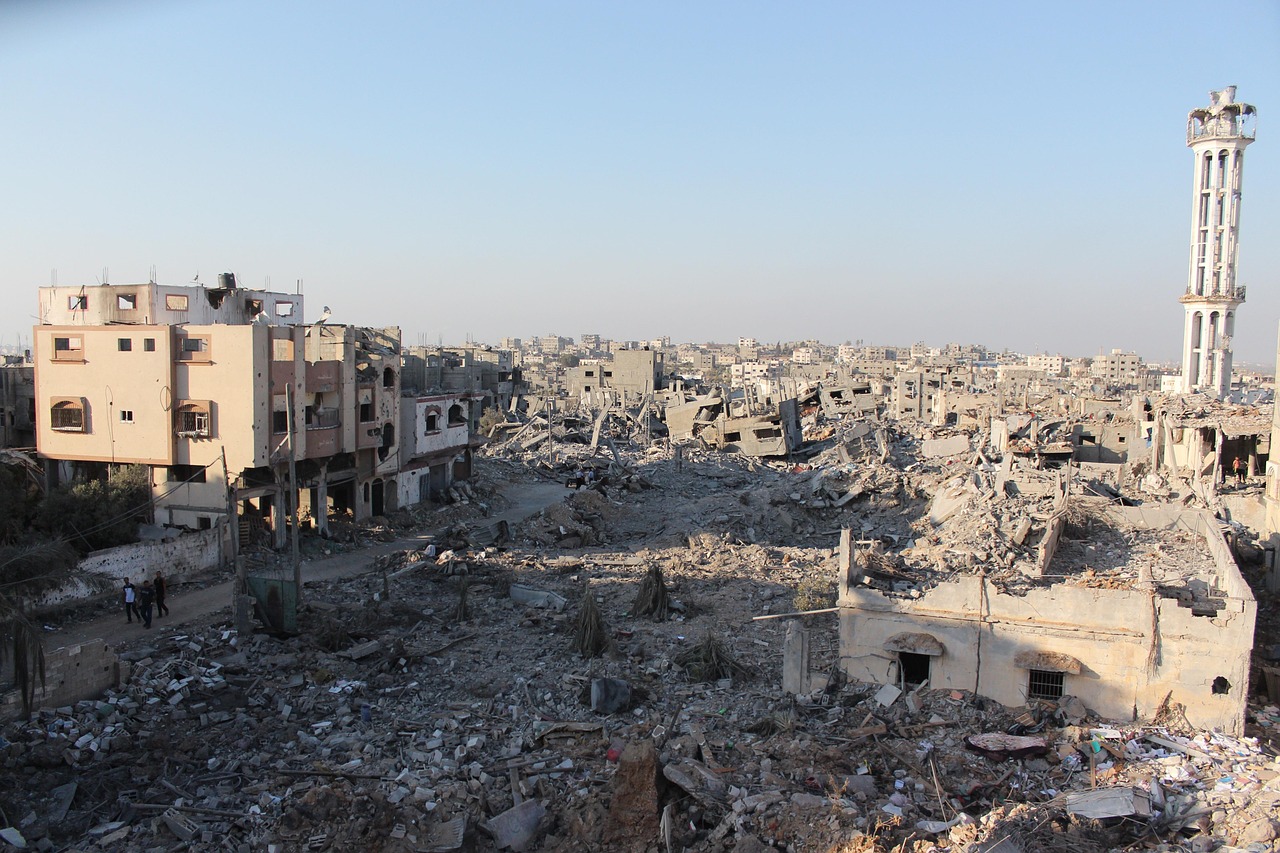
Out of every 10 people, one has been killed or injured in an Israeli strike. Nine are displaced. At least three have not eaten for days. Out of every 100 children, four have lost either one or both parents. Out of every 10 buildings that stood in Gaza prewar, eight are either damaged or flattened. Out of every 10 homes, nine are wrecked. Out of every 10 acres of cropland, eight are razed (more than three out of every four hectares).
In this explainer, we will review the various legal proceedings that have emerged from the crisis, and where they leave us two years after Hamas’ grisly attack.
International Criminal Court: Arrest Warrants and Political Pressure
The ICC’s investigation into Palestine, opened in March 2021, covers alleged crimes since June 2014, including events from October 7, 2023 onward. The Court’s jurisdiction stems from Palestine’s accession to the Rome Statute in 2015, which the ICC accepted, giving it authority over crimes committed on Palestinian territory or by Palestinian nationals. In November 2024, Pre-Trial Chamber I issued arrest warrants for Israeli Prime Minister Benjamin Netanyahu and former Defense Minister Yoav Gallant on charges including crimes against humanity and the war crime of starvation. Simultaneously, warrants were issued for Hamas leaders for war crimes related to the October 7 attacks, including extermination, murder, torture, hostage-taking, and sexual violence. Mohammed Deif’s warrant was terminated in February 2025 after confirmation of his death.
Israel challenges the ICC’s jurisdiction, arguing Palestine is not a sovereign state capable of being party to the Rome Statute. However, the Court ruled in February 2021 that its territorial jurisdiction extends to Gaza and the West Bank, including East Jerusalem.
The proceedings face significant political headwinds. In February 2025, President Trump reauthorized sanctions against individuals involved in ICC investigations of US citizens or allies. Reports emerged of intimidation campaigns against ICC Chief Prosecutor Karim Khan. With neither the US nor Israel as ICC members, and the Court lacking enforcement mechanisms, execution of warrants depends on the 125 member states’ willingness to act.
For more on the ICC proceedings, check out Explainer: The Israel-Hamas War and the International Criminal Court.
International Court of Justice: The Genocide Case
South Africa filed its genocide application on December 29, 2023, invoking the doctrine of erga omnes partes, which allows a state party to enforce treaty rights even if not directly affected by violations. The ICJ found prima facie jurisdiction and granted South Africa standing to bring the case.
In January 2024, the Court issued provisional measures ordering Israel to take steps to limit harm to Palestinians and preserve evidence, while notably declining to order suspension of military operations. The Court has issued multiple subsequent provisional measures orders.
South Africa submitted its written case (memorial) on October 28, 2024. After being granted a six-month extension, Israel’s written response is not due until January 12, 2026. A hearing on the merits may not occur until 2027. Meanwhile, upwards of a dozen countries have announced intentions to intervene in the case, including most recently Brazil, Belize, Cuba, and Ireland.
For more on the ICJ proceedings, check out Explainer: The Israel-Hamas War and the International Court of Justice.
UN Commission of Inquiry: Investigating Both Sides
The UN Independent International Commission of Inquiry, established in May 2021, issued its first set of reports on the current Gaza hostilities in June 2024, examining violations from October 7 through December 31, 2023. The Commission found “on reasonable grounds” that Hamas and other Palestinian militants committed war crimes in the October 7 attack, while Israeli authorities and security forces committed war crimes and crimes against humanity in subsequent operations.
In September 2025, the Commission concluded that Israel has committed genocide against Palestinians in Gaza, finding four of five genocidal acts under the 1948 Convention: killing, causing serious bodily or mental harm, deliberately inflicting conditions calculated to bring about destruction, and imposing measures to prevent births. The Commission applied the “only reasonable inference” standard from the ICJ’s Bosnia v. Serbia case, analyzing both statements by Israeli authorities and patterns of conduct, concluding: “The State of Israel bears responsibility for the failure to prevent genocide, the commission of genocide and the failure to punish genocide against the Palestinians in the Gaza Strip.”
Israel “categorically” rejected the findings as biased and false.
While the Commission cannot prosecute cases, its findings and evidence collection can support ICC prosecutions or ICJ proceedings.
For more on the Commission’s work, check out Explainer: What the UN Genocide Finding Against Israel Means Under International Law.
Domestic Proceedings and Universal Jurisdiction
Israeli military reportedly opened investigations in early 2024 suspected friendly fire deaths that may have added to the overall casualty count on October 7, though Israel’s high court suspended these probes in June 2024. The New York Times reported in August that although Israel had carefully compiled evidence and had arrested upwards of 200 Palestinians in connection with the October 7 attack, “not one has been charged or put on trial.”
In March 2025, US Attorney General Pam Bondi established the Joint Task Force October 7 to prosecute perpetrators of the attacks, pursue charges against senior Hamas leaders, and target entities financing Hamas.
The UN Commission recommended that states parties to the Geneva Conventions investigate core international crimes under domestic or universal jurisdiction.
Procedural Challenges and Timeline Realities
ICJ proceedings typically span years, with states afforded due process through multiple stages of written submissions and oral proceedings. Israel requested and received a six-month extension for its written response, reflecting the complexity of genocide allegations.
ICC cases face similar temporal challenges. Even if arrests occur, trials could extend for years with opportunities for extensions from both prosecution and defense. The ICC operates under complementarity, meaning it can only act when national authorities are unable or unwilling to prosecute.
Multiple UN bodies have reported obstacles to evidence collection, including lack of access to witnesses and crime scenes. Documentation of sexual violence has proven particularly challenging, with competing narratives about the scale and systematic nature of alleged assaults.
Legal and Political Implications
These proceedings raise fundamental questions about state obligations under international law. The prohibition of genocide is considered jus cogens, a peremptory norm binding all states under international law. State parties to the Genocide Convention have additional specific obligations to prevent and punish genocide. The UN Commission urged countries to halt weapons transfers to Israel, raising questions about state complicity for countries providing military aid.
Following the ICC’s warrants, the UK government stated it would adhere to international law, with enforcement being a decision for courts rather than government. Other ICC member states face similar tensions between legal obligations and political considerations.
Outstanding legal questions include the genocide intent standard, the application of proportionality and military necessity principles in densely populated areas, and mechanisms for holding non-state armed groups accountable when they lack formal judicial systems.
Conclusion
Two years after October 7, the international legal response demonstrates both the robustness and limitations of international justice mechanisms. Multiple bodies have asserted jurisdiction and issued orders, yet meaningful accountability remains elusive amid political resistance and protracted proceedings.
Elise Baker, a staff lawyer for the Atlantic Council’s Strategic Litigation Project, wrote of the UN Commission’s initial batch of findings:
While investigations and prosecutions may take years, legal accountability is essential to recovering and healing from a conflict that has resulted in ‘months of losses and despair, retribution and atrocities.’ As the COI concluded: ‘The only way to stop the recurring cycles of violence…is to ensure strict adherence to international law.’
The ultimate test will be whether the international legal architecture can deliver justice for victims on all sides while maintaining its legitimacy amid intense political pressure. With ICJ merits hearings unlikely before 2027 and ICC trials potentially extending years beyond any arrests, the pace of international justice continues to test the patience of those seeking accountability.
*As reported by Reuters, Gaza’s Health Ministry reports to both Hamas authorities and the Palestinian Authority in the West Bank; Israel disputes the figures as manipulated and notes they don’t differentiate between civilians and combatants, while the UN considers the ministry’s data systems credible.
