
 Features
On July 29, 1999, Dr. Neelan Tiruchelvam, a distinguished Sri Lankan Tamil constitutional lawyer, academic, and parliamentarian, was assassinated by the Tamil separatist rebel group, the Liberation Tigers of Tamil Eelam (LTTE). His killing was in retaliation for his efforts to resolve Sri Lanka’s decades-long ethnic conflict through democratic, power-sharing constitutional reforms within a united Sri Lanka—an alternative to the LTTE’s armed struggle for a separate Tamil state.
On the 26th anniversary of his assassination, filmmaker and JURIST Senior Editor Pitasanna Shanmugathas released NEELAN: UNSILENCED, a poignant documentary that revives Tiruchelvam’s legacy as both a public intellectual and a force for reconciliation. The film traces his wide-ranging contributions—from co-authoring Sri Lanka’s 1995 “Union of Regions” constitutional reform proposals to his contributions in the drafting of Kazakhstan’s post-Soviet constitution and observing Chile’s 1988 democratic plebiscite which saw the end of Pinochet’s dictatorship.
Through meticulous storytelling, NEELAN: UNSILENCED not only revives Dr.Tiruchelvam’s legacy but also challenges contemporary Sri Lanka—and the world—to confront the urgent need for inclusive governance. The documentary stands as both a historical record and a moral call to action, urging us to carry forward his vision of a united yet pluralistic society where peace and democracy reinforce one another.
In this interview, JURIST’s South Asia Chief of Staff, Arnav Laroia, speaks with filmmaker and fellow JURIST colleague Pitasanna Shanmugathas about making NEELAN: UNSILENCED and how the film highlights Dr. Tiruchelvam’s legacy, constitutional work, international impact, and lessons for peace and democracy in divided societies.
JURIST: What was the personal or political motivation that compelled you to make NEELAN: UNSILENCED, and why did you feel this was the right time to tell Dr. Tiruchelvam’s story?
Shanmugathas: Dr. Tiruchelvam, a Sri Lankan Tamil himself, was severely vilified during his life and even in death—particularly by segments of the Tamil community—for opposing the LTTE’s demand for a separate state. Dr. Tiruchelvam believed in a united Sri Lanka where all communities—Sinhalese, Tamils, Muslims—could coexist with equal rights. As a constitutional scholar and parliamentarian, his efforts in formulating bold power sharing constitutional reform proposals as a peaceful solution to end the civil war directly challenged the LTTE’s separatist agenda and ultimately led to his assassination.
Drafted thirty years ago, Dr. Tiruchelvam’s proposals remain the boldest and most progressive attempt in Sri Lanka’s history to redress the longstanding grievances of the minority communities.
Years after his death, when I first began researching his life, I was struck by how Dr. Tiruchelvam’s legacy had been largely forgotten and even suppressed. My initial understanding of Dr. Tiruchelvam’s legacy came through reading the work of Sri Lankan Tamil journalist DBS Jeyaraj, whose writings emphasized the bold, inclusive nature of the constitutional reform proposals Dr. Tiruchelvam helped formulate.
It was around the time I was learning about Dr. Tiruchelvam that I watched No More Tears Sister, a powerful documentary by Canadian filmmaker Helene Klodawsky about another Tamil dissident, Dr. Rajini Thiranagama, who was also assassinated by the LTTE. Seeing how that film gave her a voice and highlighted her legacy inspired me to do the same for Dr. Tiruchelvam—setting in motion what would become a nine-year journey until the release of NEELAN: UNSILENCED.
The reason why I felt this was the most important time to release the documentary is because Sri Lanka is once again at a constitutional crossroads. Sri Lankan President Anura Kumara Dissanayake’s government currently holds a rare supermajority in Parliament and during his election he campaigned on introducing a new constitution to Sri Lanka that would abolish the Executive Presidency, devolve power to the regions—promises that mirror the reforms championed within the proposals Dr. Tiruchelvam helped formulate.
As a result, I wanted to release this documentary now—and to make it freely accessible—so that it can reach audiences far and wide as both a tribute to Dr. Tiruchelvam’s legacy and a call to action. The film aims to show the Sri Lankan people what meaningful constitutional reform looks like, and why they must hold President Dissanayake accountable to his promises to implement a new constitution—one that is just, inclusive, and reflective of the constitutional vision Dr. Tiruchelvam championed.
JURIST: The documentary blends Dr. Tiruchelvam’s personal life, family background, and Sri Lanka’s turbulent socio-political context. How did you decide on the balance between portraying the man and the political figure?
Shanmugathas: Striking the right balance was certainly a challenge. Dr. Tiruchelvam achieved an extraordinary amount in the 55 years he was on this planet—from institution-building, advising on constitutional reform in multiple countries, to pioneering democratic election monitoring across the Global South, and emerging as a globally respected human rights figure. There was a great deal of ground to cover.
That’s why I felt it was important to begin by grounding the documentary in his personal story. In particular, I wanted to highlight the formative influence of his father, Senator Murugeysen Tiruchelvam, who was a staunch advocate of federalism and Tamil minority rights during a period of Sinhala majoritarian violence against the Tamil community in Sri Lanka’s immediate post-colonial history. Understanding this early context helps explain how Dr. Tiruchelvam developed his lifelong commitment to minority rights and democratic governance.
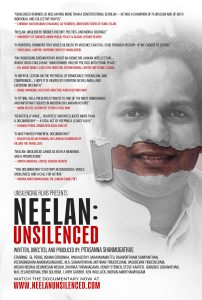
Film Poster
© Unsilencing Films/Pitasanna Shanmugathas
The film then traces how the convictions he formed to protect minority rights while growing up in Sri Lanka shaped his broader international work. This included advising on Kazakhstan’s post-Soviet constitution, engaging in democratic election monitoring in countries like Chile and Bangladesh, and ultimately advancing the bold and progressive constitutional reform proposals to resolve Sri Lanka’s ethnic conflict, for which he is most remembered.
I wanted the documentary to show that Dr. Tiruchelvam’s legacy cannot just be confined to Sri Lanka. Dr. Tiruchelvam was an international figure. For Dr. Tiruchelvam democracy wasn’t just a national imperative—it was a universal framework through which pluralism could take root and flourish.
JURIST: The “Unitary State” clause which first notably appeared in Sri Lanka’s 1972 Constitution remains one of the most contentious issues for Tamil aspirations. In your view, why has there been persistent resistance to exploring a federal model despite Dr. Tiruchelvam’s assurances of unity?
Shanmugathas: Constitutional scholar Dr. Rohan Edrisinha, whom I interviewed for the documentary, explains in the film that much of the resistance stems from historical and linguistic misunderstandings.
As Dr. Edrisinha points out, the “Unitary State” clause was first introduced in the 1972 Republican Constitution by the United Front Government, and its inclusion was widely perceived by Tamils as a political attack on their political party, the Federal Party, led by Tamil civil rights leader S.J.V. Chelvanayakam. Ironically, the Federal Party had explicitly campaigned in the 1970 elections on a federal solution within a united Sri Lanka and rejected separatism. Yet, the decision to embed the term “unitary” in the constitution was viewed by many Tamil leaders as a symbolic rejection of any meaningful devolution of power.
Dr. Edrisinha also points out that in the Sinhala language, the words for “unitary” (akeeya) and “united” (eksath) are often conflated—leading many to falsely believe that abandoning a unitary structure would mean breaking up the country. This linguistic confusion has fueled fear, emotion, and resistance among both the Sinhala public and Sinhala political leaders, despite federalism being compatible with national unity.
The brilliance of the 1995 constitutional reform proposals—spearheaded by President Chandrika Kumaratunga’s government with key input from Dr. Tiruchelvam—was their attempt to address this Sinhala fear head-on. They proposed removing the term “Unitary State” and replacing it with “Union of Regions,” while still emphasizing that Sri Lanka would remain an “indissoluble union.” This was a bold symbolic step, intended to reassure skeptics that the reforms were not a path to secession, but rather a framework for inclusive governance.
The real barrier to constitutional reform in Sri Lanka has been political fear and public misunderstanding—not the feasibility of federalism itself. Dr. Tiruchelvam’s work showed that power-sharing within a united state is both possible and necessary for peace.
JURIST: The 1995 constitutional reform proposals are described as the boldest attempt to resolve the conflict. From your research, what were the obstacles that prevented the political implementation of the “Union of Regions” model?
Shanmugathas: There were two primary obstacles to the implementation of the proposals.
First, although Chandrika Kumaratunga won the 1994 Presidential elections with a strong mandate to resolve the civil war through constitutional reform, her government lacked the two-thirds parliamentary majority required to enact a new constitution. A long-standing problem in Sri Lankan politics is the rivalry between the two major Sinhala dominated parties—the Sri Lanka Freedom Party (SLFP) and the United National Party (UNP). Historically, when either party is the ruling party in power and attempts to address minority grievances, the other obstructs those efforts for political gain. This dynamic played out again when UNP leader Ranil Wickremesinghe withheld his party’s support for the 1995 proposals. In 2000, when Kumaratunga finally tabled the draft constitution, members of the UNP dramatically set copies of the proposals on fire in Parliament.
Second, the LTTE refused to negotiate with the government’s 1995 proposals. Despite offering the most far-reaching power-sharing framework in Sri Lanka’s history—transforming the country into a “Union of Regions,” devolving real authority to the provinces, embedding safeguards to protect those powers from central government intrusion, and establishing mechanisms to resolve disputes between regions and the central government—LTTE leader Velupillai Prabhakaran refused to engage with the proposals. He remained committed to a separate Tamil state and saw any compromise as betrayal. Dr. Neelan Tiruchelvam, one of the architects of the proposals, was ultimately assassinated by the LTTE for his role in drafting the proposals.
Had the LTTE been willing to negotiate, public pressure from a war exhausted nation might have forced the oppositional UNP to cooperate—creating a genuine opportunity for peace. Unfortunately, that moment was lost.
JURIST: The film shows Dr. Tiruchelvam’s involvement in Chile’s democratic transition and Kazakhstan’s post-independence constitution. What insights did you gain about how these comparative experiences shaped his approach to Sri Lanka’s constitutional challenges?
Shanmugathas: For Dr. Tiruchelvam, I believe it was actually the other way around. His experiences in Sri Lanka, particularly his belief in protecting minority rights within a democratic framework, informed his approach to constitutional reform in other countries.
In Kazakhstan, where he served as a constitutional consultant, Dr. Tiruchelvam consistently emphasized that Kazakhstan’s constitution must guarantee equal rights and security for all individuals, regardless of ethnicity, religion, or socio-economic status. Steve Kanter, former dean of Lewis & Clark Law School in the United States, who also participated in the Kazakh constitutional consultancy effort, recalled in my documentary that this commitment to inclusive, rights-based governance shaped nearly all of Dr. Tiruchelvam’s recommendations and had a meaningful impact on Kazakhstan’s constitutional framework.
JURIST: Given Sri Lanka’s current political climate, with President Anura Kumara Dissanayake’s parliamentary supermajority, do you believe the political space exists today to revive Dr. Tiruchelvam’s constitutional vision?
Shanmugathas: President Dissanayake holds a rare supermajority in Parliament, giving him the political mandate to enact a just and inclusive constitution. Yet, he has deprioritized constitutional reform in favour of first resolving the nation’s economic and corruption problems. But lasting economic and political stability cannot be achieved under Sri Lanka’s current constitution, which remains deeply centralized and majoritarian.
His political coalition, the National People’s Power, rose to power through grassroots mobilization by a public disillusioned with the traditional SLFP–UNP system. That same public pressure can now be harnessed to demand meaningful reform. Given his party’s rise to power through grassroots organization, President Dissanayake may be more responsive than his predecessors to such civic engagement. The political space exists—what’s needed now is public will to push for a new constitution aligned with the inclusive, power-sharing vision Dr. Tiruchelvam championed.
My hope is that this documentary inspires the Sri Lankan public to mobilize and demand the inclusive, power-sharing constitution Dr. Tiruchelvam envisioned—before this rare political opportunity slips away.
JURIST: The documentary conveys that Dr. Tiruchelvam pursued reconciliation even during periods of deep personal risk. In making this film, what struck you most about his personal courage and moral consistency?
Shanmugathas: What struck me most was the depth of Dr. Tiruchelvam’s personal sacrifice—he stood by his convictions even when it put his life at risk. As a Harvard Law-educated constitutional lawyer, he could have chosen a prestigious and lucrative legal career in a safe environment free from harm. Instead, he returned to war-torn Sri Lanka and devoted himself to building a democratic framework where people of all communities could live in peace. He paid for that commitment with his life.
That moral consistency was reflected not only in his constitutional work, but also in his public advocacy. During the height of the LTTE’s vilification campaign against him, one of the many falsehoods they spread was that he remained silent on the suffering of Tamil civilians. But the record shows otherwise. In his Parliamentary speeches, Dr. Tiruchelvam consistently condemned the government’s atrocities against Tamil civilians—including forced displacement of Tamil civilians by the army, the use of torture and arbitrary detention, and the potential reintroduction of the death penalty. He even raised concerns and called for accountability over allegations of mass Tamil graves in the North, reportedly carried out by the Sri Lankan army. The mass grave allegations were confirmed in February 2025, but his words on this issue—and many others—remain more relevant today than ever.
JURIST: If there is one message or lesson that you hope viewers—both Sri Lankan and international—will carry forward after watching NEELAN: UNSILENCED, what would it be?
Shanmugathas: Dr. Tiruchelvam often spoke about “the sanctity of life”—and you hear him say those very words in the film. In fact, he said those words in one of his final speeches to Parliament prior to his assassination. In a world where violence is rampant—whether it’s Israel’s relentless slaughter of Palestinians in Gaza or Russia’s brutal invasion of Ukraine—it feels as though that fundamental value of the sanctity of life has been forgotten. What I hope viewers take away from this documentary is inspiration from Dr. Tiruchelvam’s unwavering belief in peaceful coexistence through democratic, power-sharing frameworks. His vision remains deeply relevant—not just for Sri Lanka, but for conflict-affected regions around the world. And I hope people are moved to carry his vision forward and apply it wherever the pursuit of justice and peace is needed.
NEELAN: UNSILENCED can be watched for free on its website by clicking here
