
 Commentary
Orchestrated voices are laying the groundwork for a constitutional amendment required to partition the four provinces. The Interior Minister, close to the Establishment (a popular term for serving generals and top bureaucrats), declared that the current system has collapsed and cannot deliver. The military spokesman, who periodically holds press conferences on state affairs, opined that “if good governance requires an administrative reset, then it has to be done through constitutional methods…” A few days ago, the Planning Minister proposed a fundamental restructuring that would either create 15 new provinces or establish fully empowered local governments in 160 districts.
Since Pakistan’s birth in 1947, the Establishment has engaged in catastrophic experiments with constitutionalism. Last year, at the Establishment’s urging, the national Parliament amended the Constitution to weaken the Supreme Court by transferring some of its constitutional authority to a new apex court called the Federal Constitutional Court.
Perhaps the most thoughtless experiment was folding the historical Western provinces into a single administrative unit called One Unit in 1955. Other failed experiments included imposing Urdu on East Pakistan, where people spoke Bangla and later rebelled and declared independence as Bangladesh. Military rulers, including Field Marshal Ayub Khan (1958-69), General Zia ul Haq (1977-88), and General Pervez Musharraf (1999-2008), repeatedly established presidential governments by revoking or suspending parliamentary constitutions.
Constitutional subversions accompanied traumatic national memories. Military rulers executed an elected prime minister (Zulfikar Ali Bhutto) after a controversial criminal trial and exiled two other elected prime ministers (Benazir Bhutto and Nawaz Sharif). Yet another former prime minister (Imran Khan) remains in prison while facing more than 100 cases.
Most constitutional experiments stemmed from complaints about inefficiency and corruption, a pervasive problem throughout most government departments. Instead of solving problems through policies and laws, however, change-seekers repeatedly disregard or amend the Constitution, preferring dramatic resets over continuity.
Good governance is indeed a treasured value, but it stems from competence, knowledge of statecraft, and structural stability, not from constantly jolting the Constitution, the supreme law of the land. A lack of constitutional stability is itself a significant cause of poor governance.
This commentary argues the following: first, any constitutional change to the federal structure is unnecessary, a detour from addressing economic and social problems, and a waste of time and resources. Constantly amending the Constitution does not improve governance. Second, because partitioning provinces is constitutionally difficult, the national legislature may adopt a questionable route, further undermining constitutional stability. Third, if provinces must be reconfigured, devolving power and revenues to local governments within the province is a much better solution.
The Four Provinces and Demands for Partition
Pakistan’s four provinces have deep historical roots, even though their names and borders have shifted over the centuries. In 1580, Mughal Emperor Akbar divided his empire into 12 Subahs (a Persian word), translated into English as provinces. Three of these Subahs—Lahore and Multan, together covering present-day Punjab, and Kabul, extending into Khyber Pakhtunkhwa—fall within present-day Pakistan, though Kabul, the city, is now the capital of Afghanistan. The remaining Subahs were in present-day India and Bangladesh. The British Raj changed the names and boundaries of the Subahs, but the division persisted.
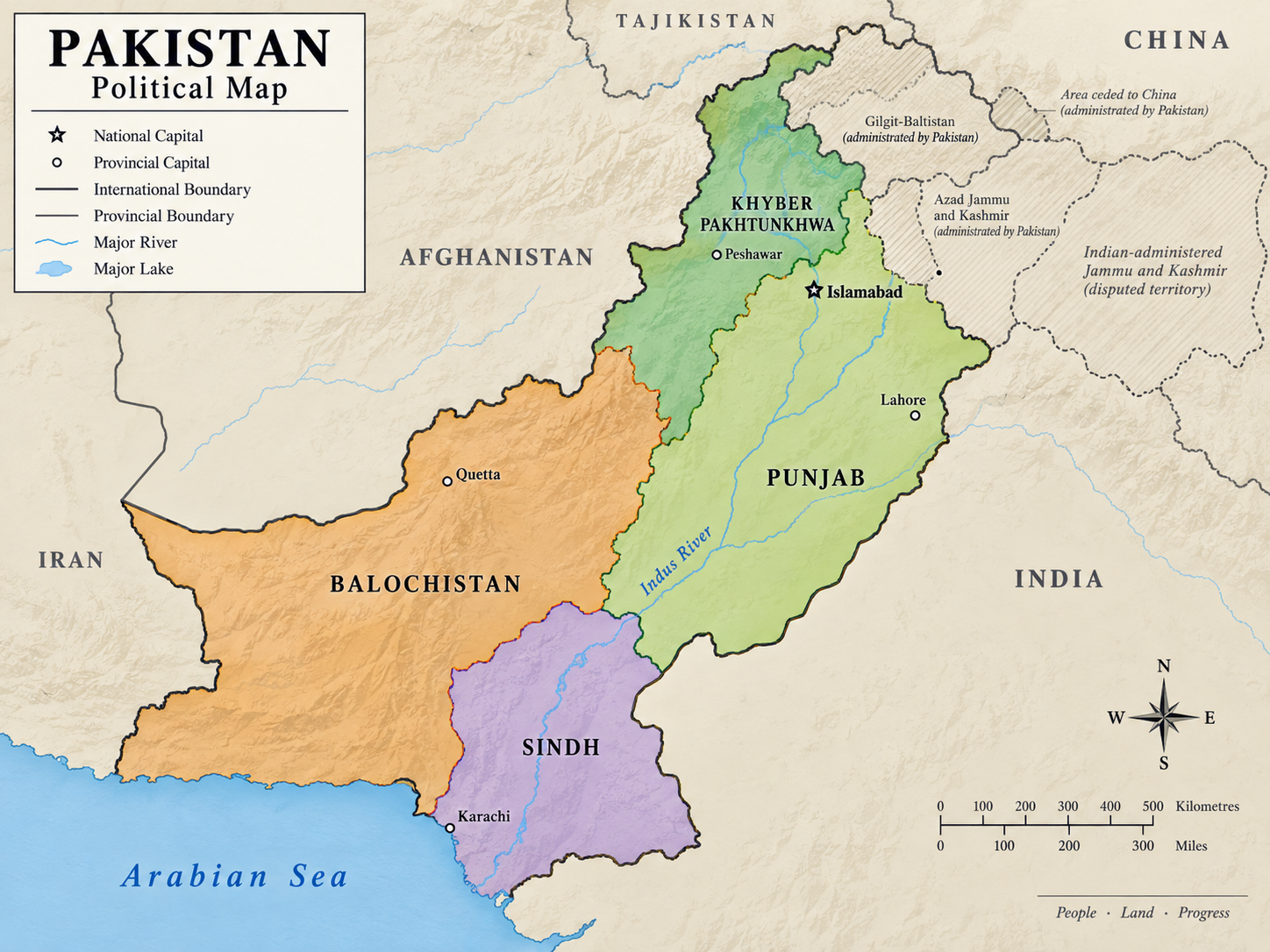
After 1947, Pakistan inherited the three provinces of Punjab, Sindh, and Khyber Pakhtunkhwa and merged the princely Khanates and other contiguous territories into Balochistan, which became the fourth province in 1970. The four provinces vary in size and population. Balochistan, the largest province by area, has the smallest population. Punjab dominates the federation with its massive population and GDP, while Sindh is home to Karachi, the most populous city.
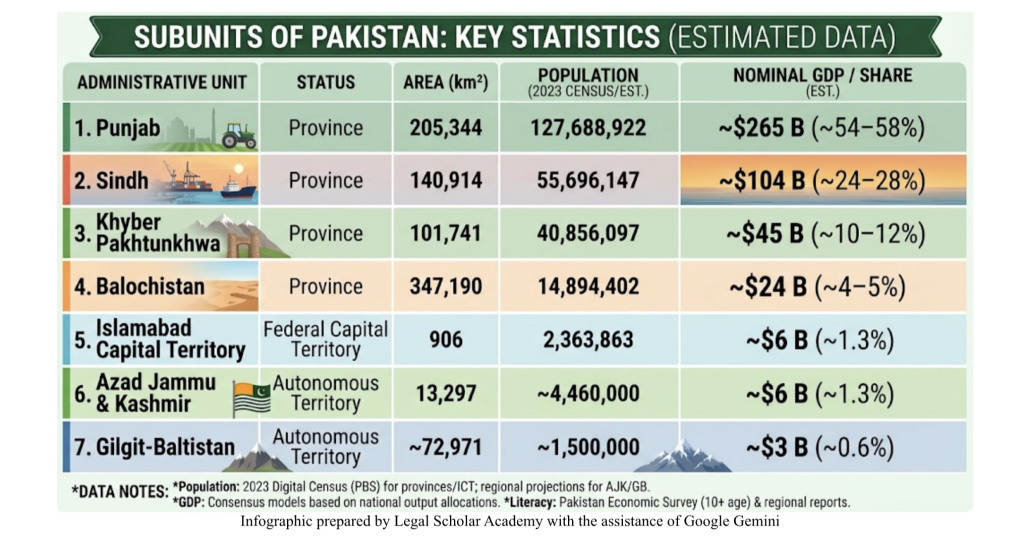
The provinces differ in size, population, and resources, but that disparity is not a good reason to divide them into smaller federal units, as most federations (the US and Canada, for example) show enormous size and population imbalances among federated units. Some federations address this disparity through an upper house; the Pakistan and US Senates give constituent units equal representation.
Historically, ethnically, and linguistically, the four provinces differ significantly, and dismantling the One Unit in 1970 restored the identities erased for the sake of an efficient abstract unit. Similarly, dividing a historical province into smaller units is the same error in reverse. Centuries of history have left various ethnicities and dialects coexisting within each province, and none of the four provinces has a monolithic ethnicity or language. For example, South Punjab can easily be distinguished from North Punjab. So, partitioning every province, not just Punjab, is readily possible.
Political parties have even argued that Punjab is too large as a unit and can be split into two federal provinces. However, the question is whether even such a clear partition is worth jolting the Constitution, particularly if there are ways to devolve power and money to administrative units within the province.
Some ethnic and linguistic communities, like the Saraiki in South Punjab, Hindko speakers of Hazara division in Khyber Pakhtunkhwa, and Urdu-speaking immigrants (Muhajir) in Sindh, do ask for separate provinces. Their desire for a separate federated unit stems from their lack of a voice in provincial government. These sentiments point to the over-centralization of power within the Province. Tearing Karachi from Sindh or Gwadar from Balochistan into separate provinces or making them into federal territories like Islamabad would be a dramatic change, full of potential problems rather than solutions.
The militants in the former Federally Administered Tribal Areas (FATA) are fighting to free their lands that were merged into Khyber Pakhtunkhwa, another constitutional amendment that has brought division rather than unity, nationwide terrorism rather than promised prosperity to the merged areas. Still, Pakistan has not learned that constantly amending the state structure has not benefited the country.
Intra-provincial devolution rather than federal redesign can resolve many of these grievances. Any attempt to reshape the federal structure requires the utmost deliberation, giving constitutional inertia the benefit of the doubt to preserve the hard-won 1973 consensus.
Constitutional Barrier to Provincial Partition
After Pakistan lost East Pakistan in 1971, the 1973 Constitution, drafted with extraordinary consensus, established a federal republic with a parliamentary system at the center and elected provincial governments. The Constitution, now the supreme law of the land, affirmed Pakistan as a federation of four constitutionally protected provinces. Territorially, however, Pakistan is much larger than the four provinces, as Pakistan-controlled territories of Jammu and Kashmir and Gilgit-Baltistan remain distinct and autonomous subunits.
The founders of the Constitution did not foresee partitioning the four provinces, and to ensure their continued integrity, they made it harder to amend the Constitution on provincial matters. The procedure for amending the Constitution requires: “the votes of not less than two-thirds of the total membership” of each House and presidential consent. Thus, the national legislature alone can amend the Constitution with a supermajority, but it cannot by that procedure alone partition a Province.
The Constitution jealously protects the federation it creates through the double-supermajority requirement. For example, it is stricter when it comes to “altering the limits of a Province.” Partitioning an existing Province into smaller provinces is tantamount to “altering the limits of a Province.” In such cases, in addition to a supermajority of the national legislature, the Constitution requires the “votes of not less than two-thirds of its total membership” of the Provincial Assembly of the Province proposed to be split into smaller provinces.
The national legislature alone cannot partition a Province without overwhelming support from the Province’s people. Nor can a Province partition itself into federated units without the supermajority consent of the national legislature.
Note that the Constitution does not contemplate that if a particular Province needs to be reconfigured, the other three Provinces must be similarly divided. If the people of Punjab consent to be divided, the people of Sindh may not agree to their own division. Any proposal to divide all Provinces is thus more ambitious and disruptive than dividing a single Province. It need not be either all or none. It could be just one.
However, partitioning one Province into two or more federated units will require the Senate to give equal representation to the new federated units. In that case, the divided Province will have more seats in the Senate than the undivided Province, further spoiling the current inter-provincial balance.
Questionable Route
To circumvent these constitutional barriers, the national legislature may pursue an alternative by repealing Article 239(4), which would remove the requirement that a supermajority of the Provincial Assembly approve a Province’s partition. However, disenfranchising a province’s people from their own partition could produce a profound crisis of provincial legitimacy, particularly if a Province were divided despite opposition from its elected assembly.
Article 239(4) is unlikely to be repealed because it underpins the federation. The Federal Constitutional Court may declare such an amendment unlawful because it dismantles “salient features” of the State. However, this constitutional doctrine for invalidating a constitutional amendment is far from established.
Article 239(5) specifically provides “Notwithstanding anything contained in the Constitution and any judgment of any court, no court shall have jurisdiction to call in question any amendment to the Constitution on any ground whatsoever.” This categorical protection of amendments against judicial reversal under 239(5) may encourage pro-partitioners to repeal Article 239(4).
As explained below, dividing a Province into subunits for efficiency and good government closer to the people does not require a constitutional amendment. A Province is already empowered, under the Constitution and provincial law, to subdivide itself for the purposes of administration and local government, provided those subdivisions do not acquire the constitutional status of Provinces and the federal structure remains intact.
Provincial Autonomy
The Constitution confers autonomy on each Province to organize itself into political subunits. Article 140A mandates that “Each Province shall, by law, establish a local government system and devolve political, administrative and financial responsibility and authority to the elected representatives of the local governments.” The Province, not the national legislature, establishes local governments through provincial legislation.
Culturally, linguistically, and legally, a federated Province is much better suited to create political subunits than the national legislature or a constitutional amendment. People in the Province are much closer to its socioeconomic and cultural realities than the central government in Islamabad.
Already, Chapter II of the 1967 West Pakistan Land Revenue Act (now a provincial statute after the One Unit was dissolved to restore the provinces) allows the Province to subdivide itself into divisions, subdivisions, and even smaller units. Currently, each Province is divided into divisions, districts, subdivisions, and tehsils, and each division is a bureaucratic unit designed for administrative efficiency, but politically each division remains subject to the same Provincial Assembly.
However, nothing prevents a Province from creating a subunit with its own political assembly or council. For example, the Provincial Assembly of Punjab can consolidate the divisions in South Punjab and vest the new subunit with an elected assembly. South Punjab, so created, would then serve as a province (with a small p) without compromising the Province of Punjab’s integrity or the federal structure, and without affecting the Senate membership of the National Parliament.
Provincial autonomy offers much more flexibility and adaptability to each Province in designing and redesigning, if need be, its administrative units, since cultural, ethnic, and linguistic realities differ from Province to Province. Sindh can divide itself as it pleases, and so can Punjab, Balochistan and Khyber Pakhtunkhwa. This method preserves the Provinces as they are, without disturbing their constituent relationship with the federal government or each other. Most importantly, the method protects the Constitution’s integrity, which has been compromised too many times in the past.
To understand how provinces exercise autonomy, we need to distinguish between federated units and administrative units. Indonesia and the United Kingdom show how a Province in Pakistan can use its autonomy to create more efficient and vibrant subunits.
Federated Units and Administrative Units
Most countries are unitary states, and only a small number are federations. Even unitary states have administrative units. Indonesia, for example, is a unitary state under its Constitution. Yet Article 18 divides Indonesia into provinces empowered with autonomy. However, these provinces are not federated units. Compare this with Pakistan’s Constitution. Article 1 declares Pakistan a Federal Republic with four named provinces, along with “States and territories” that may be included through accession or otherwise. Part IV of the Constitution outlines the provinces’ unicameral structure, and Part V outlines relations between the provinces and the federation. To maintain inter-provincial parity, Article 59 allows each Province to send 23 members to the Senate: 14 general, four women, four technocrats/ulema, and one non-Muslim.
Both Indonesia and Pakistan call their units provinces. However, their legal framework differs. Pakistan’s federation is a constitutional structure and protects the provinces’ constitutionally allocated powers. In a unitary state, the national legislature ordinarily has greater authority to change provincial powers, territorial boundaries, and governmental structures through legislation. Thus, reorganizing the administrative units of a unitary state, regardless of their designation, is generally easier.
Like Indonesia, the United Kingdom is also a unitary entity. However, Scotland, Wales and Northern Ireland have their own elected assemblies that act as both administrative and political subunits. Yet Scotland, Wales, and Northern Ireland remain subject to the UK Parliament, and their political assemblies do not make the UK a federation. This example shows that a subunit could be administrative or combine political and bureaucratic structures.
The lesson for Pakistan is not to copy Indonesia or the UK, or change the Constitution to become a unitary state, but to recognize that meaningful political government need not require federal status. Acting as a federated unit, each Province in Pakistan can design subunits as administrative, political, or both; however, all units remain part of the Province. This allows a Province to create political subunits without compromising the federal structure under the Constitution.
Part of the frustration stems from the fact that Provinces have been reluctant to implement devolution consistent with Article 140A. Yet, amending the Constitution to address that failure would recall the Punjabi saying, ڈگنا کھوتے توں تے غصہ کمیار تے (falling off the donkey but taking the anger out on the potter).
Conclusion
The Constitution of Pakistan establishes a federation with provincial autonomy. Constitutional experiments such as One Unit and the presidential form of government have undermined the stability a country needs to develop socially and economically. Resetting the constitutional button too often undercuts good governance, as expectations constantly shift from one model to another. If provincial legislation can address an issue, national legislation is unnecessary; if national legislation can fix an issue, amending the Constitution is counterproductive. On these sound legal principles, the Constitution allows each Province to establish local governments as it sees fit. The national government and the Establishment must refrain from intervening in the Provinces, focus on their many responsibilities, and let the Provinces determine their configuration according to local realities.
Pakistan does not need more Provinces to bring government closer to the people. It needs the existing Provinces to design local governments that are closer to the people.
Professor L. Ali Khan is the founder of Legal Scholar Academy and an Emeritus Professor of Law at the Washburn University School of Law in Topeka, Kansas. He has written numerous scholarly articles and commentaries on law. In addition, he has regularly contributed to JURIST since 2001. He welcomes comments at legal.scholar.academy@gmail.com.
