
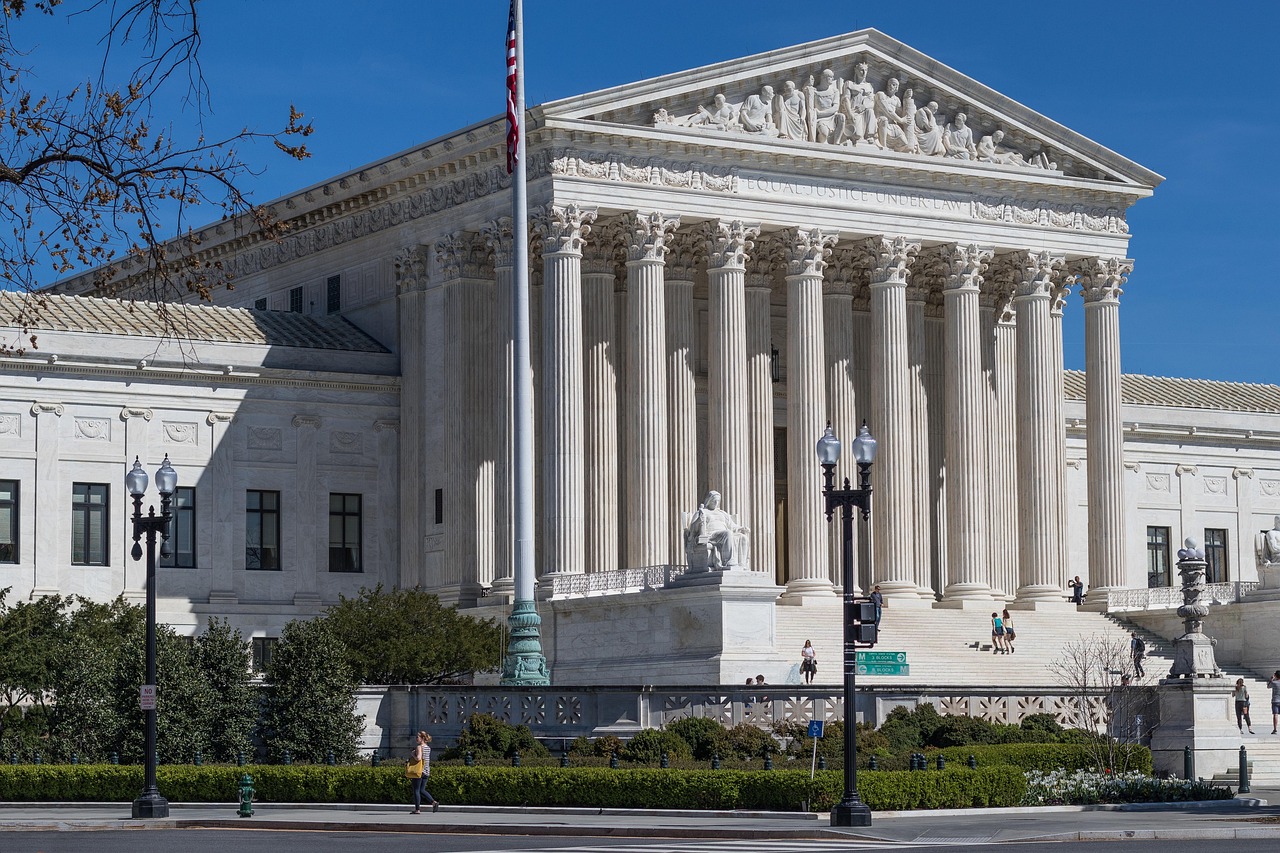
Whether the issue is redistricting, affirmative action, voting rights, abortion, presidential immunity, or any of the other country-defining questions that the Roberts Court has decided over the last two decades, there can be no doubt that the justices dramatically changed our nation’s politics and national identity. But the Roberts Court is not unique in its importance. In 1857, the Court did not allow Congress to end slavery in the territories—a decision that led to the Civil War. In the early 1930s, the Court blocked several of Franklin Delano Roosevelt’s important New Deal programs during the middle of the Great Depression, leading to his threats to pack the Court. The Warren Court transformed America with its criminal procedure and civil rights decisions, leading directly to the Republican Party/Evangelical fusion that plays such a large role in our elections. No court of law in world history has exercised this much power and influence.
The Court often acts in ideologically charged ways in important constitutional law cases in one political or partisan direction. Those who disagree with that trend often push for reforms to cut back the Court’s power or to persuade the justices to decide cases differently. In the 1960s and 1970s these efforts came from conservatives opposed to Brown, Miranda, and Roe. Today, those efforts are coming from liberals because of the Roberts Court’s dismantling of the progressive decisions that came before it and its zealous over-protection of religion, guns, GOP redistricting, and presidential power. But no matter who is angry with the Court, a shared premise underlying reform efforts has been that the justices are judges of law restrained by the Constitution, other positive law, and prior cases. But that premise is incorrect, and the myths it creates are dangerous.
The justices have life tenure and cannot be removed from office absent impeachment. They are nominated by the president and confirmed by the Senate through a nakedly partisan political process which We the People have no control over. And when they issue constitutional decisions, they possess effectively unreviewable power given the super-majoritarian requirements for constitutional amendments.
Because we call this institution the “Supreme Court,” and the nine people who make it up wear black robes and sit in a majestic courtroom, the American people view them as judges of law. And the justices see themselves that way, so they express their opinions in technical, legal language that is often difficult for non-lawyers to understand. We accept the anti-representative nature of the institution because the justices are not supposed to make “political” decisions but “legal” ones.
In my 2012 book Supreme Myths and my 2018 book Originalism as Faith, I argued at great length that the institution we call the Supreme Court does not take prior law seriously enough to warrant the conclusion that the justices act like other judges. Although many legal scholars largely agreed with my descriptive accounts, some suggested that I only showed that the Court is a bad or irresponsible or partisan court but a court, nonetheless. But that distinction matters. The point is not that the current justices are acting like politicians as many on the left argue but that the institution we call the “Supreme Court” is structured in a way that makes it impossible for the justices to act like judges. That problem has plagued our country from the beginning.
The Supreme Court is not meaningfully constrained by constitutional text that is often too imprecise to provide guidance, history that is too contested to persuasively resolve current problems, or precedent, which the Court is free to ignore, distort, or reverse—and often does. The Roberts Court’s unjustified rewriting in just a few short years of abortion rights, voting rights, presidential power, congressional authority, free exercise of religion, and affirmative action—among many other areas of law—represents political value choices, not legal decisions. The Court’s constitutional doctrines are legislative in nature and effect and are creations of new law, not interpretations of old law.
Assuming the United States rises from the ashes of its current political and legal dysfunction and the pendulum shifts back to the left or even to the center, and assuming this country can have a serious discussion about Court reform, we will never truly solve the problem until we recognize that the Supreme Court of the United States is not now, nor has it ever been, a court of law. The institutional and political incentives inherent in the institution (life tenure and largely unreviewable power) lead the justices to inevitably impose their personal values (not prior law) when deciding important cases. For any reform effort to work, we must see this institution as one dominated by ideology and politics, not law.
Before Americans can decide whether or how to reform the Supreme Court, they must first understand the true nature of the institution. The central question is how to constrain a political and partisan body with no political accountability that writes and re-writes the rules under which American democracy operates. The first and necessary step is for court reformers to recognize that the justices are not doing the work of judges but of politicians.
Ending life tenure, imposing a binding ethics code, and legislation making it more difficult for the justices to strike down laws should be the starting points of serious reform efforts. The country needs to have a conversation along these lines to save itself from arbitrary rule by a governing body of elite, unelected, life-tenured former lawyers whom we mistakenly call judges but are just another set of government officials who wield far too much power and influence but without any political accountability. No constitutional representative government should house such a dangerous institution.
Eric J. Segall is the Ashe Family Chair Professor of Law at Georgia State University College of Law, where he teaches courses in constitutional law. He is the author of Supreme Myths: Why the Supreme Court is not a Court and its Justices are not Judges and a frequent commentator on the Supreme Court for major media outlets.
