
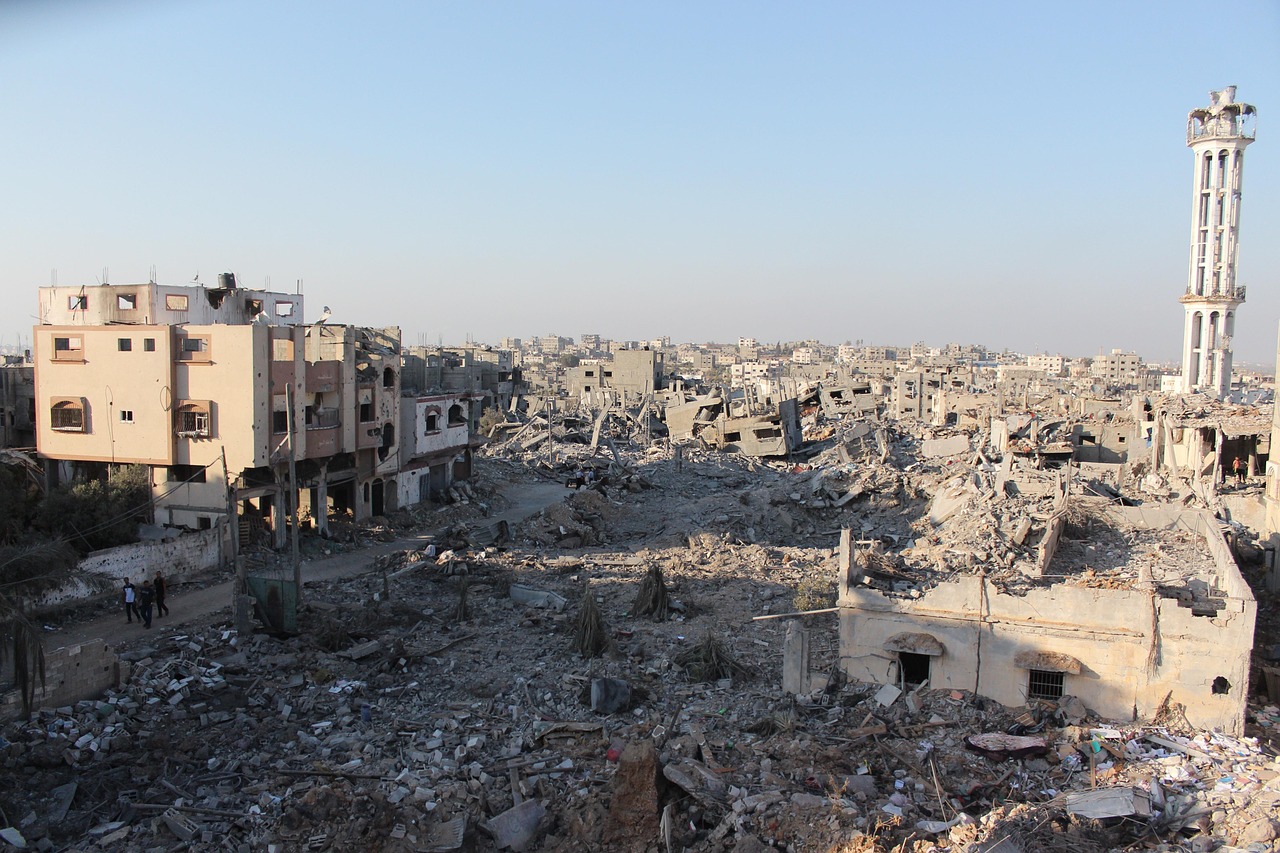
A ceasefire is an agreed-upon temporary cessation of hostilities, allowing for negotiation and the delivery of humanitarian aid. It has no legal definition under international law. As Israel and Hamas are now engaged in a ceasefire, a small glimmer of light appears. The last 20 living hostages have been returned to Israel. In exchange, Israel has released 2,000 prisoners, many with blood on their hands. In this most recent convulsion of violence, the internecine nature of the conflict between Israel and Hamas feels perpetually close at hand. The regular re-inoculation of trauma fuels enmity.
Only a surrender by one side can end a war. World War I ended with an armistice, not a surrender, on November 11, 1918. The Treaty of Versailles formally ended the war in 1919, but the terms were so harsh that they likely contributed to the spark that ultimately created the Nazi party and World War II. The war between Israel and Hamas has not yet ended. Actual peace remains elusive.
In The Art of War, Sun Tzu articulates the necessity of knowing the mindset of one’s enemy. Hamas had years of intimate experience in the study of the Israeli mind and very likely anticipated the Israeli response. In the first few months after Hamas invaded Southern Israel, the Israeli response was overwhelming. World War II ended with the surrender of Germany in May 1945 and Japan in July 1945. With respect to war, an understanding of the Israeli response to the aftermath of World War II is highly illustrative.
In April 1962, renowned Israeli oven builder Pinchas Zacklilkowsky accepted an unusual commission. He was to build an oven, 2.5 meters long and 1.5 meters high, capable of reaching a temperature of 1800 degrees Celsius. The completed oven was used only once, and the ashes it produced were collected and placed on an unspecified naval vessel. Once the ship was beyond territorial waters, the ashes were given to the sea. The ashes belonged to a person who, twenty years earlier, in a quiet suburb of Berlin, had been a major participant in creating a successful plan that ultimately turned millions of people into ash.
The conviction and execution of Adolph Eichmann is the only example of a judicially sanctioned execution by the State of Israel. Israel abolished the death penalty for ordinary murder in 1954. However, existing Israeli law provides a carve-out to punish by execution with the Nazi Collaborators Punishment Law and the Genocide and War Crimes Law. The legal justification for Eichmann’s execution relied on these laws. The trial and execution of Eichmann was a watershed moment for Israeli society. It created a new national understanding of the Holocaust, making it central to Israeli and Jewish identity. It reaffirmed the need for a Jewish state and for that state to always protect itself.
Though now largely overused and more a slur than anything, “genocide” was invented by Eichmann and his associates. The staggering amount of intentional killing by Eichmann et al needed a new name, and it was Polish lawyer Raphael Lemkin who first coined the term genocide—race killing— in his 1944 book Axis Rule in Occupied Europe. In 1948, genocide was made a crime by the UN General Assembly’s adoption of the Convention on the Prevention and Punishment of the Crime of Genocide.
Defining the crime was simple. It was lifted directly from Nazi documents and Nazi actions. It is the intent to destroy, in whole or in part, a national, ethnic, religious, or racial group. With respect to the stateless Jews, it was Nazi policy to find them and kill them in every country within reach of the Nazi war machine. No serious student of history doubts that if the Nazi regime had not been vanquished, it would have killed every Jew, everywhere. The Final Solution – the extermination of the entirety of European Jewry was the apex of depravity. No one could reasonably imagine anything worse.
Israel used hanging as the method of execution for Adolf Eichmann. This method was chosen because it was the standard form of capital punishment under the law Israel inherited from the British Mandate. German lawyers were also influential in the emergence of Israeli legal thinking, and the Nazi regime itself pushed for hanging in preference to the guillotine as a form of execution that was more shameful. It is doubtful that the regime was rigid about the matter. Roaming Nazi executioners carried around their portable guillotines rather than lots of ropes in a box.
Recently, some politicians in Israel have been calling for the use of the death penalty once again. This new version does not require a connection to the Holocaust. Such a demand is an aberration and runs counter to the Israeli relationship to capital punishment. In 1992, Israel adopted the Basic Law: Human Dignity and Liberty. This law prohibits torture, cruel, inhuman, or degrading punishment. The use of the death penalty against Eichmann post-factum would likely not discourage any future purveyors of genocide on the scale he reached. It was a singular and specific event.
It is also doubtful that post-World War II Eichmann, living in disguise as Ricardo Klement on a quiet street in Buenos Aires, was planning a comeback tour of mass murder. When Klement was Eichmann, the Israeli court did not exist, nor were the laws used to punish Eichmann in place. It is hard to parse Hanna Arendt’s critical and dismissive reporting of the Eichmann trial, separate from her being an acolyte of the highly influential and strongly antisemitic philosopher Martin Heidegger. The reason to kill Eichmann was not ambiguous. It was the need for justice.
Execution by hanging causes death by suspending a person by the neck with a noose. The aim is to cause death by asphyxiation or by breaking the neck. The outcome depends on the length of the drop and the placement of the noose. Small changes can cause an agonizingly protracted death, even when unintended. Eichmann was left suspended for an hour after the trap door was pulled. Those tasked with removing his body found his tongue dangling from his mouth, and his tongue and chest were covered in blood. Still, even the most ardent abolitionist might pause at the thought of judicial alternatives for Eichmann.
Although judicially sanctioned killing in Israel has been rare, Israel uses targeted killing- an attack on a specific enemy individual during a conflict. Defenders of targeted killing consider it an effective method of targeting enemy belligerent leadership in a precise manner that degrades the enemy’s capabilities. If so, it must comply with the laws of war, including distinction, proportionality, military necessity, prohibition against unnecessary suffering, and the humane treatment of those not participating in the hostilities. Targeted killing does advance very emphatically the just war doctrine of discrimination.
Legal and political oversight in Israel does exist, and when mistakes are made, a system is in place to hold responsible individuals accountable. Israel’s democratic elections remove politicians from office. The Israeli legal system also has a history of prosecuting and convicting prominent political figures, including a former President, Prime Minister, Cabinet Ministers, several Knesset members, Chief Rabbis, and Mayors. The internal military justice system has also acted against military leaders, such as the 2024 attack on the World Central Kitchen convoy.
Since the creation of the modern state of Israel, and before, a real and existential threat to existence has been a constant reality. The apparent passivity of European Jews toward Nazi extermination shocked the consciousness of the new state of Israel. After the Eichmann trial, Israelis better understood that European Jews were not simply cowardly but had faced an unprecedented and overwhelming event. It bolstered a sense of pride in modern Israel and affirmed its right to exist. Israel will defend that right with all the strength it has.
By hanging Eichmann, burning his dead body to ashes, then drowning his ashes in the sea, many claim it still did not settle a profoundly embittered score. It is hard to imagine how Israel could have done more to him and still lived with itself. Israel won’t need judicial execution as a meaningful deterrent on a go-forward basis when the existential threat is much more immediate.
In such circumstances, Israel may utilize targeted killing in the context of war and under the watchful eye of the justice system. Israel has a right to exist and a right to live in peace. It agreed to the ceasefire and should honor it. Hamas should do the same. We now find ourselves in a period of uncertainty. Opportunities for a better future for all parties are available. They simply need to be chosen.
Joel Zivot is a practicing physician in anesthesiology and intensive care medicine and a senior fellow in ethics at Emory University in Atlanta, Georgia. Zivot, who also holds a legal master’s degree, is a recognized expert who advocates against the use of lethal injection in the death penalty and against the use of the tools of medicine as an arm of state power. Follow him on “X”/Twitter @joel_zivot
