
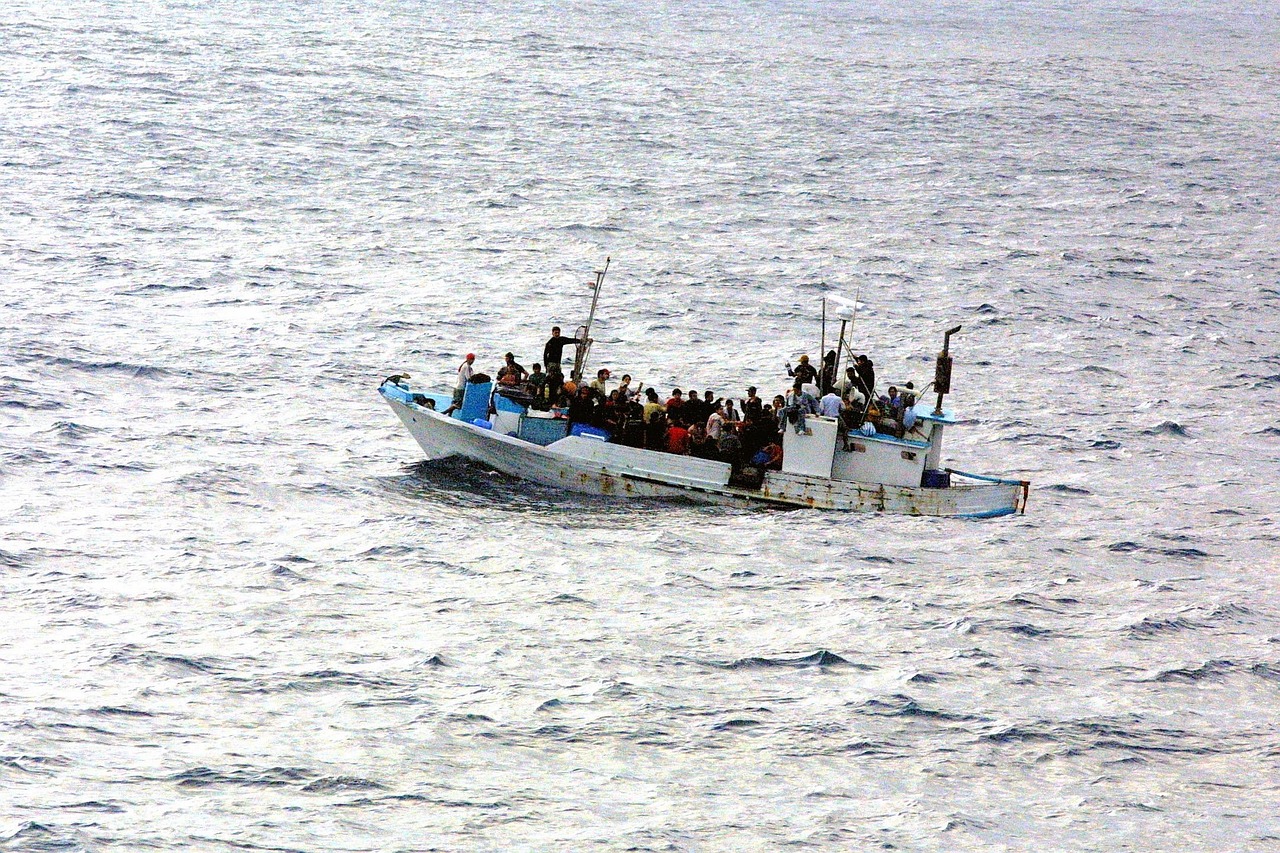
Many migrants embark on dangerous sea journeys in search of better lives in foreign countries. Too often, these voyages end in tragedy, with lives lost in the middle of the ocean far from any help. For migrants fleeing conflict or persecution, boarding an un-seaworthy boat may seem like their only option when safer routes are unavailable. This form of migration means grave risk of injury or death at sea, while presenting complex challenges for both states and private search-and-rescue organizations.
Tragic Events of Migrants Drowning
October 2013 marked a particularly devastating period for Mediterranean crossings. Two catastrophic shipwrecks within eight days claimed over 630 lives near the Italian island of Lampedusa. The first disaster occurred on October 3rd, when a vessel carrying migrants from Libya sank, killing 368 people. Just over a week later, another tragedy struck when a boat filled primarily with Syrian asylum seekers went down, drowning 268 individuals, including at least 60 children. These back-to-back catastrophes sent shockwaves through the international community and exposed the deadly consequences of dangerous sea crossings.
The crisis intensified in 2015, when the number of migrants dying at sea increased dramatically, with 3,771 reported dead, including over 1,200 migrants who perished while crossing the Mediterranean from North Africa in April alone.
Moreover, the recent data recorded by the International Organization for Migration (IOM) accentuates that 2,452 deaths of migrants were documented in the Mediterranean Sea in 2024, although not the largest annual total ever. IOM has, therefore, called for adequate search and rescue systems, as well as safer migration routes as an alternative to dangerous journeys.
The October 2013 disasters prompted Italy to take immediate action. Within two weeks, on October 18, 2013, the Italian government launched “Mare Nostrum,” an ambitious military and humanitarian operation designed to prevent further loss of life in the Mediterranean while targeting human traffickers and migrant smugglers. The program proved remarkably effective at saving lives, facilitating the safe arrival of approximately 150,000 people to European shores.
However, Mare Nostrum faced significant obstacles. The operation carried enormous financial costs, requiring over $11 million monthly to maintain. Critics argued that the rescue missions inadvertently encouraged more dangerous crossings by providing a safety net for smuggling operations. Italian officials grew increasingly frustrated, claiming that European partners had abandoned them to handle the crisis alone.
These pressures ultimately proved insurmountable. Mare Nostrum officially ended on October 31, 2014, after just over a year of operation. The European Union replaced it with Operation Triton, a border management initiative run by Frontex with significantly reduced funding and personnel. This transition marked a fundamental shift in European policy—from prioritizing rescue operations to emphasizing border security and surveillance. Tragically, migrant deaths in the Mediterranean increased following Mare Nostrum’s termination. This sudden shift in Italy’s humanitarian cause has severely impeded civilian efforts to rescue the people in distress at sea.
In 2021, 21 crew members from various NGOs were charged in Italy for aiding and abetting illegal immigration, in the context of their search-and-rescue missions conducted between 2016 and 2017. This includes four crew members of the Iuventa, which had reportedly rescued around 14,000 migrants in the Mediterranean Sea.
The preliminary criminal proceedings, which began in May 2022, were criticized by Mary Lawlor, the UN Special Rapporteur on the situation of human rights defenders. In particular, she stated that the ongoing proceedings are “a darkening stain on Italy and the EU’s commitment to human rights.” She further denounced that “They are being criminalised for their human rights work. Saving lives is not a crime and solidarity is not smuggling.”
Although an Italian court in Trapani had dismissed the charges in 2024, there has not been any significant change in Italian government’s response to NGO efforts in search-and-rescue mission.
In July 2025, Human Rights Watch (HRW) similarly criticized the Italian Constitutional Court’s ruling, which upheld a law that imposed sanctions on sea rescue groups, as “cast[ing] a dark shadow over sea rescue.” Despite that, HRW had acknowledged a silver lining in the Court’s judgment, wherein “an order that leads to a violation of the primary obligation to save human life and is likely to endanger it is not binding, and failure to comply with it cannot be sanctioned.” It follows that if an order illegitimately violates migrants’ fundamental right to life, rescuers are justified in disobeying such orders.
Who should bear the responsibility of safeguarding the vulnerable migrants at sea?
The past events raise an urgent question from a humanist perspective: why did the surrounding countries not rescue the migrants drowning in the sea? A simple, yet profound, question serves to show the paradox of the class divide between legal and illegal migration. France, Greece, Italy, Spain and other countries situated around the Mediterranean Sea are state parties to the 1951 Refugee Convention, except for Lebanon and Libya. These countries undeniably provide better treatment to legal migrants, who serve their economic interests. By contrast, there’s a stinging silence in matters pertaining to the imperilled seaborne migrants who embark on illegal voyages.
We live in a world where civilization is treading backwards, with the persistent existence of a class society – the class that divides legal and illegal migrants. Often, the former who yearn for protection are being abandoned by States merely because they travel through illegal routes. These States micro-focus on the word “illegal” by casting off the morality of saving lives.
In contemporary society, where there are numerous ways to breach the fundamental human rights of individuals, a stronger humanization of such rights is a necessity to reflect the inextricably intertwined morality. The humanization of contemporary international human rights would mean imposing the responsibility of rescuing sea migrants on the surrounding countries in whose territory the migrants are found.
Indeed, the EU Assembly, in a recent report, reinforced the right to life guaranteed to sea migrants as entrenched in Article 2 of the European Convention on Human Rights (ECHR), referring to the European Court of Human Rights’ (ECtHR) landmark decision in Safi and Others v. Greece. In particular, the ECtHR underscored the States’ positive obligation to effectively investigate violations of Article 2 in the context of migrant rescue operations, adopting the test propounded in the case of Amaç and Okkan v. Turkey.
The test requires “the authorities knew or ought to have known at the time of the existence of a real and immediate risk to the life of an identified individual and that they failed to take measures within the scope of their powers which, judged reasonably, might have been expected to avoid that risk.”
The obligation supplements the existing international legal frameworks, such as Article 98 of the UN Convention on the Law of the Sea, which stipulates that member States must ensure that shipmasters promptly render assistance to anyone who is in distress at sea. Other similar instruments include the International Convention for the Safety of Life at Sea, the Council of Europe Convention on Action against Trafficking in Human Beings, and the Protocol against the Smuggling of Migrants by Land, Sea and Air (Palermo Protocol).
However, the Court refused to interpret Article 2 of the Convention as guaranteeing an absolute level of security to seaborne migrants where their right to life may be in jeopardy. This is particularly pertinent to migrants who bear a degree of responsibility for the accident that exposed them to an unjustified risk. The Court further took into account the unpredictability of human conduct and the choices of priorities and resources, to avoid imposing an impossible burden on national authorities.
From the decision, it can be discerned that although the law, as it stands today, preserves migrants’ right to life as long as they are within the constructive knowledge (or ought-to-know element) of the State authorities, it does not impose an absolute obligation on States. Besides, whether the State has violated the migrants’ right depends on the specific circumstances of each incident, having regard to the availability of resources of the country. In my opinion, while this approach balances the migrants’ right to life with States’ interests on a thin line, a comprehensive approach is required to address the root causes of the issue.
The best alternative solution to avert the tragic fate of seaborne migrants imperiled at sea is to establish safer routes for them. The question of illegality should be peripheral to the primary responsibility of protecting these vulnerable migrants. Moreover, there must be effective investigation into the deaths of the migrants, as well as swift procedures for handing over their bodies to the next of kin.
This aligns with the UNHCR’s 2015 report, in which the UN Refugee Agency urged European countries to adopt a comprehensive approach to illegal migration, reiterating that “fences and borders will not stop people fleeing for their lives. They will come. The question facing the international community is not whether to engage with this crisis, but how best to address it, and how humanely.” The UNHCR’s call substantiates the fact that toughening up border control will only contribute to more illegal migrants resorting to dangerous paths. Therefore, it is crucial for countries to adopt laws that mitigate such dangerous situations.
Furthermore, as reiterated by the Assembly, the States’ responsibility under Article 3 of the Convention extends to respecting the principle of non-refoulement, which was applied by the ECtHR in Hirsi Jamaa and Others v. Italy concerning maritime search and rescue operations. The principle requires States to abstain from forcibly deporting rescued migrants to where they may face torture and inhuman or degrading treatment.
It is imperative that the countries in whose territorial waters migrants are found drowning shoulder the responsibility of guaranteeing their safety at all costs. The lives of those who travel dangerously, albeit illegally, are not just statistics. Their lives should be seen as equally valuable to those of people who enter a country lawfully. Instead of viewing them as enemy aliens, countries should start treating them as human beings with the right to life.
Divyabharthi Baradhan, an LLB (Hons) Graduate from the University of London (External Program), and currently working as an Assistant Editor at JURIST.
